
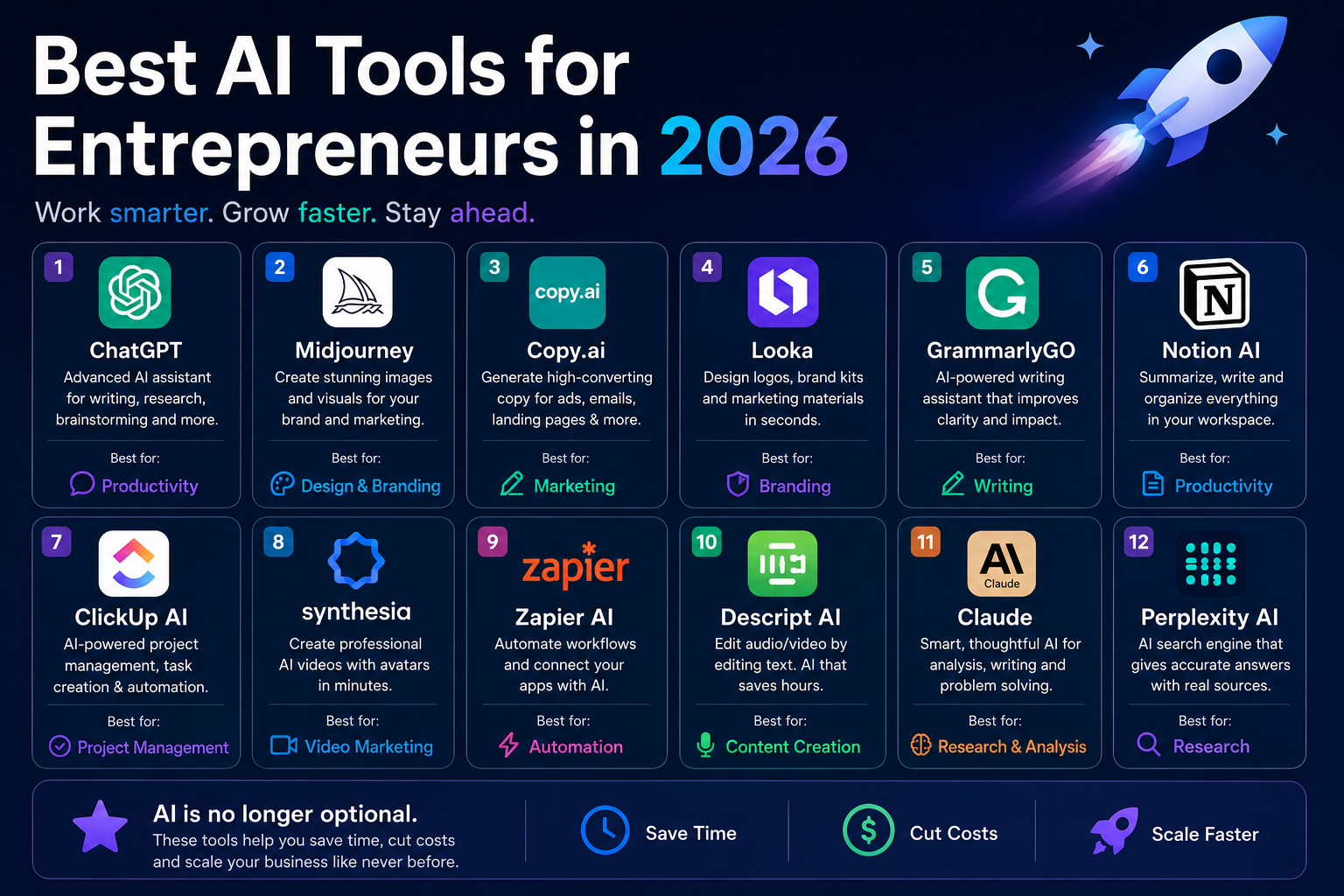
The entrepreneurial landscape has undergone a seismic shift. Just a few years ago, leveraging artificial intelligence in a startup meant using basic chatbots to draft emails or deploying simple software to clean up messy spreadsheets. Today, in 2026, AI is no longer a novelty or a simple productivity add-on. It has matured into the core operating engine of modern business infrastructure.
According to recent business performance benchmarks, 84% of high-growth founders reported that autonomous AI agents are now directly responsible for executing at least one core operational workflow in their company.
For startup founders, freelancers, and agile marketers, this evolution changes everything. The classic constraint of “not enough hours in the day” is dissolving. The competitive edge belongs to those who understand how to orchestrate networks of specialized, autonomous tools that work around the clock. If you are building a business today, you aren’t just competing against other companies; you are competing against the efficiency of their AI-optimized operations.
Whether your goal is to launch a minimum viable product (MVP) in days instead of months, run hyper-personalized cross-channel marketing campaigns without an agency, or forecast cash flow with institutional precision, the modern AI ecosystem has an explicit solution. This guide breaks down the absolute best AI tools for entrepreneurs in 2026, categorized by business function, with practical applications to give your startup an unfair advantage.
1. Strategic Foundations: Core Large Language Ecosystems
Every entrepreneur needs a central “command center” tool. These are the versatile, generalized conversational platforms that act as sounding boards, research assistants, and primary draft engines. In 2026, these tools have moved past simple predictive text; they understand complex business contexts, multi-step constraints, and can process vast quantities of data natively.
OpenAI ChatGPT-5 & Custom GPT Teams
ChatGPT-5 functions as a virtual chief operating officer for solo founders and small teams. Its advanced reasoning engine can ingest entire legal contracts, cross-reference them with regional regulations, and highlight compliance risks in seconds. The true value for business owners lies in its Team environment, where custom-built agents can be trained on internal company wikis, brand guidelines, and historic sales calls to answer internal queries instantly.
- Practical Application: Upload your last four quarters of profit and loss statements and ask the system to perform a holistic variance analysis, identifying exactly where operational overhead is leaking capital.
Google Gemini 2.0 Ultra
Gemini 2.0 Ultra’s primary competitive advantage is its massive, native multimodal context window. It handles deep research tasks effortlessly, allowing users to upload hours of video footage, audio from focus groups, or massive 800-page market research PDFs simultaneously. It processes this multi-format data to find patterns, synthesize trends, and output precise summaries.
- Practical Application: Record a two-hour raw brainstorming session or workshop with your team, upload the raw file directly, and let Gemini extract a structured project roadmap, complete with specific milestone timelines and task delegations.
Anthropic Claude 4.5
Claude 4.5 remains the benchmark for highly nuanced, emotionally intelligent, and brand-aligned writing. When your communication needs to sound deeply authentic, sophisticated, and free from typical robotic clichés, Claude is the industry favorite. It excels at drafting high-stakes investor updates, complex customer service resolutions, and thought-leadership essays.
- Practical Application: Paste a rough outline of your business values along with notes on a recent PR crisis. Claude can craft an elegant, empathetic press release that retains your distinct human voice perfectly.
2. Hyper-Automated Business Operations & Workflow Agents
True leverage does not come from doing work faster; it comes from eliminating the need to do it manually at all. Autonomous agents are the breakout tech category of 2026, executing multi-step workflows across completely different software platforms without requiring human intervention. Early adopters are seeing up to a 65% reduction in administrative overhead by setting up multi-agent autonomous frameworks to handle standard customer onboarding and invoicing pipelines.
CrewAI Enterprise
CrewAI has evolved from a popular developer framework into an accessible, enterprise-grade platform for setting up “crews” of specialized AI agents. Instead of giving one prompt to one AI, you set up an entire virtual department. For example, you can create a “Research Agent” that scrapes market trends, a “Writer Agent” that drafts content based on those trends, and a “Quality Assurance Agent” that refines the text to match your specific brand voice.
- Practical Application: Deploy a customer onboarding crew. When a new client signs a contract, the crew automatically spins up a shared Slack channel, generates a customized kickoff deck, issues their first invoice via Stripe, and schedules the initial alignment call.
Zapier Central
Zapier Central introduces a persistent, cognitive layer to standard API integrations. Instead of configuring rigid “If This, Then That” rules that break whenever data formats change slightly, you program Zapier Central using plain English instructions. It watches your live data feeds, understands the intent behind your business rules, and adjusts its automation behavior dynamically.
- Practical Application: Instruct the system: “Whenever an enterprise-level lead fills out our website form, check their LinkedIn company profile size. If they have over 100 employees, alert the sales team on Slack and draft a personalized email response using our case study data.”
3. Next-Generation Marketing, Branding, and Content Machinery
In 2026, generic content gets completely buried by search engines and ignored by consumers. Modern marketing tools rely on deep hyper-personalization, producing localized, context-aware visual and text collateral at scale.
Jasper Commerce & Brand Voice Hub
Jasper has evolved far beyond a basic copywriting interface. Its platform acts as a unified hub that locks down your exact brand identity, color schemes, product nuances, and audience personas. Once set up, Jasper can generate full, multi-channel launch campaigns—including email flows, social ads, and blog copy—ensuring every single asset sounds identical in tone and style.
- Practical Application: Launching a new product variant? Input the core specifications, and Jasper will simultaneously output optimized Shopify descriptions, targeted Meta ad creatives, and a sequence of five segmented email newsletters.
Midjourney v7 & Runway Gen-4
For visual branding, the combination of Midjourney v7 (for static imagery) and Runway Gen-4 (for high-definition video generation) has effectively democratized high-tier creative production. Small startups can now produce studio-quality visual assets, social media video promotions, and website background graphics for a fraction of the cost of traditional photography or videography.
- Practical Application: Generate ultra-realistic, photorealistic lifestyle images of a physical product prototype in various settings (e.g., a modern apartment, a minimalist office) before investing a single dollar in physical manufacturing or professional photography sessions.
ElevenLabs Studio
Audio marketing has boomed, and ElevenLabs dominates the space with hyper-realistic voice synthesis and cross-language translation tools. It goes far beyond standard text-to-speech, capturing the precise emotional inflections, pauses, and cadence of a human voice.
- Practical Application: Clone your own voice with a brief 30-second sample, and instantly translate your entire library of podcast episodes or video tutorials into Spanish, German, and Japanese, using your exact vocal signature for seamless global reach.
4. Financial Engineering and Predictive Analytics Tools
The number one reason startups fail is running out of money. Financial AI tools in 2026 mitigate this risk by moving past historic reporting and acting as predictive advisory engines that look ahead at market conditions.
| Tool Name | Primary Use Case | Key Benefit for Entrepreneurs |
|---|---|---|
| Runway Financial | Predictive cash flow modeling and automated scenario planning. | Simulates hiring, market drops, and runway impact instantly. |
| Clockwork AI | Real-time accounting synchronization and intelligent forecasting. | Eliminates manual bookkeeping errors and generates dynamic balance sheets. |
| Glean AI | Accounts payable automation and strategic spend visibility. | Uncovers hidden software subscription overlap and negotiates vendor rates. |
Runway Financial
Runway Financial makes complex corporate financial modeling accessible to everyone. By integrating directly with your bank accounts, accounting software, and CRM, Runway builds an incredibly intuitive, visual map of your business operations. It continuously models your cash runway and simulates how major business decisions will impact your finances down the line.
- Practical Application: Create a detailed “What-If” scenario to see the immediate, mid-term, and long-term financial impact of hiring three new engineers and decreasing your product’s retail price by 15% simultaneously.
5. Intelligent Software Engineering and Rapid Prototyping
In 2026, being a non-technical founder is no longer a barrier to building a software company. The emergence of natural-language software creation tools allows anyone to turn a concept into functional code through iterative conversation.
Cursor & Vercel v0
Cursor (an AI-first code editor) combined with Vercel v0 (a generative user interface system) has completely redefined rapid prototyping. A founder can describe a web application interface in natural language, watch v0 generate clean, modern UI code, and then use Cursor to wire up complex backend functionality seamlessly.
- Practical Application: Build a fully operational, custom internal tracking dashboard for your delivery business in a single afternoon by simply describing the required metrics and layout.
6. Key Takeaways for Entrepreneurs in 2026
- Embrace Agentic Orchestration: Stop viewing AI as an isolated chat interface. The real returns come from setting up multi-agent networks that execute workflows end-to-end.
- Build a Moat Around Context: Generalized AI is a commodity. Protect your competitive advantage by feeding your tools unique, proprietary data, clean internal wikis, and specific client feedback loops.
- Prioritize Human-in-the-Loop Oversight: Use AI to handle 90% of the repetitive baseline generation, heavy quantitative modeling, and structural layouts, but preserve human intuition for strategic approval and creative polishing.
7. Frequently Asked Questions (FAQs)
Q1: How do I ensure my AI-generated content still ranks well on modern search engines?
Search engines in 2026 heavily prioritize authentic experiential data and deep human insight (Google’s E-E-A-T framework). To rank well, avoid publishing raw, unedited AI content. Instead, use AI to construct the core outlines, research facts, and clean structures, then weave in your personal case studies, unique business metrics, and definitive points of view.
Q2: Are there major security or data privacy concerns when feeding company data to these tools?
Yes. Always ensure you are utilizing enterprise-grade or team-level tiers of platforms like OpenAI, Anthropic, or Runway Financial. These specific business tiers explicitly guarantee that your uploaded proprietary data, customer documentation, and financial histories are completely excluded from public model retraining cycles.
Q3: Can a completely non-technical founder build a tech startup in 2026?
Absolutely. Tools like Vercel v0, Cursor, and visual backend builders allow founders to generate clean, professional-grade minimum viable products (MVPs) using conversational English. While basic technical conceptual awareness remains helpful, the requirement to write thousands of lines of syntax manually is no longer a barrier.
Q4: What is the most cost-effective way to assemble an AI tech stack?
Avoid signing up for dozens of hyper-specific point solutions that charge high individual monthly fees. Start with one foundational language ecosystem subscription (such as ChatGPT Team or Claude) for general tasks, and pair it with a versatile workflow layer like Zapier Central to orchestrate your existing stack efficiently.
Q5: Will relying heavily on AI hurt my brand’s connection with customers?
Only if you hide behind generic automation. Use AI to optimize your back-office administrative tasks, research pipelines, and data formatting. By offloading this administrative overhead, you actually free up more time to engage directly with your customers, build relationships, and focus on high-touch human communication.
8. Conclusion & Actionable Next Steps
The democratization of artificial intelligence has leveled the playing field for entrepreneurs. In 2026, an individual freelancer or small team can wield the operational capabilities, predictive insights, and creative output that once required a fully staffed corporate department. However, this massive accessibility means that true success is determined by how strategically you construct your stack.
Do not try to overhaul your entire business framework overnight. Pick a single friction point in your current operations—whether that is a slow customer onboarding pipeline, repetitive content formatting, or unpredictable cash flow mapping. Deploy one targeted tool or autonomous agent to optimize that specific bottleneck. Master that integration, measure the operational impact, and then expand your digital ecosystem from there. The future of business isn’t just about working harder; it is about orchestrating smarter.