
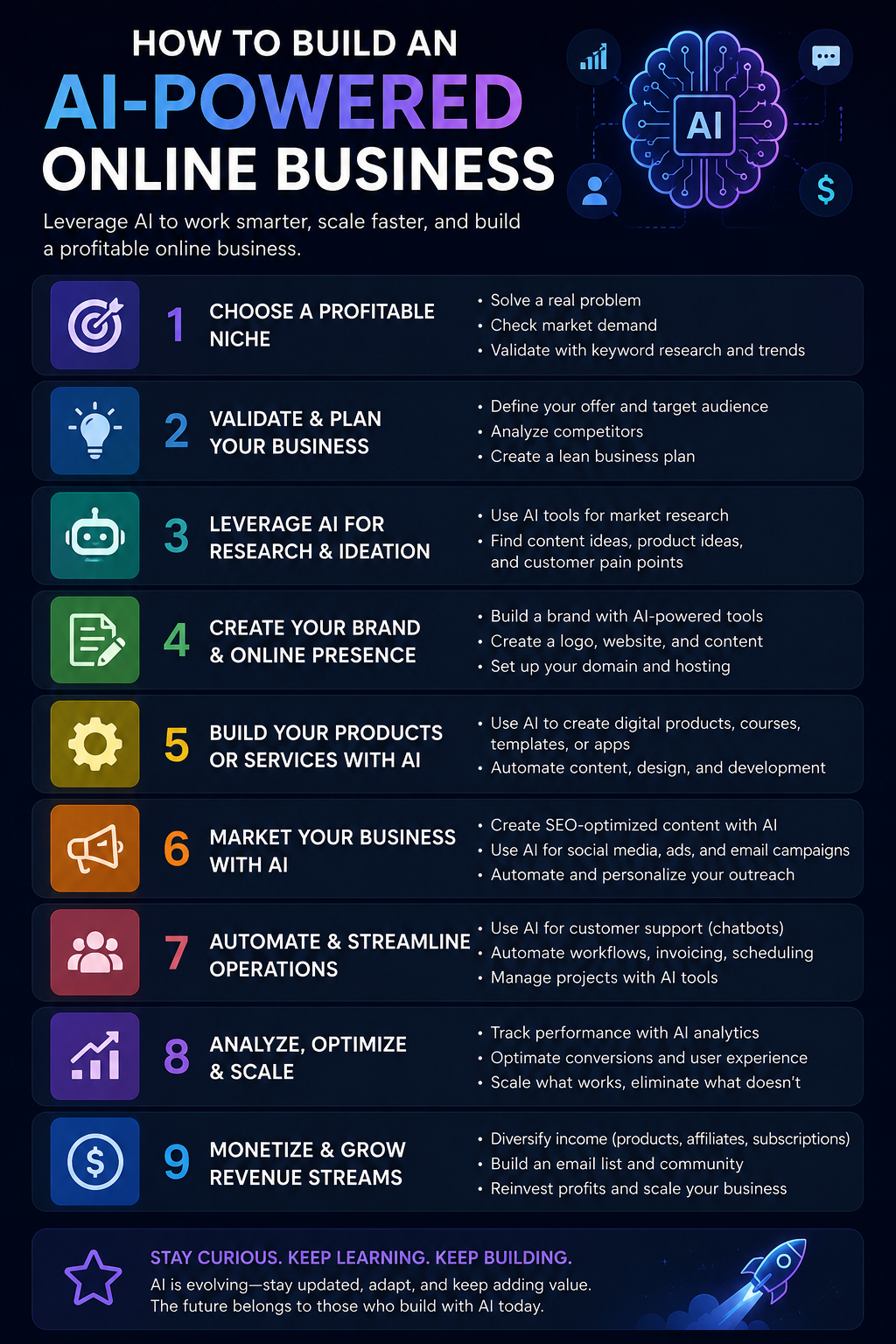
Imagine launching a company that can generate high-quality marketing copy, handle complex customer service inquiries, optimize your inventory, and write custom code—all while you sleep, and all for less than the cost of a utility bill.
This isn’t a futuristic fantasy. It is the current reality of the digital economy.
Artificial Intelligence has democratized entrepreneurship. Historically, launching a highly scalable digital enterprise required a small army of developers, marketers, and operational staff. Today, a solo founder armed with a suite of specialized AI tools can match the output of a traditional ten-person team.
According to global market reports, the corporate AI market is projected to skyrocket past $1.3 trillion by 2032. For forward-thinking entrepreneurs, the window of opportunity is wide open. But success isn’t about slapping an “AI” label on a generic product. It’s about deeply integrating machine learning into your business model to solve real human problems faster, cheaper, and more efficiently.
This comprehensive guide will walk you through the step-by-step process of building an AI-powered online business from the ground up.
Table of Contents
- Understanding the AI Business Landscape
- Step 1: Identifying a Profitable, AI-Viable Niche
- Step 2: Choosing Your AI Business Model
- Step 3: Building the Tech Stack Without a Tech Degree
- Step 4: Automating Operations and Marketing
- Step 5: Managing Risk, Ethics, and the E-E-A-T Framework
- Key Takeaways
- Frequently Asked Questions (FAQs)
- Conclusion: Your Next Actionable Steps
1. Understanding the AI Business Landscape
Before writing code or buying a domain, you must understand what it actually means to run an AI-powered business.
There are two primary ways to leverage AI in entrepreneurship:
- AI as the Product: Your core offering is driven by machine learning (e.g., a software tool that automatically edits podcast audio or an AI tool that writes hyper-personalized sales emails).
- AI as the Engine: You sell a traditional product or service (e.g., an e-commerce brand or a consulting agency), but you use AI to handle marketing, customer support, supply chain logistics, and content creation at a fraction of standard costs.
The most successful modern startups often combine both. They use AI to create a lean organizational structure while delivering a superior, data-driven customer experience.
Step 1: Identifying a Profitable, AI-Viable Niche
The gravest mistake an entrepreneur can make is building a solution in search of a problem. “Let’s build an AI app for lawyers” is a recipe for failure. Instead, you must isolate a specific, painful bottleneck within an industry and use AI to dissolve it.
Look for High-Friction, Repetitive Tasks
AI thrives on pattern recognition and data processing. To find a viable niche, look for industries weighed down by tasks that are:
- Time-consuming
- Highly repetitive
- Prone to human error
- Expensive to outsource
Real-World Application: The Real Estate Copywriter
Consider real estate agents. They spend hours writing property descriptions for online listings. A savvy entrepreneur could build a localized AI writing assistant trained specifically on local real estate zoning laws, architectural trends, and high-converting MLS vocabulary. By solving a narrow, specific pain point, you instantly differentiate your business from generic AI writers like ChatGPT or Claude.
Validating Demand
Before building anything, ensure people will pay for your solution:
- Search Intent: Use tools like Ahrefs, SEMrush, or Google Trends to see if people are searching for solutions to the problem.
- Community Deep-Dives: Browse Reddit, Quora, and specialized Discord servers to read complaints about existing workflows.
- Pre-Sales: Create a simple landing page using a tool like Carrd or Framer explaining your concept. Run $50 of targeted ads to see if users will input their email addresses or place a small deposit to join a waitlist.
Step 2: Choosing Your AI Business Model
Once you have identified a problem, you need to structure how your business will make money. Here are three of the most profitable AI-driven business models today.
| Business Model | How It Works | Low-Code Tools to Use | Risk Level |
| Micro-SaaS (Software-as-a-Service) | A niche software tool that solves a hyper-specific problem for a monthly subscription fee. | Bubble, FlutterFlow, OpenAI API | Medium-High |
| AI-Enhanced Productized Agency | Offering premium services (e.g., video editing, SEO, ad management) delivered rapidly using AI automation behind the scenes. | Make.com, Zapier, Midjourney | Low |
| Data-Driven Content Ecosystem | Building niche informational sites, newsletter networks, or directories curated and updated by automated data pipelines. | WordPress, Webflow, Clay | Low-Medium |
Deep Dive: The Productized Agency Asset
For beginners, an AI-Enhanced Productized Agency is the lowest barrier to entry. Instead of charging by the hour, you charge a flat monthly fee for a specific deliverable.
For instance, you could launch a social media repurposing agency. Your clients send you a 60-minute raw podcast file. Using AI tools, your system automatically isolates the top five viral moments, generates captions, adds dynamic subtitles, and schedules the posts across TikTok, Instagram Reels, and YouTube Shorts.
The client receives immense value, while your actual manual labor per client drops from ten hours to thirty minutes.
Step 3: Building the Tech Stack Without a Tech Degree
You do not need a computer science degree to build an AI business. The modern “no-code” and “low-code” movement allows you to piece together powerful applications using visual interfaces and APIs (Application Programming Interfaces).
[User Interface] ---> [Automation Layer] ---> [AI Brain]
 (Bubble/Webflow)        (Make.com/Zapier)      (OpenAI/Anthropic)
The Three Tiers of Your AI Tech Stack
- The Front End (The Face): This is what your customer sees. Tools like Bubble, Webflow, or Framer allow you to build stunning, responsive user interfaces where clients can log in, view dashboards, and interact with your service.
- The Automation Layer (The Nervous System): Tools like Make.com or Zapier act as the glue connecting your software applications. They pass data from your front end to your AI models seamlessly.
- The AI Brain: This is where the heavy lifting happens. By plugging into APIs from OpenAI (GPT-4), Anthropic (Claude), or open-source models hosted on Hugging Face, you can embed state-of-the-art intelligence directly into your workflow.
The Importance of Custom Data (The “Moat”)
If your business simply passes a prompt to ChatGPT and hands the output back to the user, you have a fragile business. Anyone can replicate that.
To build a defensible business—a structural “moat”—you must combine public AI models with proprietary data. This can be achieved through Retrieval-Augmented Generation (RAG) or fine-tuning, where you connect the AI model to a private database of industry-specific insights, case studies, or user behaviors that your competitors cannot access.
Step 4: Automating Operations and Marketing
Building the business is only half the battle; you also have to market it. Fortunately, AI can handle the bulk of your operational and marketing workflows.
Hyper-Personalized Cold Outreach
Instead of blasting generic emails to thousands of prospects, use tools like Clay or Phantombuster. These platforms scrape data from a prospect’s LinkedIn profile, company website, and recent news articles. They then feed that data into an AI model to draft an introductory email so personalized it reads as though you spent hours researching them.
Predictive Lead Scoring
AI can analyze your existing customer base to identify common traits among your highest-value users. By deploying machine learning algorithms across your inbound leads, your sales team can ignore dead ends and focus 100% of their energy on prospects with the highest probability of converting.
Contextual Customer Support
Customer support shouldn’t rely on rigid, frustrating chatbots that only understand pre-programmed commands. By utilizing modern customer service platforms like Intercom or ManyChat powered by advanced LLMs (Large Language Models), your business can resolve up to 70% of customer inquiries instantly, accurately, and with a surprisingly empathetic tone.
Step 5: Managing Risk, Ethics, and the E-E-A-T Framework
As an AI-driven business, navigating Google’s search algorithms and user trust requires intentionality. Google’s core search updates place heavy emphasis on E-E-A-T: Experience, Expertise, Authoritativeness, and Trustworthiness.
The Pitfalls of Pure AI Content
If you plan to use AI to generate blog posts or marketing materials to rank on search engines, proceed with caution. Google does not penalize AI content inherently, but it aggressively penalizes low-value, unoriginal content designed solely to manipulate search rankings.
Crucial Rule: AI should be used for research, outlining, and structural drafting, but it must be heavily reviewed, polished, and augmented by human experts.
How to Maintain High E-E-A-T:
- Add Proprietary Insights: Embed unique data, personal anecdotes, quotes from industry experts, or custom screenshots into every piece of content you produce.
- Establish Clear Authorship: Ensure your articles are signed by real people with demonstrable experience in the field, complete with links to their professional social media profiles.
- Prioritize Accuracy: AI is prone to “hallucinations” (confident fabrications of facts or data). Implement a strict human-in-the-loop verification process for every fact, statistic, and code snippet your business publishes or utilizes.
Key Takeaways
- Focus on the Pain Point: AI is merely a tool; a successful business requires a concrete, validated market problem to solve.
- Build a Defensible Moat: Don’t rely solely on basic wrapper APIs. Integrate proprietary data, unique workflows, or exceptional user experiences to keep competitors at bay.
- Embrace No-Code Solutions: Use visual builders and automation connectors like Make.com and Bubble to test ideas quickly without high development overhead.
- Maintain the Human Touch: Blend automated efficiency with human oversight to preserve trust, protect brand identity, and secure high E-E-A-T scores across search engines.
Frequently Asked Questions (FAQs)
1. Do I need to know how to code to start an AI business?
No. Thanks to the rise of robust visual software platforms and intuitive APIs, you can build fully functioning AI applications, automated agencies, and content networks using low-code or no-code development stacks.
2. How do I protect my AI startup from being copied by tech giants?
Focus on highly specific, hyper-local, or deeply niched problems. Tech giants build broad, horizontal solutions designed for mass markets. They will rarely build a tool tailored specifically to the workflow of a regional agricultural supplier or a specialized medical billing office. Your deep vertical focus is your competitive advantage.
3. Does Google penalize websites that use AI-generated content?
No, Google’s official guidelines state that use of AI is not penalized as long as the content is high-quality, highly helpful, and created primarily for users rather than search engine rankings. However, lazy, unedited AI content will struggle to rank.
4. What are the highest-margin AI business models for beginners?
An AI-Enhanced Productized Service or Agency typically offers the highest profit margins for beginners. It requires almost zero upfront capital, builds immediate cash flow, and leverages AI to slash fulfillment times dramatically.
5. How much capital do I need to launch an AI-powered business?
You can launch an AI-powered business for under $100. Your primary upfront investments will be domain registration, basic hosting, and subscriptions to foundational tools like Make.com, Webflow, and OpenAI API access.
Conclusion: Your Next Actionable Steps
Building an AI-powered business isn’t about chasing hyper-complex tech trends; it is about leveraging modern automation tools to build an agile, efficient, and deeply helpful organization.
To kickstart your entrepreneurial journey today, follow this simple framework:
- Choose an industry you understand well or have worked in previously.
- Interview three professionals in that industry and isolate their single most frustrating daily task.
- Map out a simple automation workflow using a visual canvas that could theoretically cut that task’s completion time in half.
- Build a simple landing page highlighting this solution, and open up five spots for a beta test.
The tools are ready, accessible, and more affordable than ever before. The only remaining ingredient is your execution.