
The business landscape is moving at a breakneck pace. If you are running a business using strategies that worked just a couple of years ago, you are already falling behind. The tools of innovation have been democratized, market dynamics have shifted, and customer expectations have undergone a massive transformation.
For entrepreneurs, startup founders, freelancers, and small business owners, staying ahead isn’t just about survival anymore—it’s about positioning yourself to capture massive market share before the competition even realizes the game has changed.
As we position our strategies to align with upcoming shifts, we look toward the immediate horizon. What will separate the hyper-profitable startups from the struggling businesses in the near future?
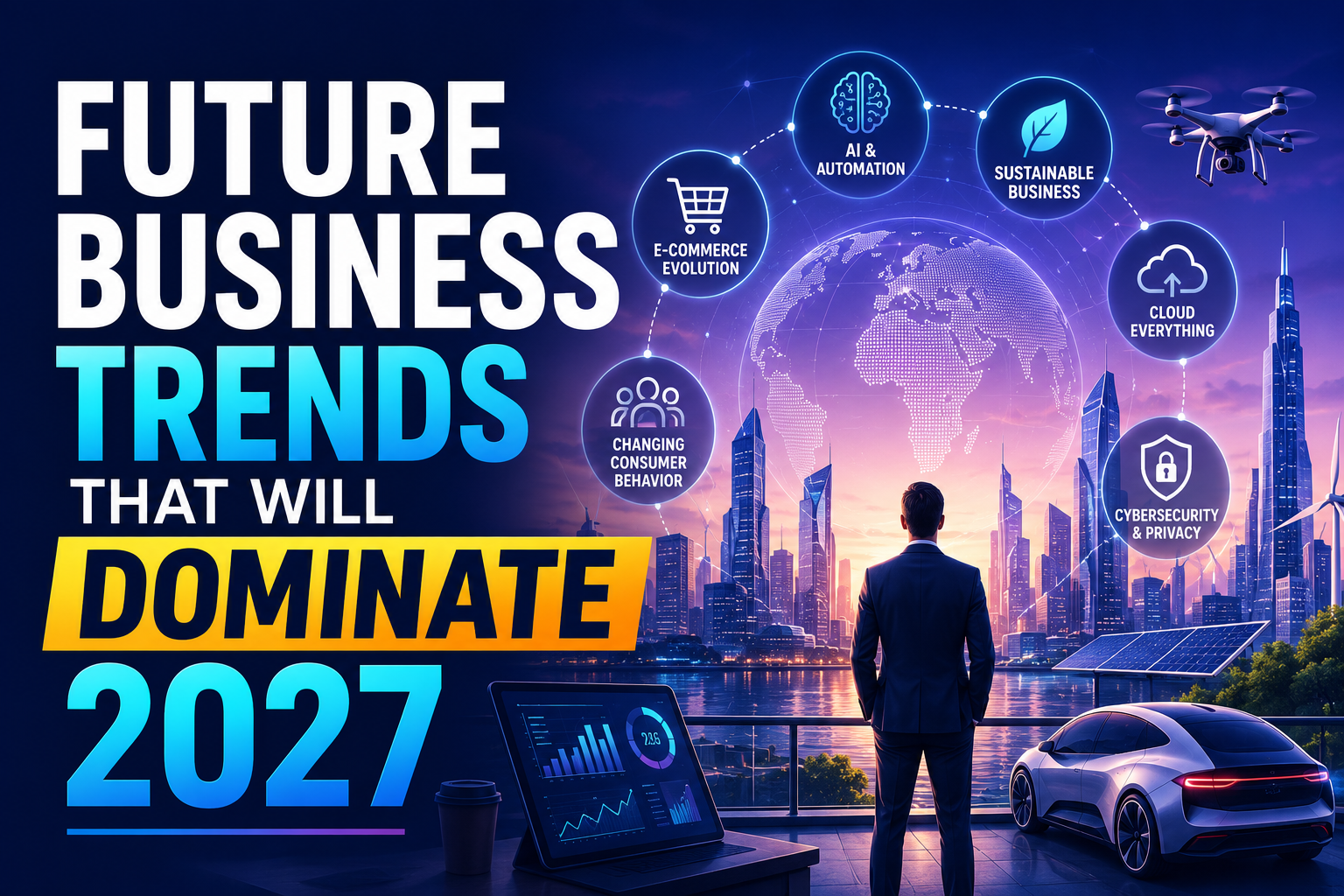
This comprehensive guide breaks down the defining future business trends that will dominate 2027, offering actionable insights to future-proof your venture today.
Table of Contents
- The Macro Shift: Moving Beyond Basic Automation
- Trend 1: The Rise of Agentic AI and Multi-Agent Workforces
- Trend 2: The Premium on Human Interaction (H.I.)
- Trend 3: Hyper-Personalization and Predictive Commerce
- Trend 4: Decentralized Operations and Localized Data Sovereignty
- Trend 5: GreenOps and Ethical Transparency
- Common Mistakes to Avoid When Adapting to Future Trends
- Key Takeaways
- Frequently Asked Questions (FAQs)
The Macro Shift: Moving Beyond Basic Automation
We have officially moved past the initial hype phase of artificial intelligence. In the early days, businesses achieved quick wins simply by using AI to draft simple emails or generate generic images. Today, those foundational capabilities are baseline commodities.
According to recent data from global research firms like Gartner, the intersection of advanced software development, shifted consumer psychology, and intelligent automation is driving a massive operational overhaul. Businesses are no longer just asking, “How can AI write this faster?” Instead, they are asking, “How can an autonomous digital ecosystem manage this entire department?”
The organizations that scale rapidly are those transitioning from task-based automation to complete workflow autonomy, balanced by an intentional, highly strategic return to human-centric value.
Trend 1: The Rise of Agentic AI and Multi-Agent Workforces
The single biggest technological trend impacting business operations is the evolution from single-purpose generative chatbots to Agentic AI and Multi-Agent Systems (MAS).
From “Doers” to “Orchestrators”
Instead of a human sitting at a computer giving prompt after prompt to an AI to complete a single task, Agentic AI uses interconnected networks of specialized AI agents to achieve complex, multi-step business goals entirely on their own.
Imagine a standard customer onboarding or supply chain operation. In a multi-agent system:
- Agent A monitors incoming client data and extracts key variables.
- Agent B runs a background compliance check and flags anomalies.
- Agent C drafts custom onboarding materials tailored to that client’s historical data.
- Agent D audits the entire output for security risks before presenting it to a human manager.
Statistics show that enterprises implementing multi-agent workflows are realizing up to a 40% reduction in manual operational tasks, allowing smaller teams to accomplish massive corporate outputs without scaling their headcount costs proportionally.
[Incoming Data] ➔ [Agent A: Extraction] ➔ [Agent B: Compliance Check] ➔ [Agent C: Custom Draft] ➔ [Human Review]
Actionable Tip for Founders
Don’t look for standalone AI widgets. Audit your business for “high-friction, repeatable workflows”—such as invoice processing, customer support tier-2 routing, or complex content distribution pipelines. Design an internal roadmap where your human team steps away from repetitive execution and steps into the role of strategic orchestrators.
Trend 2: The Premium on Human Interaction (H.I.)
As digital automation becomes completely invisible and universally accessible, an interesting counter-trend is emerging: The extraordinary economic premium on raw Human Interaction (H.I.).
When every company has access to lightning-fast AI copywriters and automatic video generation tools, generic digital content loses its competitive edge. If it takes zero effort to generate a piece of content, it holds zero inherent value to a consumer.
Trust as a Luxury Commodity
The advantage is shifting heavily toward authenticity, community-building, and high emotional intelligence. Consumers are experiencing digital fatigue. They are increasingly craving verified human connections, raw behind-the-scenes transparency, and community-led commerce models.
- Real-World Example: E-commerce brands are finding that highly produced, AI-generated product advertisements are being outperformed by raw, unedited livestream commerce events and creator-led community interactions where buyers can interact with a real person in real time.
Trend 3: Hyper-Personalization and Predictive Commerce
Generic marketing funnels are dead. Modern consumer trends reveal that 86% of consumers expect personalized interactions, and businesses that rely on static, one-size-fits-all email blasts or web pages face immediate competitive disadvantages.
Anticipating Needs Before the Click
By utilizing domain-specific language models and real-time sensory data, businesses are shifting from reactive personalization to predictive commerce. This involves analyzing subtle user behaviors, micro-interactions, and localized trends to deliver bespoke experiences, custom pricing tiers, and product recommendations tailored down to an individual consumer level.
- The Retail & CPG Shift: In fashion and retail, technologies like Augmented Reality (AR) virtual try-ons and visual search optimization are integrating invisibly into everyday checkout structures. It is no longer about showing off the technology; it’s about making the buying journey completely frictionless.
💡 Pro Tips for Future-Proofing Your Business
- Build Proprietary Data Moats: Because general AI models are accessible to everyone, your unique competitive advantage lies in your proprietary data. Ensure you are capturing clean, structured, and compliant first-party data from your customer interactions. A micro-model fine-tuned on your specific business history is worth more than a generic global framework.
- Optimize for Non-Traditional Search: Consumers are moving away from standard text-based search engines. Optimize your digital presence for Voice Search and Visual Search Optimization. Ensure your products can be discovered when users take a photo or ask an AI assistant a direct verbal question.
- Implement FinOps Early: As your operations scale up their use of real-time software integrations and cloud computing resources, cloud costs can quickly spiral out of control. Implement a basic Financial Operations (FinOps) structure to track your software cost-per-user margins tightly.
Trend 4: Decentralized Operations and Localized Data Sovereignty
As global privacy regulations tighten, the era of unmonitored global cloud tracking is closing. Businesses face stricter regional data compliance requirements (building on frameworks like GDPR and CCPA).
The Rise of Geopatriation
A major trend impacting tech infrastructure is Geopatriation—the strategic relocation of data workloads from centralized global servers to localized, sovereign regions. Small businesses and startups must ensure that their software architecture respects the geographic boundaries of their user base.
Furthermore, blockchain technology is maturing beyond speculation into a pragmatic tool for transparent asset management. Startups are increasingly utilizing decentralized ledger platforms to authenticate digital products, track physical supply chains transparently, and automate fraud-proof return management systems.
Trend 5: GreenOps and Environmental Accountability
Sustainability is no longer a corporate public relations buzzword; it is a core metric of operational efficiency and consumer brand loyalty. Data insights indicate that over 81% of global consumers feel strongly that companies must actively help protect the environment.
Enter GreenOps
With the massive computational power required to run modern AI workflows, cloud computing centers consume enormous amounts of energy. Forward-thinking startups are embracing GreenOps (Green Operations)—a strategy aimed at optimizing the energy efficiency of digital ecosystems.
| Trend Category | Core Driving Technology | Strategic Business Value |
| Autonomous Work | Agentic AI / Multi-Agent Systems | 40% reduction in manual tasks; extreme operational efficiency. |
| Trust Economy | Livestream Commerce / Creator Channels | High customer loyalty; distinct differentiation from generic AI noise. |
| Predictive Sales | Hyper-Personalization / Spatial AR | Accelerated conversion rates; reduced product return volumes. |
| Infrastructure | Geopatriation / Local Clouds | Bulletproof data compliance; lower localized system latency. |
| Sustainability | GreenOps Practices | Enhanced brand value; lower computing overhead costs. |
Common Mistakes to Avoid When Adapting to Future Trends
- Chasing Every Shiny Object: Do not adopt a technology simply because it is trending in tech headlines. If a tool doesn’t directly solve a verified customer pain point or lower your internal operational costs, ignore it.
- Ignoring Data Privacy Compliance: Implementing advanced AI tracking systems without robust, transparent data governance structures is a recipe for catastrophic legal penalties. Always prioritize user consent and data encryption.
- Losing the Human Touch: Over-automating your customer service or content creation pipelines will alienate your core audience. Use automation to handle back-end friction so your human team has more time to deliver meaningful front-end experiences.
- Failing to Upskill Internal Talent: Buying sophisticated software tools is useless if your managers and team members do not know how to leverage them strategically. Shift your corporate training budgets toward prompt optimization, digital security awareness, and human-agent workflow management.
Key Takeaways
- Autonomy is the standard. The future belongs to businesses that leverage Multi-Agent AI systems to automate complex, multi-layered workflows.
- Authenticity scales. As automated content floods the digital marketplace, genuine human interaction, community building, and ethical clarity become premium competitive advantages.
- Personalization must be predictive. Use data analytics, visual search integration, and tailored UI experiences to anticipate consumer needs before they even click.
- Build clean infrastructure. Protect your operational margins by focusing on data sovereignty, FinOps tracking, and eco-efficient GreenOps strategies.
- Stay agile. The velocity of change means that flexibility, rapid market testing, and continuous learning are your ultimate entrepreneurial assets.
Frequently Asked Questions (FAQs)
1. How can a small business afford to implement Agentic AI systems?
You don’t need a massive enterprise IT budget to leverage Agentic AI. The rapid evolution of no-code integration software (such as Make.com, Flowise, and Langflow) allows non-technical founders to easily connect different specialized AI models into a unified workflow for the cost of a few standard software subscriptions.
2. What is the difference between standard automation and Agentic AI?
Standard automation follows rigid, linear paths (e.g., “If a user fills out this form, send them this specific template email”). Agentic AI possesses contextual reasoning capabilities. It can evaluate an unexpected situation, determine the optimal sequence of actions, use tools to find missing data, and make independent adjustments to achieve a high-level business goal.
3. Will AI completely eliminate the need for digital marketers or copywriters?
No. Instead, it transforms their core responsibilities. AI eliminates the time-consuming grunt work of formatting, basic data analysis, and variation drafting. Successful marketers are evolving into strategic directors, creative storytellers, and brand guardians who ensure the AI systems perfectly match the company’s voice and consumer trust framework.
4. How does data privacy legislation impact small businesses using cloud tools?
Stricter localized compliance laws mean that small businesses cannot blindly harvest or store user data across global networks. You must use software vendors that offer clear regional data hosting options, maintain transparent data handling disclosures, and provide automated ways for users to request the total deletion of their records.
5. Why are visual search and voice search becoming so important?
The way people interact with devices has shifted away from traditional desktop keyboards. With the proliferation of smart glasses, voice-activated assistants, and mobile-first visual shopping apps, consumers expect to find products simply by speaking or taking a quick picture of an item they see in the physical world.
Ready to Dominate the Future of Business?
The future isn’t a distant point on a timeline—it is being engineered right now by the founders who refuse to rely on yesterday’s blueprints. The technological advances and cultural shifts on the horizon present an unprecedented window of opportunity for agile entrepreneurs.
At IdeasPros, we specialize in turning visionary concepts into high-growth, future-proof realities. Whether you are aiming to build a disruptive startup from scratch, deploy next-generation AI integrations, or scale your existing business model to align with the demands of the modern consumer market, our elite strategic guidance can help you get there faster.
The future belongs to those who prepare for it today. Partner with IdeasPros to design, validate, and launch your next breakthrough venture!