
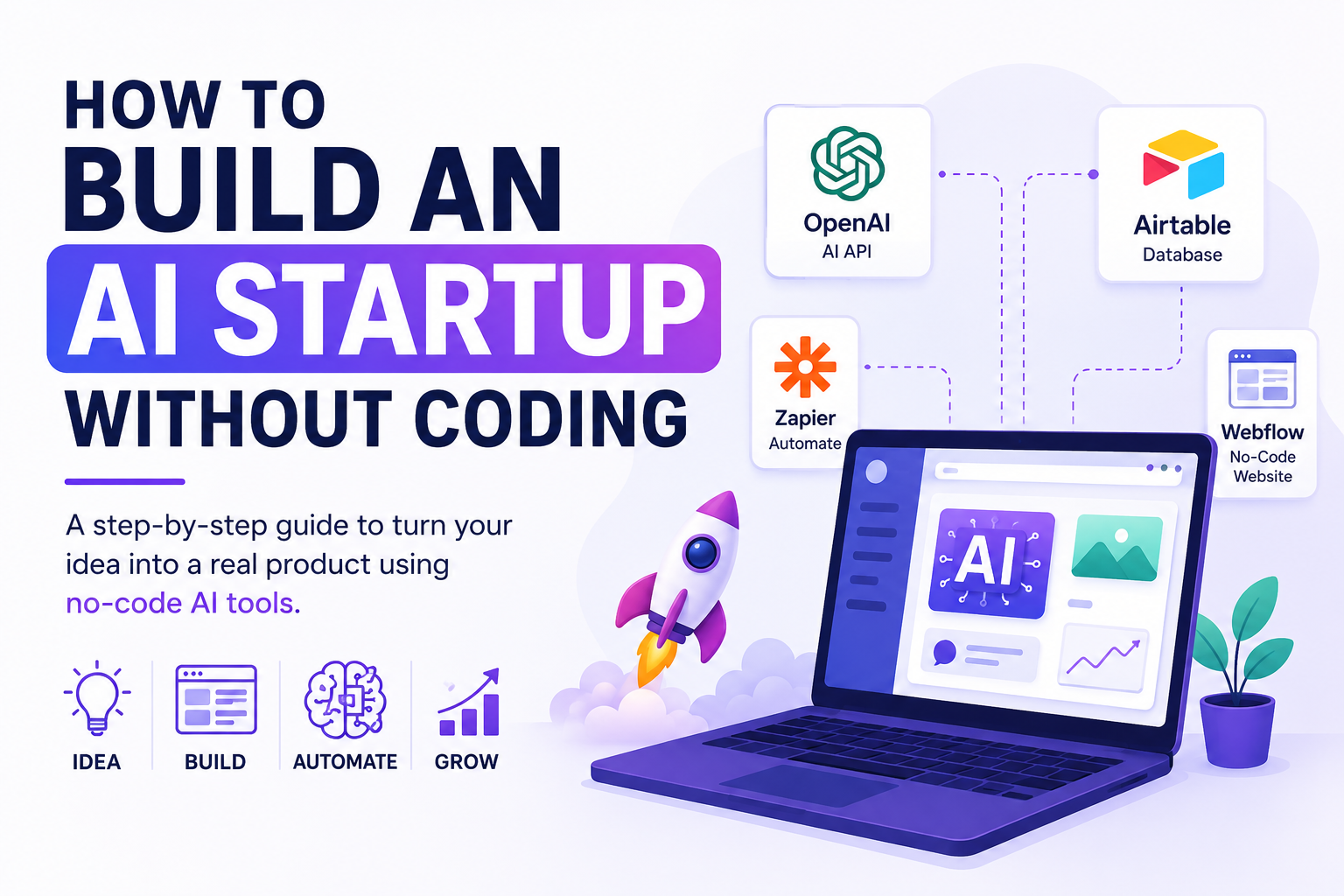
Imagine having a groundbreaking idea for an artificial intelligence platform, but your programming knowledge starts and ends with basic spreadsheet formulas. A few years ago, that would have been the end of the road. You would have needed to raise hundreds of thousands of dollars just to hire a software engineer to build a basic prototype.
Not anymore.
The tech landscape has shifted dramatically. We are living in the golden age of democratic technology. Thanks to the massive evolution of no-code platforms, visual development environments, and modular AI integrations, building a tech company is no longer exclusive to software engineers.
If you are an entrepreneur, freelancer, or small business owner with a brilliant idea, this guide is for you. Here is exactly how to build an AI startup from scratch without writing a single line of code.
Table of Contents
- The State of No-Code AI in 2026
- Why Build an AI Startup Without Coding? (The Benefits)
- The Core Challenges (and How to Overcome Them)
- Step-by-Step Blueprint to Launch Your No-Code AI Startup
- The No-Code AI Tech Stack
- Real-World Success Stories
- Common Mistakes to Avoid
- Future Trends in No-Code AI
- Key Takeaways
- Frequently Asked Questions (FAQs)
The State of No-Code AI
The global no-code development platform market is skyrocketing. Recent industry data shows that the market is projected to surpass $65 billion globally, driven largely by the integration of generative AI into visual development tools. Furthermore, Gartner estimates that by 2026, nearly 80% of digital products and services will be built by people who do not know how to code traditionally.
What does this mean for you? It means the technical barrier to entry has completely collapsed.
Today’s artificial intelligence tools aren’t just for building chatbots anymore. They allow non-technical founders to connect large language models (LLMs), computer vision, predictive analytics, and automated workflows into sophisticated, market-ready software applications.
Why Build an AI Startup Without Coding? (The Benefits)
Before diving into the “how,” let’s look at the competitive advantages of choosing the no-code route.
- Lightning-Fast Speed to Market: Traditional software development takes months, sometimes years. With no-code tools, you can build a fully functional Minimum Viable Product (MVP) in days or weeks. This allows you to launch quickly and test your business idea against real market demand.
- Incredibly Low Startup Costs: Hiring a full-stack developer or an agency to build a custom AI application can easily cost $50,000 to $150,000. No-code platforms operate on affordable monthly subscription models, dropping your initial development costs by up to 90%.
- Agility and Extreme Pivotability: When you write code, making a major shift in your business model means rewriting thousands of lines of programming. With no-code, changing your application’s workflow or switching to a different AI model can be done visually in an afternoon.
- Focus on Business Growth: As a founder, your primary job is not writing syntax; it is finding customers, marketing your product, and refining the user experience. No-code frees up your time to focus on what actually generates revenue.
The Core Challenges (and How to Overcome Them)
While building an AI startup without coding offers massive advantages, it is not without its hurdles. Being aware of these limitations early on will save you massive headaches later.
1. Platform Dependency (Vendor Lock-in)
When you build your entire business on top of a third-party no-code platform, you are subject to their pricing changes, server downtimes, and feature updates.
- The Fix: Choose reputable, established platforms (like Bubble, FlutterFlow, or Make) that allow you to export your data easily, or look for platforms that allow you to export clean code if you choose to transition to a traditional setup later.
2. Scalability Bottlenecks
No-code tools are fantastic for handling thousands of users, but if your AI startup explodes to millions of concurrent users, you might face performance lags or high operational costs.
- The Fix: Use your no-code MVP to reach profitability and validate market fit. Once you have consistent cash flow or investor backing, you can strategically hire developers to rebuild resource-intensive parts of your system.
3. Data Privacy and AI API Costs
AI startups rely heavily on calling external APIs (like OpenAI, Anthropic, or Google Gemini). These API costs can add up quickly if your users run intensive queries.
- The Fix: Set strict usage limits for free tiers and implement efficient prompt caching. Ensure your privacy policy aligns with data protection laws (like GDPR or CCPA), explicitly stating how user data interacts with external AI models.
Step-by-Step Blueprint to Launch Your No-Code AI Startup
[Find the Problem] ➔ [Validate the Market] ➔ [Select Your No-Code Stack] ➔ [Build the MVP] ➔ [Launch & Iterate]
Step 1: Identify a Specific, Niche Problem
The biggest mistake new founders make is trying to build “another ChatGPT.” The broad AI market is dominated by tech giants. Your power lies in hyper-specialization.
Find a specific problem in a niche industry. For example:
- An AI tool that writes compliant real estate listings for agents in a specific state.
- An AI assistant that analyzes legal contracts specifically for freelance graphic designers.
- A predictive maintenance scheduler for independent trucking fleets.
Step 2: Validate the Market Demand
Before building anything, ensure people will actually pay for your solution.
- Create a simple landing page using tools like Carrd or Framer detailing what your product will do.
- Set up a waitlist or a “Pre-order” button.
- Run small budget ads on LinkedIn or Meta, or post in specialized Reddit and Skool communities to see if your target audience registers.
Step 3: Map Out Your AI Logic and Workflow
Grab a digital whiteboard tool like Miro or Figma and map out your user journey.
- What does the user input? (e.g., A PDF contract).
- What happens to that input? (e.g., It gets stripped of text, sent to Anthropic’s Claude API with a specific prompt, and analyzed for risk factors).
- What does the user see as an output? (e.g., A clean PDF report highlighting red-flag clauses).
Step 4: Choose Your No-Code Tech Stack
Select the visual builder that matches your layout requirements. Connect your front-end user interface to an automation engine, which handles sending information back and forth to your AI brain. (See our detailed stack breakdown below).
Step 5: Build and Test Your MVP
Keep your first version as simple as possible. Focus on solving the one core problem perfectly. Run beta tests with 10 to 20 users from your target audience, collect feedback relentlessly, fix the bugs, and get ready to launch.
💡 Pro Tips for Aspiring Non-Technical Founders
- Master Prompt Engineering First: Your product’s value relies entirely on how well it instructs the underlying AI. Spend time mastering system prompts, few-shot prompting, and context setting before building your UI.
- Focus on the “Wrapper” Value: Critics often dismiss no-code AI startups as “just an API wrapper.” Your job is to build a user interface, a workflow integration, and a data-saving mechanism that is so valuable, intuitive, and native to your customer’s daily routine that they wouldn’t dream of trying to replicate it using a raw AI prompt.
- Utilize AI to Build AI: Use tools like ChatGPT or Claude to explain how to structure your databases, write short snippets of custom JavaScript for your no-code tools, or troubleshoot API connection errors.
The No-Code AI Tech Stack
To build a fully operational AI business, you need three core pillars: the User Interface (Front-End), the Logic/Automation Engine (Back-End), and the AI Brain.
| Component | Top Tool Choices | Best Used For |
| Front-End / App Builder | Bubble FlutterFlow Softr | Bubble: High customization web apps. FlutterFlow: Sleek iOS/Android mobile apps. Softr: Turning Airtable/Google Sheets into user portals quickly. |
| Automation / Back-End | Make.com Zapier | Connecting your front-end application to your AI models and databases without writing Webhooks. |
| Database | Xano Airtable | Xano: Scalable, secure backend data storage. Airtable: Visual, easy-to-manage relational database for beginners. |
| AI Brain (LLMs & APIs) | OpenAI API Anthropic Claude Replicate | Generating text, analyzing documents, processing logic, or running open-source AI image/video models. |
Real-World Success Stories
Case Study 1: InteriorAI
Founded by independent developer Pieter Levels, InteriorAI started as a simple concept: users upload a photo of their room, and AI redesigns it in different styles. By combining basic web hosting with stable diffusion image generation APIs, the platform quickly scaled to thousands of dollars in monthly recurring revenue (MRR) within weeks of launch, proving that user experience and a clear hook trump complex infrastructure.
Case Study 2: PDF.ai
This platform allows users to chat with any PDF document (contracts, financial reports, textbooks). Built quickly by leveraging existing AI models and clear, accessible web structures, it solved a universal pain point. It quickly scaled into a highly profitable SaaS platform and was later acquired, showcasing that simple, highly functional utility tools can achieve massive financial exits.
Common Mistakes to Avoid
- Scaling Too Quickly on Expensive APIs: If you don’t limit how many queries a user can make, a handful of power users can run up an OpenAI bill that destroys your profit margins. Always set hard caps on API requests.
- Neglecting the User Experience (UX): Non-technical founders sometimes spend all their energy making the AI connection work while leaving the website looking unpolished. If your app is confusing or ugly, users will leave—no matter how smart your AI is.
- Building in a Vacuum: Do not spend three months building features you think people want. Launch a rough, usable version in two weeks, and let actual customer feedback dictate your roadmap.
- Ignoring Niche Security Requirements: If you are building an AI app for healthcare, finance, or legal sectors, standard data handling won’t cut it. Ensure you understand compliance rules (like HIPAA) before targeting sensitive industries.
Future Trends in No-Code AI
Looking ahead, the line between “coder” and “non-coder” will blur completely. Here are the shifts driving the landscape:
- Natural Language Coding: We are moving toward a future where you don’t even need to drag and drop visual blocks. You will build entire software applications simply by describing how they work to an AI agent.
- Multi-Agent AI Systems: Future no-code startups will utilize networks of specialized AI agents that talk to one another—one handles sales data, another creates graphics, and a third writes copy—all working seamlessly behind your app’s user interface.
- Hyper-Localized AI Models: Small, specialized AI models are becoming cheaper and faster. No-code founders will be able to plug into custom-trained micro-models tailored precisely to narrow industries, drastically reducing API costs and increasing response speeds.
Key Takeaways
- No coding skills? No problem. Visual builders and API integrations make it entirely possible to launch a highly profitable tech startup.
- The money is in the niche. Avoid generic solutions; solve highly specific workflow problems for defined professional audiences.
- Speed is your unfair advantage. Use no-code tools to launch an MVP in a fraction of the time it takes traditional tech startups.
- Protect your margins. Be mindful of API costs and set proper limits within your application infrastructure.
- Focus on the user. Your user experience, branding, and customer service are what truly separate your product from a generic prompt interface.
Frequently Asked Questions (FAQs)
1. Is it legal to build a business that relies on OpenAI or Anthropic APIs?
Yes, it is entirely legal. These companies intentionally provide APIs so that developers and businesses can build software on top of their infrastructure. However, you must comply with their terms of service, which include rules regarding data safety, restricted content, and clear usage transparency.
2. Can I actually protect my intellectual property (IP) if I don’t write the code?
Your intellectual property doesn’t just reside in lines of code. It lives in your unique dataset, your proprietary prompt engineering, your custom workflows, your brand reputation, and your user experience. If your startup grows to a point where custom code becomes a competitive moat, you can easily use your profits to hire developers and build a proprietary framework.
3. How much money does it take to start a no-code AI startup?
You can get started for less than $100 to $200 a month. Your initial expenses will typically include a no-code builder subscription (like Bubble or Softr), an automation tool subscription (like Make), domain hosting, and pay-as-you-go AI API tokens.
4. Can no-code applications handle secure user data?
Yes. Top-tier no-code platforms and backend databases (such as Xano or Bubble) offer robust security protocols, data encryption, and compliance features. If you are handling sensitive information, ensure you utilize secure API authentication keys and strictly configure your user privacy rules within your chosen platform.
5. What happens if my startup outgrows its no-code tools?
This is a high-quality problem to have! If your user base scales beyond your platform’s capacity, it means you have a highly validated, revenue-generating business. At this stage, you can seamlessly raise venture capital or use your existing profits to hire software engineers to rewrite your platform in a traditional coding language like Python, React, or Node.js.
Ready to Launch Your AI Venture?
The tools are ready, the market demand is surging, and the technical barriers are completely gone. The only thing missing is your execution.
Don’t let a lack of programming experience hold you back from building the next great software solution. At IdeasPros, we specialize in transforming brilliant concepts into market-dominant products. Whether you are searching for your next big business idea or trying to figure out how to streamline your existing workflow using the latest technological innovations, we are here to help you guide your entrepreneurial journey.