
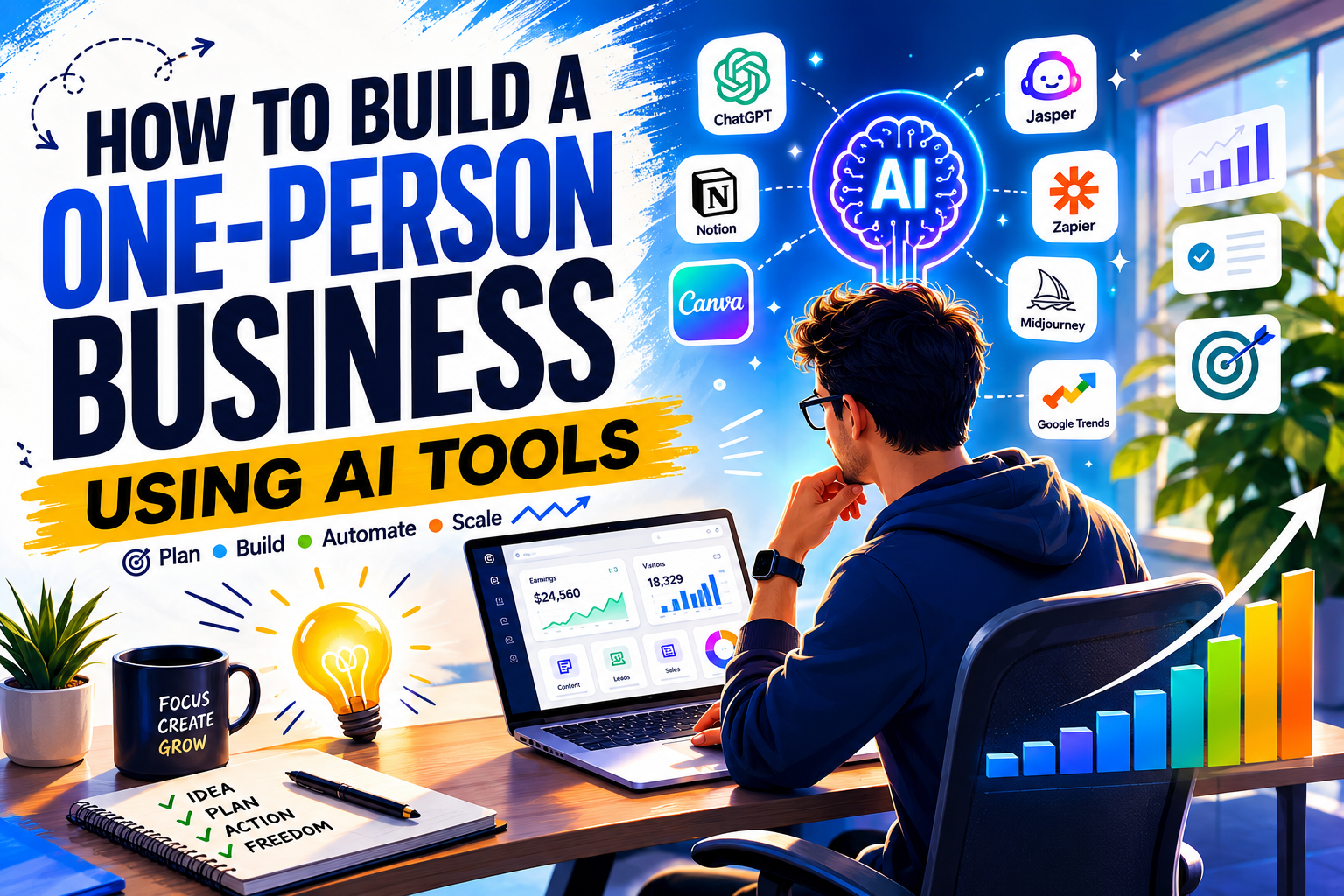
Introduction: The Rise of the AI-Powered Solopreneur
There has never been a better time to build a one-person business. Historically, starting a company required capital, a team of specialized employees, and substantial overhead costs. A solo entrepreneur—or solopreneur—faced a natural growth ceiling determined by the number of hours in a day. You had to act as the CEO, marketer, salesperson, customer support agent, and accountant simultaneously. Inevitably, execution suffered, or burnout took over.
Today, that bottleneck has completely vanished. The emergence of advanced artificial intelligence tools has fundamentally altered the economics of small businesses. AI functions as an infinite force multiplier, enabling a single individual to handle tasks that previously required entire departments.
The solopreneur economy has grown exponentially, with tens of millions of non-employer businesses operating globally. With generative AI, predictive modeling, and intelligent automation systems integrated into modern workflows, a lone founder can achieve operational efficiency and output levels that match traditional mid-sized teams.
This comprehensive guide breaks down exactly how to build a one-person business using AI tools from the ground up. Whether you are a freelancer looking to scale, a side hustler wanting to go full-time, or a digital marketer seeking to automate client delivery, this blueprint provides actionable steps to launch, manage, and scale your AI-driven solo enterprise.
1. Validating and Designing Your Business Model
Before writing code or launching marketing campaigns, you must establish a clear business model. AI can assist significantly in this exploratory phase by processing massive amounts of market data, evaluating competitors, and refining your unique value proposition.
Identifying Highly Scalable Solopreneur Niches
Not all businesses are equally suited for solo operations. The ideal solopreneur business models rely heavily on digital leverage, low marginal costs of replication, and high profit margins. Top niches include:
- Digital Product Creation: E-books, online courses, templates (Notion, Figma), and software components.
- Micro-SaaS (Software as a Service): Niche software solutions addressing specific pain points for targeted user bases.
- Content Commerce & Newsletters: Paid premium newsletters, sponsorships, and digital media brands.
- Productized Services: Standardizing service delivery (e.g., UI/UX design, copywriting, video editing) into flat-fee monthly packages.
Leveraging AI for Market Research and Validation
Instead of spending weeks analyzing competitors manually, you can use advanced language models to perform market gap analyses.
- Competitive Auditing: Input competitor reviews or product features into a premium reasoning model. Prompt the AI to identify recurring customer complaints, missing features, and underserved needs.
- Ideal Customer Profile (ICP) Generation: Use AI to build granular buyer personas based on demographics, psychological drivers, and professional friction points.
- Offer Structuring: Use conversational AI to stress-test your pricing strategy. Input your target margins and costs, and ask the model to generate tiered subscription structures or bundling options that maximize Average Order Value (AOV).
2. Branding and Identity Creation in Minutes
A strong brand builds trust, establishes authority, and commands higher pricing power. In the past, creating professional assets required thousands of dollars in agency fees. Today, AI-powered design stacks can establish your brand identity in an afternoon.
Name and Visual Concept Generation
Start by feeding your business concept, target audience, and core values into specialized generative text tools. Brainstorm 50–100 brand name variations. Once a name is chosen, proceed to visual asset generation.
Developing a Cohesive Brand Kit
- Logo Design: Use AI design platforms to generate high-resolution vector logos. Focus on clean typography and abstract symbols that scale well across mobile favicons and large billboards.
- Color Palettes and Typography: Use algorithmic color generators to create harmonic color schemes based on the psychological traits of your target industry (e.g., deep blues for financial tech trust, soft earth tones for sustainability apps).
- Brand Voice Guidelines: Write a baseline document explaining your desired tone (e.g., authoritative yet accessible, punchy and direct). Use an AI tool to expand this into a comprehensive style guide that outlines specific words to use, formatting preferences, and syntactic rules. This ensures all subsequent AI-generated content remains perfectly aligned with your brand identity.
3. The Content Engine: AI-Driven Marketing Strategy
For a one-person business, organic content marketing is often the primary driver of incoming leads. However, maintaining a consistent multi-channel presence (blog, LinkedIn, YouTube, Twitter) is incredibly time-consuming. Building an AI-driven content engine allows you to execute an enterprise-grade content strategy without burning out.
[Raw Idea/Insight]
       │
       ▼
[Advanced Language Model] ──► Comprehensive Pillar Article (SEO Optimized)
       │
       ├─► 5 LinkedIn Long-Form Posts
       ├─► 10 Twitter Threads / X Posts
       └─► Video Scripts / Short-Form Video Outlines
The Content Hub-and-Spoke System
The most efficient methodology is to use AI to expand a single piece of high-value, original thought leadership into dozens of platform-specific assets.
- The Pillar Content: Write a short bulleted outline or record a 10-minute voice note detailing a specific framework or case study from your business.
- The Expansion Phase: Feed this core insight into an AI assistant. Instruct it to generate an in-depth, long-form educational article optimized for specific search engine keywords.
- The Distribution Micro-Assets: Direct the AI to break down that comprehensive article into:
- Five distinct LinkedIn posts utilizing engagement-focused hook structures.
- Ten concise X (formerly Twitter) posts focusing on data-driven takeaways.
- A structured script for short-form video content (TikTok, Instagram Reels, or YouTube Shorts).
Enhancing Media Production with Artificial Intelligence
Text is only part of the equation. Visual assets drive conversion.
- Image Generation: Generate unique, high-fidelity blog banners, social media cards, and promotional graphics using text-to-image engines. Use specific prompt modifiers like “isometric 3D render, minimalist, tech aesthetic” to maintain visual consistency.
- Audio Synthesis & Video Cloning: Use synthetic voice tools to convert written blog posts into fully narrated podcast episodes or audio articles. If you use video marketing, AI tools can automatically cut your long-form videos into viral clips, complete with dynamic subtitles, auto-framing, and filler-word removal.
4. Setting Up AI-Powered Operations and Automation
The true secret to learning how to build a one-person business using AI tools lies within operational backend automation. If you spend your day manually copy-pasting data between spreadsheets, sending calendar invites, and tracking invoices, you aren’t running an AI-driven enterprise—you are running a traditional business manually.
Building No-Code/AI Integration Pipelines
By connecting your business applications through no-code automation platforms integrated with AI modules, you can design workflows that operate autonomously around the clock.
- Lead Capture and Enriched Qualification: When a potential client submits a contact form on your website, an automated workflow routes the data to an AI model. The AI analyzes the user’s website, summarizes their business model, determines their likely budget tier, drafts a personalized introductory email response, and saves the entry to your CRM—all within 90 seconds of submission.
- Automated Bookkeeping and Documentation: Configure pipelines to watch your professional inbox for receipts and invoices. The system passes the documents to an optical character recognition (OCR) AI tool, extracts line items, classifies the tax category, and syncs the records to your cloud accounting platform without manual entry.
Deploying Intelligent Customer Support Agents
Customer retention depends heavily on response times. As a solo operator, you cannot be available 24/7 to answer basic user queries.
By training custom AI knowledge agents on your product documentation, FAQs, and refund policies, you can deploy a live chat widget on your site that resolves over 70% of inbound customer service tickets instantly. If a complex issue arises, the AI intelligently flags the ticket and routes it directly to your inbox with a prepared summary of the user’s history.
5. Sales, Outbound Outreach, and Client Onboarding
Attracting traffic is useless if you cannot close deals and successfully onboard clients. AI tools can optimize your conversion pipelines by personalizing communication at scale.
Hyper-Personalized Outbound Campaigns
If your business model relies on high-ticket B2B sales or corporate consulting, cold outbound outreach remains a viable growth channel. However, generic, mass-blasted email templates are quickly ignored or marked as spam.
Using data enrichment engines powered by AI, you can scrape target accounts, analyze recent company press releases or executive LinkedIn updates, and automatically synthesize a unique “hook sentence” for every prospect. The result is a cold outreach sequence that feels meticulously hand-crafted by an industry expert, significantly increasing your positive response rates.
Frictionless Digital Onboarding
Once a client pays an invoice, your AI workflow should kick off an automated onboarding sequence:
- Contract Execution: Automatically generate an industry-compliant service contract populated with the client’s information.
- Workspace Provisioning: Create private cloud folders, project management boards (e.g., Trello or Notion), and communication channels dedicated to that client.
- Educational Briefings: Use an AI system to analyze the initial intake questionnaire and instantly generate a customized “Welcome Package” detailing the project timeline, milestones, and immediate action items.
6. Future Outlook: The Solopreneur Landscape in 2026 and Beyond
As we navigate through 2026, the capabilities of AI tools have shifted from simple text generation to autonomous execution. Understanding these emerging trends is critical to maintaining a long-term competitive edge as a solo founder.
The Rise of Multi-Agent AI Workforces
The current meta is moving away from disjointed, prompt-based AI interactions toward integrated autonomous agent networks. Instead of prompting an AI tool for a single task, entrepreneurs are deploying specialized teams of virtual agents that communicate with each other.
For instance, an “AI Marketing Agent” can analyze your traffic data, discover a drop-off in conversions, instruct an “AI Content Agent” to write a targeted promotional piece, and coordinate with an “AI Ops Agent” to schedule and distribute the campaign. The solopreneur’s primary role shifts from an active worker to an overseer or “Conductor of Orchestras.”
Democratization of Hyper-Complex Development
The barrier to entry for building tech products continues to plummet. Natural language coding platforms enable individuals with zero formal computer science backgrounds to construct advanced software applications, custom databases, and mobile apps. In 2026 and beyond, the most valuable business skill is no longer technical execution, but structural architecture, systemic logic, and human empathy.
7. Key Takeaways for Building an AI-Driven Business
To successfully implement this strategy, keep these core principles at the center of your operations:
- Focus on Leveraging Systems, Not Hours: Evaluate every task you perform. If you have to do a repetitive task more than three times, build an automated AI workflow to handle it.
- Preserve Your Unique Human Nuance: AI should handle 80% of the foundational heavy lifting (drafting, structuring, formatting), leaving you to supply the crucial 20% consisting of original insights, personal anecdotes, creative direction, and strategic vision.
- Build a Curated Tool Ecosystem: Avoid shiny-object syndrome. Do not sign up for dozens of disparate software tools. Focus on mastering 3 to 4 core platforms that integrate perfectly via API or no-code automation systems.
- Prioritize the Customer Experience: Use the time you save via automation to build deeper, high-touch relationships with your community, clients, and partners. Human connection is the ultimate differentiator in an AI-saturated market.
FAQ Section
Q1: Do I need coding or advanced technical skills to build a one-person business with AI?
No, advanced technical skills are no longer required. The modern AI ecosystem relies heavily on natural language interfaces and no-code automation platforms. If you can explain a process in plain English and understand basic logical steps (e.g., “If X happens, then execute Y via AI”), you can build and automate a highly profitable solo enterprise.
Q2: Is it expensive to set up a comprehensive AI business infrastructure?
Not at all. Most foundational AI tools offer generous free tiers or low-cost monthly plans. A robust, fully automated software stack—including a premium language model subscription, a no-code integration platform, a website builder, and an email newsletter tool—can easily be run for under $100 to $150 per month. This is incredibly low overhead compared to traditional brick-and-mortar or employee-heavy operational models.
Q3: How do I prevent my AI-generated content from sounding robotic or generic?
The key lies in your prompt engineering and your injection of original data. Never post raw, unedited outputs from an AI model. Use the AI to generate structural outlines, brainstorm angles, or create initial drafts. Always edit the output to add your unique perspective, real-world case studies, specific data points, and personal stories. Training custom models on your past writing style also helps maintain a distinct, authentic voice.
Q4: Will AI tools completely replace human freelancers and service providers?
AI will not replace humans; rather, humans using AI will replace humans who refuse to use it. Freelancers who rely solely on basic execution tasks face extreme commoditization. However, professionals who position themselves as strategic partners and use AI to deliver results five times faster will thrive, capturing higher profit margins.
Q5: How do I handle legal and privacy concerns when feeding client data into AI tools?
Data privacy is crucial. When setting up your infrastructure, opt for enterprise-grade API connections or premium tiers that explicitly state your inputs will not be used to train public models. Never input sensitive personally identifiable information (PII), proprietary algorithms, or confidential client records into unauthorized public AI interfaces. Always check your software agreements and keep data protection at the forefront of your operations.