
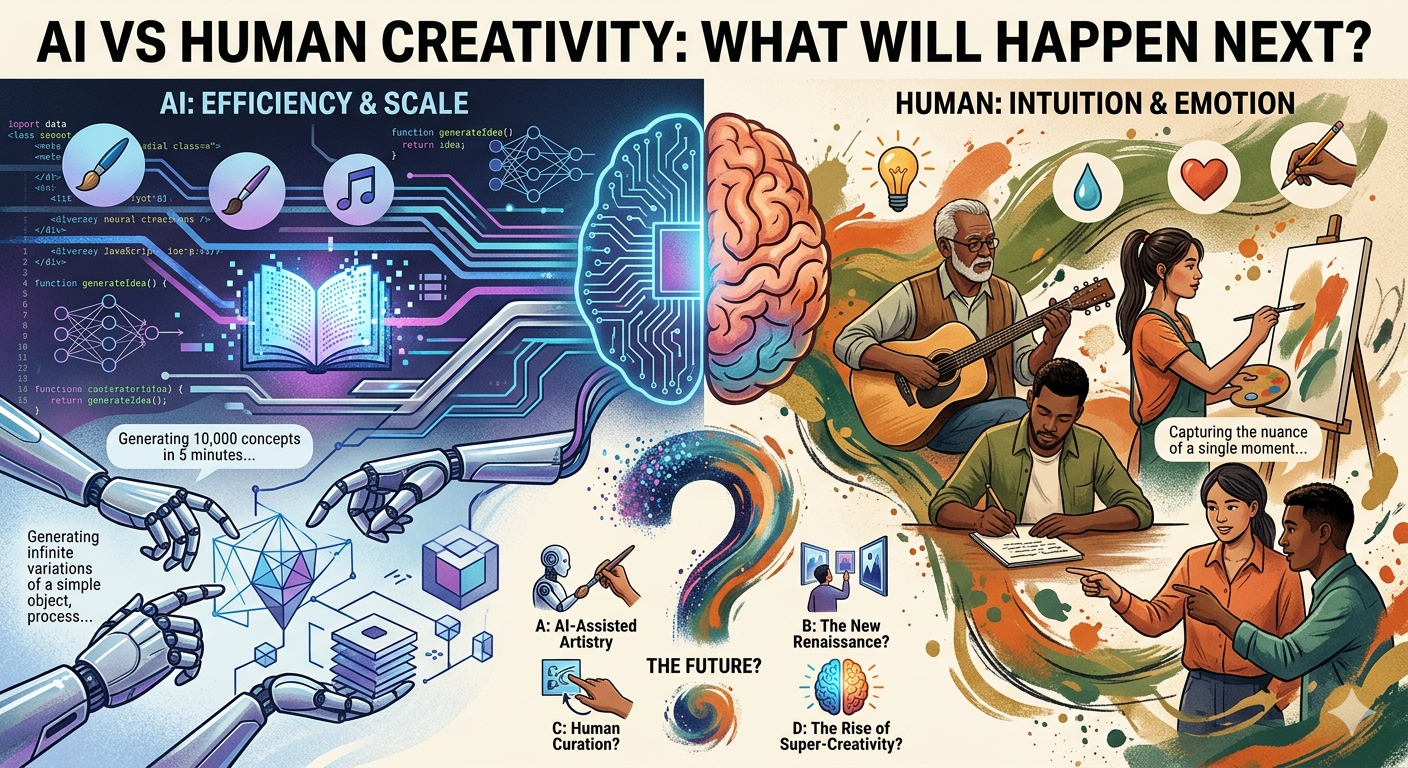
Artificial Intelligence is evolving faster than ever before. AI can now write articles, generate images, create music, design logos, edit videos, and even produce entire marketing campaigns within minutes. Because of these rapid advancements, many people are asking an important question:
Will AI replace human creativity in the future?
Some believe AI will dominate creative industries, while others argue that human imagination can never truly be replaced. The truth is more complex. AI is changing creativity, but it may not replace it completely.
In this article, we’ll explore the future of AI and human creativity, the advantages and limitations of both, and what may happen next in the creative world.
What Is Creativity?
Creativity is the ability to generate original ideas, emotions, stories, solutions, or artistic expressions. It often comes from:
- Human experiences
- Emotions
- Imagination
- Personal struggles
- Culture and memories
For centuries, creativity has been one of the most unique human abilities. Writers, musicians, artists, filmmakers, and inventors have shaped the world through creative thinking.
But now AI systems can also generate impressive creative content using large amounts of data and machine learning.
This has completely changed the conversation around creativity.
How AI Creates Content
AI does not think like humans. Instead, it learns patterns from enormous datasets.
For example:
- AI writing tools analyze millions of articles and books
- AI image generators learn from billions of images
- AI music tools study thousands of songs and melodies
Then AI predicts what content should come next based on patterns and probabilities.
This allows AI to create:
- Blog posts
- Poems
- Songs
- Paintings
- Video scripts
- Marketing content
- Website designs
The speed and efficiency of AI are remarkable. Tasks that once took hours can now take seconds.
Why AI Creativity Is Growing So Fast
Several factors are driving the growth of AI-generated creativity.
1. Faster Content Production
Businesses need large amounts of content daily. AI helps companies create articles, ads, captions, and designs much faster than humans alone.
2. Lower Costs
Hiring designers, writers, or editors can be expensive. AI tools reduce production costs significantly.
3. Easy Access
Anyone with internet access can use AI tools today. You no longer need advanced technical skills to create content.
4. Continuous Improvement
AI models improve rapidly every year. What seemed impossible two years ago is now common.
Because of these advantages, AI is becoming a major part of creative industries.
Areas Where AI Is Already Competing With Humans
AI is already influencing many creative fields.
Writing
AI can generate:
- Articles
- Emails
- Product descriptions
- Social media posts
- Scripts
Many businesses now use AI writing tools to speed up content creation.
However, purely AI-generated writing often lacks emotional depth and originality.
Graphic Design
AI image generators can create stunning artwork within seconds.
Designers use AI for:
- Concept art
- Logo ideas
- Marketing graphics
- Thumbnail creation
This saves time, but human designers still guide the creative direction.
Music
AI can compose music tracks and generate melodies.
Some musicians use AI for inspiration, background music, or experimenting with new sounds.
Still, emotional storytelling in music remains deeply human.
Video Editing
AI tools can:
- Edit videos automatically
- Generate subtitles
- Remove backgrounds
- Create short clips
This helps creators produce content faster than ever.
Can AI Truly Be Creative?
This is where the debate becomes interesting.
Some experts argue that AI is not truly creative because it does not:
- Feel emotions
- Understand meaning
- Experience life
- Have personal memories
AI creates based on patterns, not consciousness.
Humans create from experiences, emotions, and imagination.
For example:
- A human artist may create art inspired by heartbreak
- A musician may write songs based on personal pain
- A filmmaker may tell stories influenced by childhood experiences
AI cannot genuinely experience these emotions.
It can imitate creativity, but many believe it cannot truly understand creativity.
The Biggest Strengths of Human Creativity
Despite AI’s rapid growth, humans still have unique creative advantages.
Emotional Intelligence
Humans understand emotions deeply. Great storytelling often depends on emotional connection.
People relate to authentic experiences, struggles, and feelings.
Original Thinking
Humans can break rules, think abstractly, and invent completely new concepts.
AI usually works within patterns it has already learned.
Cultural Understanding
Human creators understand humor, traditions, social context, and cultural sensitivity better than AI.
This matters greatly in entertainment and communication.
Purpose and Meaning
Humans create with intention and purpose.
Artists often express:
- Personal beliefs
- Social issues
- Identity
- Emotions
- Philosophy
AI does not possess personal purpose or awareness.
The Biggest Strengths of AI Creativity
AI also has powerful advantages.
Speed
AI can generate content in seconds.
This dramatically improves productivity.
Scalability
Businesses can create massive amounts of content quickly using AI.
Assistance for Beginners
People with little experience can now create professional-looking content using AI tools.
This has democratized creativity.
Idea Generation
AI is excellent for brainstorming ideas and overcoming creative blocks.
Many creators now use AI as a creative assistant rather than a replacement.
The Most Likely Future: Collaboration
The future may not be “AI vs humans.”
Instead, it may become:
“AI + Humans”
This is already happening today.
Writers use AI for outlines and research.
Designers use AI for concept generation.
Video creators use AI for editing assistance.
In most cases, humans still guide the final creative vision.
AI becomes a tool that enhances human creativity rather than replacing it entirely.
Jobs Most Affected by AI
Some creative jobs may change significantly.
Likely to Be Automated
- Basic content writing
- Simple logo creation
- Repetitive design work
- Generic social media captions
- Basic photo editing
Less Likely to Be Replaced
- Film directing
- High-level storytelling
- Brand strategy
- Emotional marketing
- Creative leadership
- Original art styles
The more human emotion and originality required, the harder replacement becomes.
The Ethical Concerns Around AI Creativity
AI creativity also raises serious ethical questions.
Copyright Issues
Many AI systems are trained on human-created content.
This has led to debates about:
- Ownership
- Fair use
- Artist rights
Fake Content
AI can create realistic fake images, videos, and voices.
This creates risks involving misinformation and trust.
Job Displacement
Some workers fear losing jobs as AI tools become more powerful.
Businesses may automate certain creative roles to reduce costs.
How Creators Can Adapt
Instead of fearing AI, creators can learn to use it strategically.
Learn AI Tools
People who understand AI may gain a major advantage in the future job market.
Focus on Human Skills
Creativity, storytelling, emotional intelligence, and communication will remain valuable.
Build a Personal Brand
Authenticity matters more than ever.
Audiences often connect with real personalities and genuine stories.
Combine AI With Creativity
The most successful creators may be those who use AI to increase productivity while adding human originality.
Will AI Replace Artists Completely?
Probably not.
AI may replace repetitive creative tasks, but human creativity still offers something unique:
- Emotion
- Meaning
- Perspective
- Life experience
People often value art because it reflects human experiences and emotions.
Even if AI-generated content becomes extremely advanced, many audiences will still appreciate authentic human expression.
The Future of Creativity
The future of creativity will likely involve collaboration between humans and intelligent tools.
AI will continue improving rapidly, becoming more helpful in:
- Writing
- Music
- Video production
- Design
- Marketing
But human creativity will still shape ideas, emotions, storytelling, and meaning.
Rather than replacing creativity, AI may change how creativity works.
Those who adapt early could benefit greatly from this transformation.
Final Thoughts
AI is one of the most powerful technologies ever created, and its impact on creativity is only beginning.
While AI can generate impressive content quickly, human imagination remains deeply valuable. Emotion, originality, and authentic experiences continue to separate humans from machines.
The future will likely belong to people who combine both:
- Human creativity
- AI efficiency
Instead of competing with AI, learning how to work alongside it may become one of the most important skills of the future.
FAQs
1. Can AI completely replace human creativity?
AI can automate certain creative tasks, but human emotions, experiences, and originality are difficult to replace completely.
2. Is AI-generated content considered original?
AI-generated content is based on patterns learned from existing data, so originality is still widely debated.
3. Which creative jobs are safest from AI?
Jobs requiring emotional storytelling, strategy, leadership, and deep originality are less likely to be replaced.
4. Should creators learn AI tools?
Yes. Learning AI tools can improve productivity and create new career opportunities.
5. What is the future of AI and creativity?
The future will likely involve collaboration between humans and AI rather than total replacement.