
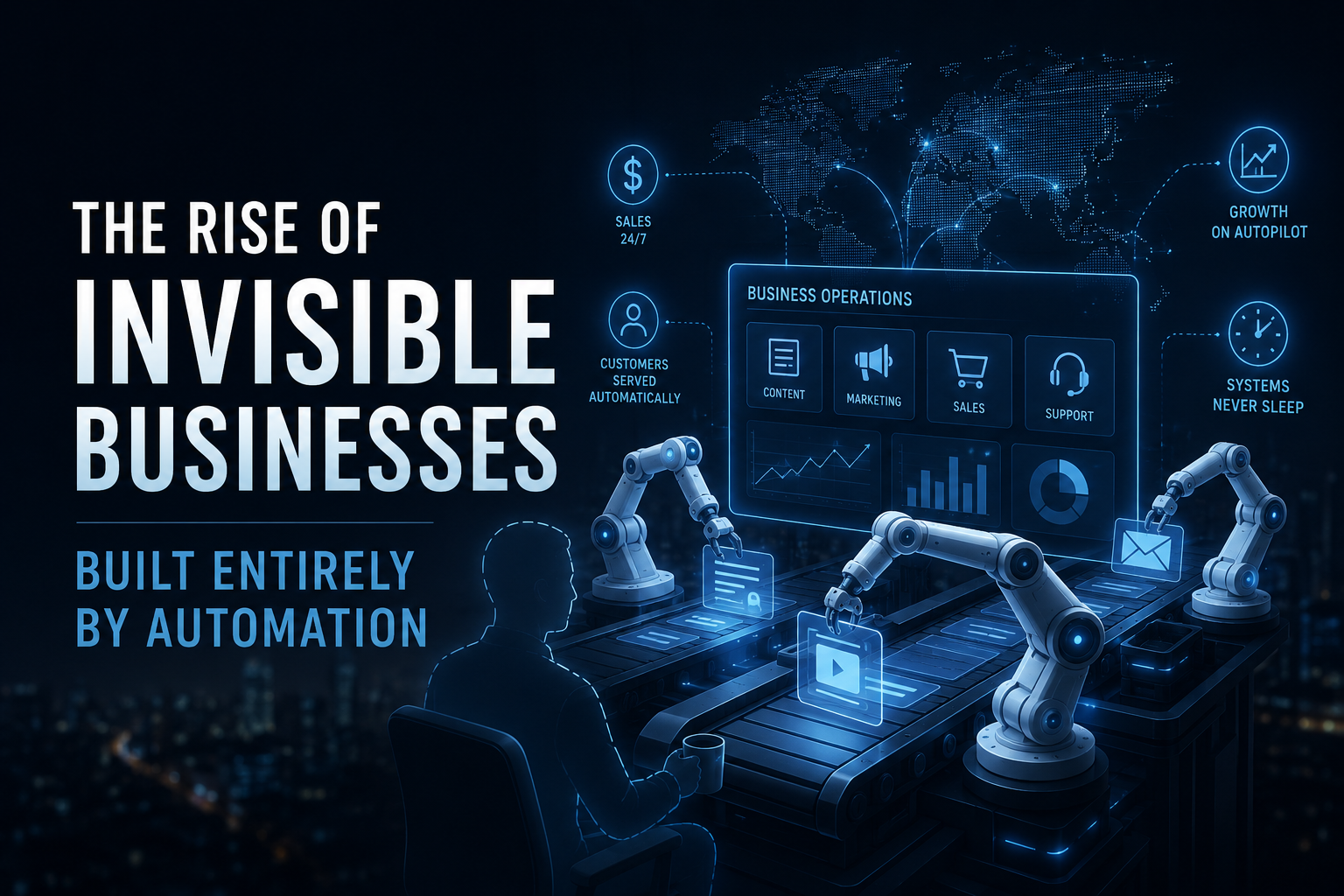
Imagine a company that generates $50,000 a month in recurring revenue. It fulfills orders, handles customer service, updates its marketing campaigns, optimizes its code, and pays its taxes. Now, imagine that this company has no office, no physical products, and exactly zero employees.
Even more surprising: the founder spends less than four hours a week looking at it.
This is not a hypothetical scenario or a late-night infomercial pitch. It is a rapidly growing economic phenomenon known as the Invisible Business.
Driven by the convergence of generative artificial intelligence, advanced API integrations, and sophisticated no-code ecosystems, a new breed of entrepreneurs is building highly profitable, entirely autonomous enterprises. These businesses operate silently in the background of the internet, scaling to six and seven figures while remaining completely invisible to traditional corporate structures.
For decades, business growth was directly tied to headcount. If you wanted to make more money, you had to hire more people. Today, that rule is broken. The modern solopreneur can wield the operational power of a 50-person agency using nothing but software.
Let’s dive deep into the mechanics of invisible businesses, explore real-world case studies, break down the exact tech stacks making this possible, and look at a step-by-step framework for building your own autonomous revenue engine.
2. What Is an Invisible Business?
An invisible business is an enterprise designed from inception to operate autonomously without human intervention for its core day-to-day functions. Unlike traditional businesses that rely on manual workflows, or standard e-commerce shops that require ongoing management, invisible businesses leverage deeply integrated software pipelines to handle the entire customer lifecycle.
[Customer Trigger] ➔ [Automated Processing] ➔ [Instant Value Delivery] ➔ [Self-Optimizing Feedback Loop]
The Three Pillars of Invisibility
To understand how these entities exist, we must look at their core design characteristics:
- Zero Operational Headcount: There are no full-time employees, virtual assistants, or project managers. The founder acts as an architect rather than an operator.
- Event-Driven Architecture: The business does not run on “working hours.” It runs on triggers. A customer action (a purchase, a signup, a search query) instantly fires a chain reaction across multiple software platforms to complete a task.
- Decoupled Delivery: The product or service is digital, programmatic, or drop-serviced, meaning fulfillment requires no physical logistics or manual oversight from the business owner.
Invisible Businesses vs. Traditional Passive Income
It is vital to differentiate this model from old-school “passive income” concepts like basic affiliate marketing or classic dropshipping.
Traditional dropshipping requires constant customer support triage, supplier negotiation, and manual ad optimization. Affiliate marketing demands a continuous stream of content creation to maintain relevance.
An invisible business, by contrast, is a self-sustaining system. It features proprietary data pipelines, programmatic logic, and AI layers that allow the business to adapt to market changes, generate its own content, optimize its user acquisition costs, and handle complex customer interactions without human eyeballs.
3. The Structural Shift: From Headcount to Software Leverage
The corporate world has long viewed a company’s headcount as a badge of honor. Founders proudly boast about managing “a team of 50” or “expanding to 100 employees.”
In the world of invisible businesses, headcount is viewed differently: it is seen as a point of failure, a drag on speed, and a massive financial liability.
The Real Cost of Headcount vs. Automation Software
| Operational Dimension | Human-Centric Team (10 Employees) | Automated Infrastructure (Invisible Business) |
| Monthly Fixed Overhead | $50,000–$80,000 (Salaries, Benefits, Software) | $500–$2,500 (API fees, Platform subscriptions) |
| Speed to Pivot | Weeks (Meetings, training, internal friction) | Minutes (Updating code, modifying webhook routing) |
| Scalability Limit | Linear (More customers = need more staff) | Exponential (More customers = nominal increase in API usage) |
| Operational Hours | 40 hours per week per person | 24/7/365 across all global time zones |
| Management Overhead | High (HR issues, performance reviews, communication) | Zero (Deterministic software logic and self-healing scripts) |
This structural shift is powered by software leverage. When an entrepreneur writes an automated workflow using tools like Make, Zapier, or custom Python scripts tied to Large Language Models (LLMs), they are creating a digital worker that never sleeps, never asks for a raise, and executes tasks with absolute precision.
By shifting the operational burden to software, profit margins regularly climb past 85%, allowing a single individual to capture wealth that previously required an entire corporate floor.
4. Anatomy of an Automated Sovereign Business Model
How do these businesses actually make money without human intervention? While the specific niches vary wildly, successful invisible businesses typically fall into four distinct operational frameworks.
A. Programmatic Content & Monetization Engines
These businesses leverage structured public data, programmatic SEO frameworks, and AI synthesis to build massive, highly targeted informational directories.
- The Mechanism: An automated script fetches data from public APIs (e.g., real estate records, weather trends, financial data, or remote job listings). The script formats this data into thousands of highly optimized landing pages targeting hyper-specific long-tail keywords.
- Monetization: Programmatic ad networks (Mediavine, Raptive), automated affiliate link insertion, or premium data subscriptions.
- The Invisible Factor: Content generation, page indexing, and ad placement happen completely via code. The founder simply monitors the traffic dashboards.
B. Micro-SaaS (Software-as-a-Service) Utilities
Micro-SaaS products solve one highly specific problem for a niche audience, often delivered as a browser extension, a Shopify app, or a simple web utility.
- The Mechanism: The software is built using clean, modular code or advanced no-code builders like Bubble. User onboarding is completely self-serve.
- The Invisible Factor: Bug tracking tools automatically flag errors, AI agents read error logs and suggest code fixes, and automated billing engines handle subscriptions, upgrades, and cancellations.
C. Arbitrage & Automated Drop-Servicing
Instead of physical products, these businesses sell high-ticket digital services (like video editing, logo design, or legal document preparation) and automate the fulfillment through third-party APIs or white-label networks.
[Client buys $500 service on Site] ➔ [Webhook triggers third-party API for $150] ➔ [AI checks quality] ➔ [System delivers to client]
- The Mechanism: A customer buys a service on the founder’s website for $500. A webhook instantly routes the project specifications to a high-quality, white-label provider or automated tool for $150.
- The Invisible Factor: The system handles client intake, project routing, quality assurance checks via AI text/image analysis, and final delivery without the founder ever seeing the file.
D. Digital Asset Flipping & Automated Licensing
These entities create, manage, and license portfolios of digital intellectual property—such as specialized datasets, stock audio, code libraries, or niche newsletter lists.
- The Mechanism: Web scrapers gather and clean niche data, packaging it into valuable CSVs or databases. Automated marketing engines post samples to marketplaces like GitHub, Product Hunt, or specialized data exchanges.
- The Invisible Factor: Payment unlocks an automated download link or grants API access token keys instantly, managing access permissions autonomously.
5. Case Studies: Real-World Ghost Companies Generating Millions
To ground these concepts in reality, let us analyze three distinct case studies of individuals who have successfully built high-revenue, zero-employee automated powerhouses.
Case Study 1: The Programmatic SEO Directory (Remote Jobs Platform)
An engineer noticed a surge in demand for remote jobs specializing in specific niche programming languages (e.g., Rust, Solidity). Instead of curated manual job boards, they built a script.
- The Automation: The script scrapes job boards daily, filters for specific keywords, uses OpenAI’s API to categorize experience levels, writes optimized meta data, and publishes the listing.
- The Result: Over 15,000 indexable pages targeting terms like “Remote entry-level Solidity jobs in Berlin.” The site attracts 400,000 monthly visitors.
- Revenue: $22,000/month through automated job postings (companies pay a premium via Stripe to feature their job) and programmatic display ads.
- Human Input: 1 hour a week checking server health.
Case Study 2: The Automated Micro-SaaS Utility (Image Optimization Tool)
A founder built a simple API that automatically compresses and converts images into modern web formats (.webp, .avif) for e-commerce store owners.
- The Automation: Marketing is driven by a free web tool that ranks at the top of Google. When users need bulk processing, they subscribe to a paid tier. Stripe handles the billing, AWS Lambda handles the computing power, and an AI chatbot trained on the software’s documentation handles 98% of support tickets.
- The Result: The software runs with a 92% profit margin, serving millions of image requests per month.
- Revenue: $34,000/month recurring revenue.
- Human Input: The founder steps in only if the core cloud infrastructure experiences an outage.
Case Study 3: The Automated Newsletter Arbitrage Engine
A marketer created a hyper-targeted daily financial news digest for busy executives.
- The Automation: Every morning at 4:00 AM, an automated system pulls RSS feeds from major financial outlets, synthesizes the core points using an LLM, applies a specific brand tone, formats an HTML newsletter, and schedules it inside a newsletter platform.
- The Result: Growth is driven via automated cross-promotions and programmatic paid acquisition ads running on strict budget caps based on subscriber lifetime value.
- Revenue: $12,000/month through automated programmatic sponsorships and premium subscription tiers.
- Human Input: Occasional editorial audits to ensure AI tone alignment.
6. The Technical Blueprint: Building the No-Code/AI Automation Stack
You do not need a Ph.D. in Computer Science to construct an invisible business. The modern no-code and AI landscape allows you to stitch powerful applications together using visual interfaces and APIs.
Below is the definitive modern tech stack required to build an autonomous business engine.
┌────────────────────────────────────────────────────────┐
│                   FRONTEND LAYER                       │
│        (Webflow / Framer / Bubble / WordPress)         │
└───────────────────────────┬────────────────────────────┘
                            │ (User Action / Webhook)
                            ▼
┌────────────────────────────────────────────────────────┐
│                   ORCHESTRATION LAYER                  │
│                     (Make / Zapier)                    │
└───────────────────────────┬────────────────────────────┘
                            │
         ┌──────────────────┴──────────────────┐
         ▼                                     ▼
┌─────────────────┐                  ┌──────────────────┐
│   BRAIN LAYER   │                  │ DATA/CORE LAYER  │
│  (OpenAI /      │                  │ (Airtable /      │
│   Anthropic API)│                  │  PostgreSQL /    │
│                 │                  │  Stripe API)     │
└─────────────────┘                  └──────────────────┘
1. The Frontend Layer (The Digital Storefront)
This is what the world sees. It must be blazing fast, optimized for conversions, and capable of capturing user inputs.
- Webflow / Framer: For high-performance, visually stunning landing pages and programmatic template layouts.
- Bubble: If your invisible business requires user authentication, database lookups, or complex user dashboards (Micro-SaaS).
- WordPress + Advanced Custom Fields (ACF): The gold standard for heavy programmatic SEO operations managing tens of thousands of pages.
2. The Orchestration Layer (The Nervous System)
This layer connects your frontend to your backend data processors. It passes information via webhooks and APIs.
- Make (formerly Integromat): Highly recommended for invisible businesses due to its visual data mapping, advanced error routing, looping functionalities, and significantly lower costs than competitors at scale.
- Zapier: Best for quick integrations with obscure apps that lack native API support.
- n8n.io: The premier choice for advanced builders who want to self-host their automation workflows to avoid third-party execution fees.
3. The Brain Layer (Cognitive Processing)
This is where unstructured data is converted into high-value assets, decisions are made, and communication is contextualized.
- OpenAI API (GPT-4o/GPT-4-turbo): For complex reasoning, text synthesis, data categorization, and running human-like support agents.
- Anthropic Claude API (Claude 3.5 Sonnet): Exceptional for long-form content synthesis, nuanced brand voice replication, and automated coding tasks.
- Vector Databases (Pinecone / Qdrant): Used to store your business’s proprietary knowledge base, enabling your AI agents to reference past customer data or technical specs accurately.
4. The Data & Operations Layer (The Engine Room)
Where your business logic, customer profiles, and product assets live.
- Airtable: Acts as a highly flexible, human-readable relational database that integrates seamlessly with automation engines.
- PostgreSQL / Supabase: For scaling data structures past Airtable’s record limits (typically over 100,000 records).
- Stripe API: Handles subscription management, multi-currency invoicing, fraud prevention, and automated payouts.
7. Step-by-Step Framework to Launch an Invisible Business
Building a system that runs without you requires engineering foresight. Follow this five-phase framework to concept, build, and deploy an autonomous business.
Phase 1: Identify an Information or Process Asymmetry
Look for areas where data exists but is unorganized, or where a multi-step digital service can be fulfilled deterministically by software. Ask yourself:
- What datasets are valuable but annoying to gather manually?
- What digital tasks do companies pay freelancers $50/hour to do that can be broken down into clear logic paths?
- What micro-problems do users face inside massive platforms like Shopify, Salesforce, or HubSpot?
Phase 2: Design the Closed-Loop Workflow
Map out your business process on a digital whiteboard (like Miro or Figma) before writing a line of code or setting up a Zap. You must account for every variable:
- What is the precise user trigger? (e.g., Form submission, Stripe checkout success).
- Where does that data go? (e.g., Sent to Make webhook).
- What processing occurs? (e.g., AI summarizes input, pulls technical data from an external API).
- How is it delivered? (e.g., PDF generated via DocsAutomator, emailed to user via Postmark).
Phase 3: Build the Minimum Viable Automation (MVA)
Do not try to automate everything on day one. Build the core fulfillment engine first. Ensure that when a test payment is made, the core value proposition is successfully generated and delivered to the buyer without you touching the keyboard.
Phase 4: Install the Automated Guardrails & Error Catching
An invisible business can quickly turn into a visible nightmare if an automation breaks and thousands of customers get error messages—or worse, empty emails.
- Breakroom Logic: In Make, use “Error Handlers” (like Resume or Ignore modules) to catch temporary API drops.
- Slack/Discord Alerts: Set up a webhook that immediately pings a private channel on your phone if an automation fails thrice consecutively, alerting you to intervene.
- Rate-Limit Buffers: Ensure your data steps include delays to avoid hitting API rate limits on services like OpenAI or Google Search Console.
Phase 5: Implement Automated Traffic Drivers
An invisible business needs an invisible marketing arm. Use these scalable customer acquisition models:
- Programmatic SEO (pSEO): Create templates that automatically rank for long-tail search queries without needing active link-building or manual writing campaigns.
- API-Driven Side Project Marketing: Build a free, useful calculator or tool that relates to your core product, index it on Google, and use it to funnel users into your paid automation.
8. Managing Risk: De-risking Platforms, API Volatility, and AI Hallucinations
Operating an automated sovereign business comes with unique operational vulnerabilities. Because you lack human eyes reviewing every output, you must engineer risk mitigation directly into your digital architecture.
1. Platform Dependency (The “Rug-Pull” Risk)
If your invisible business relies entirely on scraping data from a single platform or building a utility for one software eco-system (like Twitter or Shopify), you are exposed to platform risk. If they change their API access pricing or terms of service, your business could vanish overnight.
- Mitigation: Build multi-channel data sources. Abstract your core infrastructure so that if one data provider shuts down, you can update a single environment variable to pull data from an alternative vendor.
2. API Costs and Runaway Workflows
A looping bug in an automation script can quickly consume thousands of dollars in API fees within a few hours if left unchecked.
- Mitigation: Always set strict monthly spend caps inside your OpenAI, Anthropic, and cloud service accounts. Set up real-time billing alerts that notify you via SMS if spending exceeds daily historical averages.
3. AI Hallucinations and Quality Control
If your system relies on generative AI to produce client deliverables or consumer-facing content, false information or broken text formatting can degrade your brand equity.
- Mitigation: Implement a two-tiered AI framework. Have one model (e.g., Claude 3.5 Sonnet) generate the asset, and route it to a smaller, faster model (e.g., GPT-4o-mini) running a strict validation prompt: “Verify this file contains no placeholder text, formatting errors, or broken links. Reply with true or false.” If false, automatically reroute the script to regenerate the asset.
9. Key Takeaways
- The Paradigm Shift: Software leverage allows a single founder to break the connection between operational headcount and revenue generation, yielding profit margins exceeding 85%.
- Core Definition: An invisible business runs entirely on event-driven architecture, triggers, webhooks, and AI cognitive processing layers requiring under 4 hours of weekly manual oversight.
- The Tech Stack Pillars: Successful automated systems rely on a frontend (Framer/Webflow), an orchestration layer (Make/n8n), a brain layer (OpenAI/Claude APIs), and a structured data home (Airtable/Supabase).
- Engineered Resilience: Safeguarding these enterprises requires setting strict API spending caps, building programmatic validation loops, and installing real-time error alert channels to avoid system failure.
- Scalable Marketing: Growth in this model is achieved through zero-maintenance distribution channels like Programmatic SEO and automated utility-tool funnels.
10. FAQ Section
Q1: Can a non-technical person really build an invisible business?
A: Yes. The barrier to entry has completely shifted from writing complex syntax to mapping out clear business logic. With modern visual builders like Make and no-code design tools like Framer, anyone who understands how data flows from point A to point B can assemble a highly functional automated business without writing raw code.
Q2: How much upfront capital is required to launch this model?
A: Very little compared to traditional startups. Your primary costs will be software subscriptions and API usage fees. A standard operational stack (Webflow, Make, Airtable, OpenAI API keys) can easily run for under $150 to $250 a month during your validation and building phases.
Q3: What happens when a customer demands a refund or has a complex billing issue?
A: Stripe provides automated customer portals where users can update payment cards, download invoices, and cancel subscriptions on their own. For refund requests or support tickets, custom AI agents trained on your specific documentation can resolve the majority of standard requests. If a dispute escalates past predefined parameters, the system routes the ticket to your inbox for manual review.
Q4: Do invisible businesses require any maintenance at all?
A: Yes, nothing is 100% permanent. While daily operations are autonomous, you will need to perform occasional maintenance. This typically involves updating API keys when platforms roll out new versions, refining AI prompts to improve output accuracy, and reviewing monthly financial trends to optimize operational software spend.
Q5: Is this model ethical? Won’t it completely replace human jobs?
A: This model shifts human capital from repetitive data-entry and operational tasks toward creative architecture and systems design. Instead of managing people and handling administrative friction, founders focus on creating high-value data pipelines and building scalable internet assets.
Q6: How do these businesses handle taxes and legal compliance across different countries?
A: They use automated merchant-of-record services or automated compliance platforms like Stripe Tax or Paddle. These tools automatically calculate, collect, and remit digital sales tax and VAT globally based on the customer’s precise location, ensuring complete compliance without manual bookkeeping.