
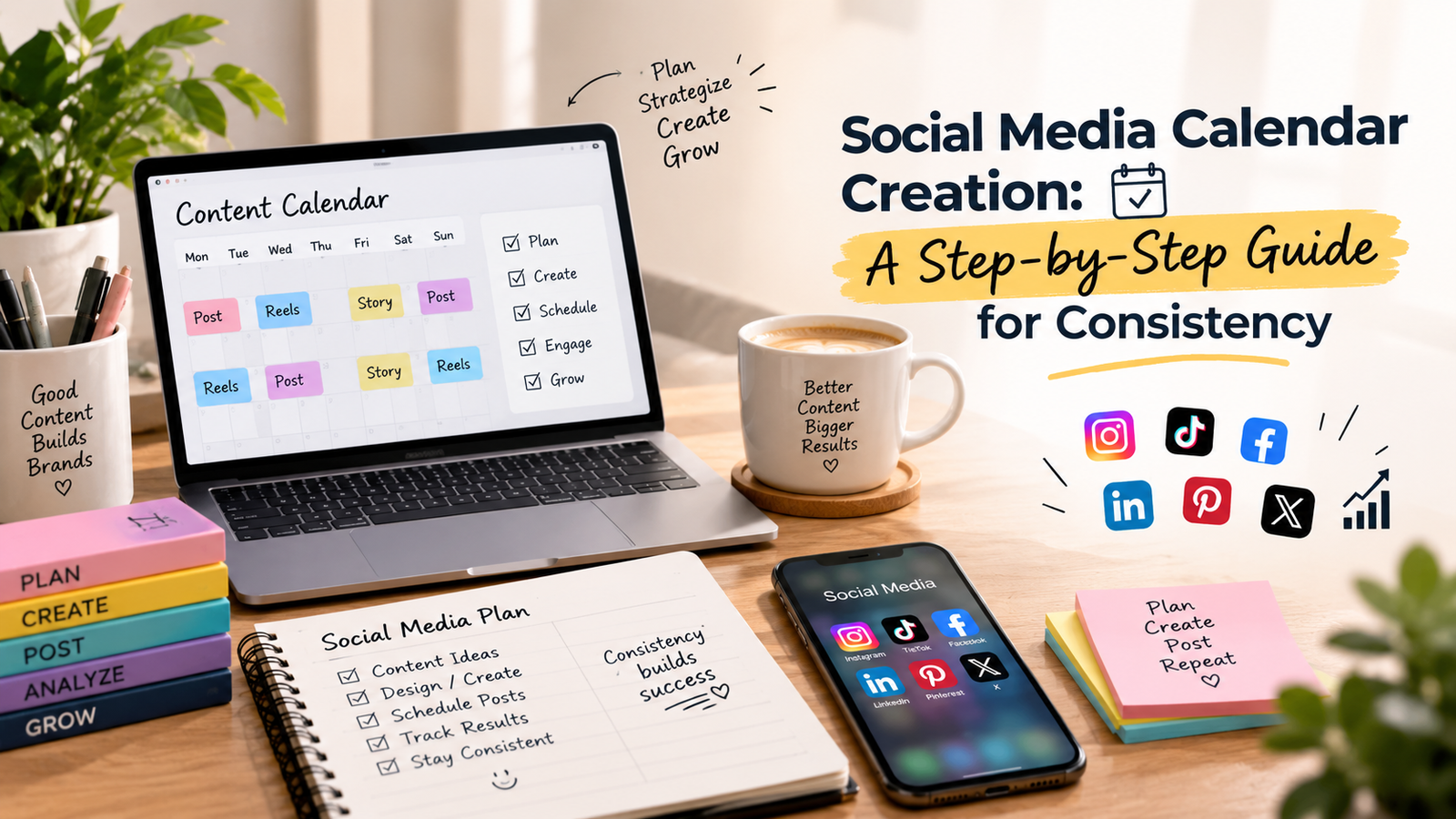
n digital marketing, consistency is the ultimate growth multiplier. Most brands and creators do not fail on social media due to a lack of creativity or poor-quality visuals; they fail because they post erratically. They release five posts in a single week, burn out, go silent for three weeks, and then wonder why their reach drops, their audience cold-shoulders them, and their algorithm visibility vanishes.
Building a dedicated social media calendar is the solution to breaking this cycle. A content calendar turns social media marketing from a reactive, last-minute scramble into a proactive, strategic system.
WOWinfotech
This step-by-step guide walks you through building a high-performing social media calendar from scratch to ensure sustainable, long-term consistency.
WOWinfotech
Why Social Media Consistency Demands a Calendar
Posting on a whim leads to content fatigue, inconsistent brand voice, and poor decision-making. A social media calendar serves as your team’s single source of truth, unlocking five essential operational benefits:
- Algorithmic Favorability: Every major social platform—from Instagram and TikTok to LinkedIn and YouTube—rewards account predictability. Regular publishing signals reliability to discovery algorithms.
- Resource & Time Management: Batching content creation using a pre-planned schedule cuts output production time by up to 40% compared to daily content drafting.
- Strategic Message Alignment: Planning content weeks or months ahead allows you to align posts directly with product launches, seasonal sales, and broader marketing campaigns.
- Improved Quality Control: Operating ahead of schedule eliminates typos, poor design execution, broken links, and off-brand visuals caused by last-minute rushes. ComeRiver LTD
- Data-Driven Iteration: Tracking organized campaigns on a central calendar makes evaluating performance easy. You can quickly analyze why specific themes hit target Key Performance Indicators (KPIs) while others underperform. ComeRiver LTD
Phase 1: Foundational Audit & Strategy Setup
Before opening a spreadsheet or a scheduling tool, establish your structural foundations. Building a calendar without defining your strategy first leads to publishing organized noise.
Medium
+-----------------------------------------------------------------------------+
|                        FOUNDATIONAL STRATEGY FLOW                           |
|                                                                             |
| [ Audit Past Posts ] ➔ [ Define Target Audience ] ➔ [ Set SMART Metrics ]   |
+-----------------------------------------------------------------------------+
Step 1: Conduct a Comprehensive Social Media Audit
Examine your existing social channels across the past 90 days to identify performance benchmarks:
- High-Performing Formats: Which formats yielded the highest engagement, reach, and outbound clicks (e.g., Short-form video, Carousels, Text threads)?
- Posting Frequency: How often did you post on each platform, and where did drop-offs happen?
- Audience Peak Activity: What days and specific times produced the highest interaction rates?
Step 2: Establish Content Pillars
Content pillars are 3 to 5 core themes or categories that align with your brand’s expertise and solve key audience problems. Content pillars prevent topic burnout and maintain a balanced feed.
Buffer
                     +---------------------------------+
                     |      BRAND CONTENT PILLARS      |
                     +---------------------------------+
                                      |
         +-----------------+----------+----------+-----------------+
         v                 v                     v                 v
  [ Educational ]   [ Inspirational ]     [ Promotional ]    [ Behind-the-Scenes ]
  (Tips, How-Tos)   (Case Studies)        (Product Launch)   (Culture, BTS)
- Educational (40%): How-to guides, industry teardowns, actionable tips, and checklists.
- Inspirational / Social Proof (20%): Customer testimonials, founder journeys, case studies, and transformation stories.
- Promotional (20%): Product spotlights, limited-time discounts, lead magnets, and sales calls-to-action.
- Entertaining / Behind-the-Scenes (20%): Relatable industry humor, culture highlights, team features, and trend responses.
Phase 2: Selecting the Right Tools and Architecture
The best social media calendar tool is the one your team will actually use every single day. Pick a system that matches your organization’s complexity and team size.
ComeRiver LTD
Calendar Tool Comparison Matrix
| Tool Category | Recommended Platforms | Best Suited For | Key Advantages |
|---|---|---|---|
| Spreadsheets | Google Sheets, Microsoft Excel | Solo creators, early-stage startups, bootstrapped budgets | 100% customizable, zero software cost, easy shareability |
| Project Management | Trello, Asana, Notion, Monday.com | In-house marketing teams, multi-tier approval workflows | Kanban boards, task assignment, status updates, asset attachments |
| Dedicated SMM Suites | Buffer, Hootsuite, Sprout Social, Later | Agencies, scaling e-commerce brands, enterprise teams | Direct auto-publishing, analytics integration, inbox management |
Essential Calendar Field Elements
Regardless of the platform you choose, set up these specific structural columns/fields:
WOWinfotech
- Publication Date & Time: Exact target date and time zone.
- Target Platform: Specific channel (e.g., Instagram, LinkedIn, TikTok, X, YouTube Shorts). Channel Eye
- Content Pillar: The assigned thematic category.
- Content Format: Single image, carousel, short video, long video, text-only.
- Post Hook & Copy: The headline, full caption text, and call-to-action (CTA).
- Visual Assets / Drive Link: Direct link to finalized images, raw footage, or graphics.
- Hashtags & Tagging: Relevant tags, keyword phrases, and profile handles.
- Status Tracker: Options like Idea Stage ➔ In Copywriting ➔ Visual Design ➔ Pending Approval ➔ Scheduled ➔ Live. Medium
Phase 3: Step-by-Step Calendar Execution Workflow
Moving from empty cells to an active, well-organized schedule requires a systematic workflow. Follow this five-step implementation process to plan out a month of content efficiently.
+------------------------------------------------------------------------------------+
|                         THE 5-STEP CALENDAR EXECUTION WORKFLOW                     |
|                                                                                    |
| [ Map Fixed Dates ] ➔ [ Idea Brainstorm ] ➔ [ Batch Production ] ➔                 |
| [ Approval Stage ] ➔ [ Auto-Publishing ]                                           |
+------------------------------------------------------------------------------------+
Step 1: Map Fixed Calendar Anchor Points
Start by marking non-negotiable dates across your calendar month:
- Product launches, feature updates, or company milestones. Bitrix24
- Federal holidays, cultural celebrations, and key industry events.
- Seasonal sales events (e.g., Black Friday, Q4 campaigns, New Year offers).
Step 2: Conduct Purposeful Brainstorming Sessions
Dedicate a single 60-minute window to generate post concepts around your remaining empty slots. Avoid generating random ideas; align every post idea with a specific content pillar and customer pain point.
- Competitor Gap Analysis: What questions are customers asking in your competitors’ comment sections?
- Customer Support Mining: What common issues are users bringing to your sales or help teams?
- Content Repurposing: How can a high-traffic blog post or long YouTube video be transformed into 3 carousel decks and 2 short video reels?
Step 3: Implement Batch Content Production
Producing content day by day causes constant cognitive switching and drains creative momentum. Instead, group similar production tasks into dedicated time blocks:
- Block A (Writing Day): Draft all written copy, hooks, and captions for the upcoming two to four weeks.
- Block B (Design/Shooting Day): Record all video footage, film talking-head clips, and design graphic assets using pre-made templates.
- Block C (Editing & Assembly Day): Edit videos, format captions, insert hashtags, and upload media assets into your central drive folders. WOWinfotech
Step 4: Establish Quality Control and Review Checks
Assign clear responsibilities for reviewing and approving draft posts:
Medium
- Copy & Tone Check: Is the hook engaging? Is the grammar correct? Does the post use the brand’s voice?
- Visual & Formatting Check: Are images formatted to correct aspect ratios (e.g., 9:16 for Reels, 4:5 for Instagram posts, 1:1 for LinkedIn graphics)?
- Compliance & Technical Check: Are destination links functional? Are tag handles accurate?
Step 5: Schedule and Automation Integration
Load approved media assets and text directly into your social media scheduling software. Set automated publication dates based on your channel’s historical peak activity times.
Phase 4: Sustainable Strategies to Prevent Burnout
A social media calendar should serve as a helpful roadmap, not a rigid prison. To maintain long-term momentum without exhausting your creative resources, build sustainability directly into your calendar framework.
The 80/20 Flexibility Rule
Reserve 80% of your calendar for pre-scheduled evergreen and campaign content. Leave 20% of your calendar open to react flexibly to real-time cultural moments, platform trends, breaking news, or sudden industry changes.
Strategic Content Repurposing (The Pyramid Framework)
Never start from scratch for every single platform. Adopt a top-down content repurposing model:
                  +-----------------------------------+
                  |         ONE CORE ASSET            |
                  |  (Long-Form Video or In-Depth Blog)|
                  +-----------------+-----------------+
                                    |
          +-------------------------+-------------------------+
          v                                                   v
 [ 3-4 Short Reels / Shorts ]                        [ 2 Detailed Carousels ]
          |                                                   |
          +-------------------------+-------------------------+
                                    |
                                    v
                       [ 5 Text Posts / Tweets ]
Realistic Posting Frequency Matrix
Choose a realistic schedule you can maintain consistently for months, rather than overcommitting early and quitting:
ComeRiver LTD
| Channel | Minimum Recommended Frequency | Optimal Peak Frequency |
|---|---|---|
| 3 posts per week | 5 posts per week (Monday–Friday) | |
| 3 Reels + 2 Stories per week | 1 Reel daily + daily Stories | |
| TikTok | 3 videos per week | 1–2 videos daily |
| X (Twitter) | 1 thread + 3 posts per week | 2–3 standalone posts daily |
| YouTube Shorts | 2 Shorts per week | 5 Shorts per week |
Phase 5: Tracking Performance & Iterative Optimization
A successful social media calendar evolves continuously based on audience data. Set aside 30 minutes at the end of every month to audit your calendar’s performance metrics.
ComeRiver LTD
+---------------------------------------------------------------------------------+
|                        MONTHLY METRIC REVIEW CHECKLIST                          |
|                                                                                 |
|  [ Reach & Impressions ]  ➔  [ Engagement Rate ]  ➔  [ Outbound Click-Throughs ] |
+---------------------------------------------------------------------------------+
- Review Top Performers: Identify the top 10% of posts that generated the highest engagement, reach, and click-through rates.
- Identify Pattern Signals: Which content pillars, formats, visual styles, or hooks appeared repeatedly among those top performers?
- Prune Underperforming Content: Reduce or modify themes that consistently generate low interaction.
- Update Calendar Templates: Double down on winning content formulas by adding similar post formats to next month’s calendar schedule.
Final Thoughts
Consistency on social media is not about working harder or pushing out endless content; it is about implementing clear, repeatable systems.
ComeRiver LTD
By defining your brand’s content pillars, picking an accessible tracking tool, batching production, and utilizing automated scheduling, you turn social media into an organized growth engine. Stop treating social media as a daily emergency and build a calendar strategy that delivers predictable, long-term business results.
ComeRiver LTD
Blog SEO Metadata
- Primary Blog Tags:
Social Media Strategy,Content Calendar,Digital Marketing,Content Optimization - Suggested Meta Title: How to Create a Social Media Calendar for Consistency (Full Guide)
- Suggested Meta Description: Learn step-by-step how to create a high-converting social media calendar. Master content pillars, batch creation, scheduling, and workflow optimization to stay consistent online.
How would you like to build on this social media calendar guide?
Generate a downloadable Google Sheets calendar template outline
Get 20 actionable social media content hooks across different pillars