
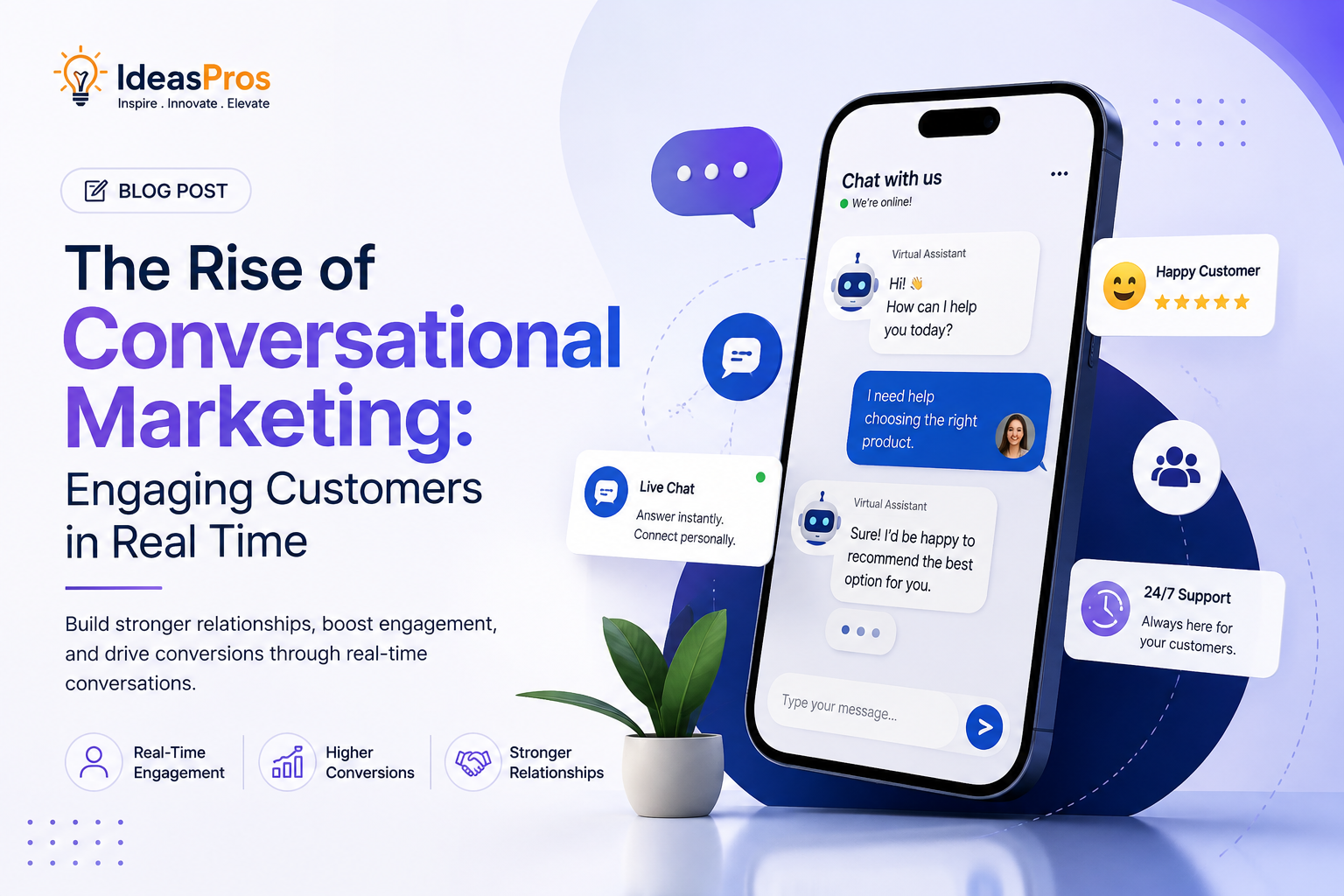
he modern digital marketplace operates at unprecedented speeds. Today’s consumers do not want to fill out static lead generation forms, submit support tickets, or wait 24 to 48 hours for an email reply. When potential buyers visit a website or social media profile with a question, they expect immediate, personalized, and relevant answers.
This fundamental shift in consumer behavior has given birth to Conversational Marketing—a strategy focused on one-to-one, real-time interactions that build relationships, reduce friction in the buying journey, and drastically improve conversion rates.
Rather than pushing one-way marketing messages at a passive audience, conversational marketing invites customers into a dialogue. It replaces traditional sales funnels with fast, interactive, and human-centric experiences powered by modern technology.
What Is Conversational Marketing?
At its core, conversational marketing is a feedback-oriented approach to marketing that drives customer engagement, boosts sales, and cultivates brand loyalty through real-time, two-way communication.
Traditional marketing relies heavily on broadcasting messages—think static landing pages, broadcast emails, television ads, and print media. Conversational marketing flips this script by creating a continuous dialogue across multiple digital touchpoints, including:
- Live Chat: Real-time text interaction between human sales or support agents and website visitors.
- AI-Powered Chatbots & Virtual Assistants: Automated bots that leverage Natural Language Processing (NLP) to answer questions, qualify leads, and schedule demos 24/7.
- Messaging Apps: Utilizing platforms like WhatsApp, Facebook Messenger, WeChat, and Telegram for direct, informal customer communications.
- Interactive Voice Assistants: Using voice technology (e.g., Alexa, Google Assistant) to engage users through natural spoken dialogue.
- Social Messaging & Direct Messages (DMs): Interacting with prospects natively on platforms like Instagram, LinkedIn, and X (Twitter).
Instead of forcing users through rigid, step-by-step landing page funnels, conversational marketing allows buyers to control the pace and direction of the interaction.
The Shift from Traditional Funnels to Conversational Frameworks
To appreciate the impact of conversational marketing, it helps to contrast it with traditional digital lead generation methods.
Traditional Lead Capture:
Traffic -> Static Form -> Email Autoresponder -> Wait for Sales Rep -> Qualification Call

Conversational Marketing Framework:
Traffic -> Immediate Real-Time Chat -> Instant Lead Qualification -> Direct Scheduling / Immediate Purchase
The Friction of Traditional Lead Capture
For years, digital marketing relied on a standard formula: direct traffic to a landing page, offer an e-book or gated asset, demand 5–10 form fields (Name, Email, Job Title, Company Size, Phone Number), and route that information to a Customer Relationship Management (CRM) platform. Days later, a sales representative would follow up—by which point the prospect’s interest had often cooled off or they had already purchased from a competitor.
The Conversational Marketing Framework
Conversational marketing eliminates this friction entirely. The framework operates on three primary principles:
- Engage: Interact with website visitors instantly when their buying intent is at its peak, using targeted welcome messages and context-aware chat widgets.
- Understand: Use automated branching logic or AI to ask natural questions, uncover pain points, and qualify the prospect’s needs within seconds rather than days.
- Recommend: Direct the prospect immediately to the exact product, solution, article, or sales representative’s calendar that best solves their problem.
Core Benefits of Conversational Marketing for Businesses
Adopting a conversational marketing strategy delivers measurable performance improvements across sales, marketing, and customer support operations.
1. Drastically Reduced Sales Cycles
By qualifying leads in real time, businesses eliminate the latency inherent in traditional sales pipelines. Prospects do not have to wait for an email response to book a meeting; they can select a time slot on a representative’s integrated calendar right within the chat window.
2. Higher Conversion Rates and Lead Volume
Static landing page forms suffer from high abandonment rates—particularly on mobile devices where filling out fields is cumbersome. Replacing or supplementing lengthy forms with a lightweight, interactive chat experience makes it effortless for visitors to engage, leading to significant increases in qualified lead capture.
3. 24/7/365 Availability
Human sales teams operate within specific working hours, but web traffic arrives around the clock. AI-driven chat solutions ensure that late-night visitors, international prospects, and weekend browsers receive immediate assistance without increasing staffing overhead.
4. Richer Data and Customer Insights
Direct conversations yield deeper, more authentic data than multiple-choice form fields. When prospects talk naturally about their challenges, goals, and objections, businesses collect rich qualitative data that can be analyzed to refine messaging, product features, and overall positioning.
5. Enhanced Customer Experience and Satisfaction
Consumers value speed, convenience, and personalization above almost everything else. Delivering instant answers builds trust early in the buyer’s journey and signals that your brand respects the user’s time.
Key Pillars of a Successful Conversational Strategy
Implementing conversational marketing requires more than just dropping a generic chatbot onto your home page. To build a system that drives meaningful revenue, businesses must focus on four foundational pillars.
| Pillar | Focus Area | Objective |
|---|---|---|
| Contextual Targeting | Page-level triggers & user data | Serve tailored opening lines based on what the user is currently viewing. |
| Intelligent Automation | Natural Language Processing (NLP) | Answer complex queries accurately and escalate seamlessly to humans when needed. |
| Omnichannel Integration | CRM & Messaging App syncing | Maintain a unified conversation history across email, web chat, and social messaging. |
| Human-in-the-Loop | Smooth Bot-to-Human Handsoff | Ensure complex or high-value interactions transition smoothly to real reps. |
Contextual Targeting
A one-size-fits-all greeting like “How can I help you today?” works, but targeted greetings perform far better. Trigger specific messages based on behavioral data:
- Pricing Page: “Looking for the right plan for your team? I can help you compare features.”
- Product Page: “Have questions about shipping times or bulk ordering for this item?”
- Blog Article: “Enjoying this guide on SEO? Want to download our free technical checklist?”
Intelligent Automation and Natural Language Processing (NLP)
Modern conversational tools leverage machine learning and large language models (LLMs) to understand context, intent, and nuance. Rather than relying solely on rigid decision trees, advanced bots interpret natural human language, provide flexible responses, and handle complex queries smoothly.
Seamless Human-in-the-Loop Transitions
Automation should handle routine, high-volume tasks—answering basic FAQs, gathering contact details, and routing inquiries. However, when a high-value sales opportunity or frustrated customer reaches out, the system must transfer the live conversation to a human agent without losing conversation history or forcing the user to repeat themselves.
Step-by-Step Implementation Guide
If you are looking to launch or upgrade a conversational marketing strategy, follow this structured roadmap.
Step 1: Identify Your Primary Goals
Determine what success looks like for your organization:
- Are you trying to reduce customer support ticket volume?
- Do you want to increase top-of-funnel lead qualification?
- Is your goal to accelerate meeting bookings for B2B account executives?
- Are you trying to cut down on e-commerce shopping cart abandonment?
Step 2: Choose the Right Platforms and Tech Stack
Select software that integrates natively with your existing tech stack (e.g., HubSpot, Salesforce, Shopify, Marketo, Zendesk). Popular conversational tools include Drift, Intercom, ManyChat, Tidio, and Qualified.
Step 3: Map Out Conversation Flows and Decision Trees
Draft conversations as natural scripts. Keep questions concise, offer clear multiple-choice buttons alongside free-text options, and always provide a clear path forward.
Conversational Flow Outline:
[Welcome Message] -> [Identify Persona] -> [Qualify Need] -> [Offer Solution/Book Demo]
Step 4: Train Your Team
Train sales and customer success teams to monitor live chat queues, respond quickly when escalated, and maintain a helpful, conversational tone that aligns with your brand voice.
Step 5: Test, Analyze, and Iterate
Regularly review conversation logs to identify where users drop off, what questions the bot fails to answer, and which opening messages generate the highest engagement rates. Continuous optimization is essential for long-term performance.
Real-World Use Cases: B2B vs. B2C
Conversational marketing manifests differently depending on your business model and target audience.
Conversational Marketing in B2B
In business-to-business (B2B) markets, sales cycles are often long, complex, and involve multiple decision-makers. Conversational strategies help streamline this complexity:
- Account-Based Marketing (ABM): When a target account visits your site, the chat widget addresses them by company name (“Welcome back to team [Company Name]!”) and connects them directly to their dedicated account executive.
- Instant Demo Booking: Qualified visitors skip long forms and select open calendar slots directly inside the chat window.
Conversational Marketing in B2C and E-Commerce
For direct-to-consumer (DTC) and e-commerce brands, conversation focuses on impulse management, product discovery, and post-purchase assurance:
- Guided Selling: Conversational quiz bots recommend specific products (e.g., skincare routines, shoe sizes, wine pairings) based on user answers.
- Cart Abandonment Rescue: Automated messaging apps send timely reminders via WhatsApp or SMS with instant checkout links or limited-time discount offers.
- Order Tracking & Support: Instant updates on shipping statuses keep post-purchase customer satisfaction high.
Overcoming Common Challenges
While conversational marketing offers immense potential, poor execution can alienate potential buyers. Here is how to avoid common pitfalls:
- Over-Automating the Experience: Do not hide human support behind endless robotic loops. If a user explicitly asks for a human agent, honor that request immediately.
- Aggressive or Intriguing Triggers: A chat widget that pops up instantly with loud audio cues can disrupt browsing. Allow users a few seconds to orient themselves on the page before initiating contact.
- Ignoring Data Privacy and Security: Ensure all data collected via chat interfaces complies with regional data privacy regulations like GDPR, CCPA, and HIPAA. Always be transparent about how user information will be stored and used.
The Future of Conversational Marketing
As artificial intelligence continues to evolve rapidly, conversational marketing is moving toward even more intuitive, proactive, and immersive user experiences.
Generative AI and Dynamic Personalization
Future conversational tools will not rely on pre-written responses. Instead, generative AI agents will synthesize complex product information, past purchasing history, and behavioral context on the fly to deliver completely unique, highly tailored responses tailored to each individual customer.
Omnichannel Voice Conversational AI
As voice synthesis becomes indistinguishable from human speech, voice bots will handle complex sales and support calls, blending voice and text conversations effortlessly across devices.
Deep Integration with Predictive Analytics
Conversational engines will not just react to what users say—they will predict what users need before they ask. By analyzing micro-interactions on site, predictive algorithms will initiate conversations at the exact moment a user experiences friction or shows intent to buy.
Final Thoughts
Conversational marketing is far more than a passing digital marketing trend—it represents a permanent evolution in how buyers and brands interact online. By prioritizing real-time engagement, active listening, and instant value delivery over static forms and delayed follow-ups, businesses build stronger relationships, shorten sales cycles, and drive sustainable growth.
To stand out in an increasingly crowded marketplace, start small: audit your highest-traffic landing pages, identify where buyers experience friction, and introduce real-time, conversational touchpoints designed to turn casual visitors into lifelong customers.