
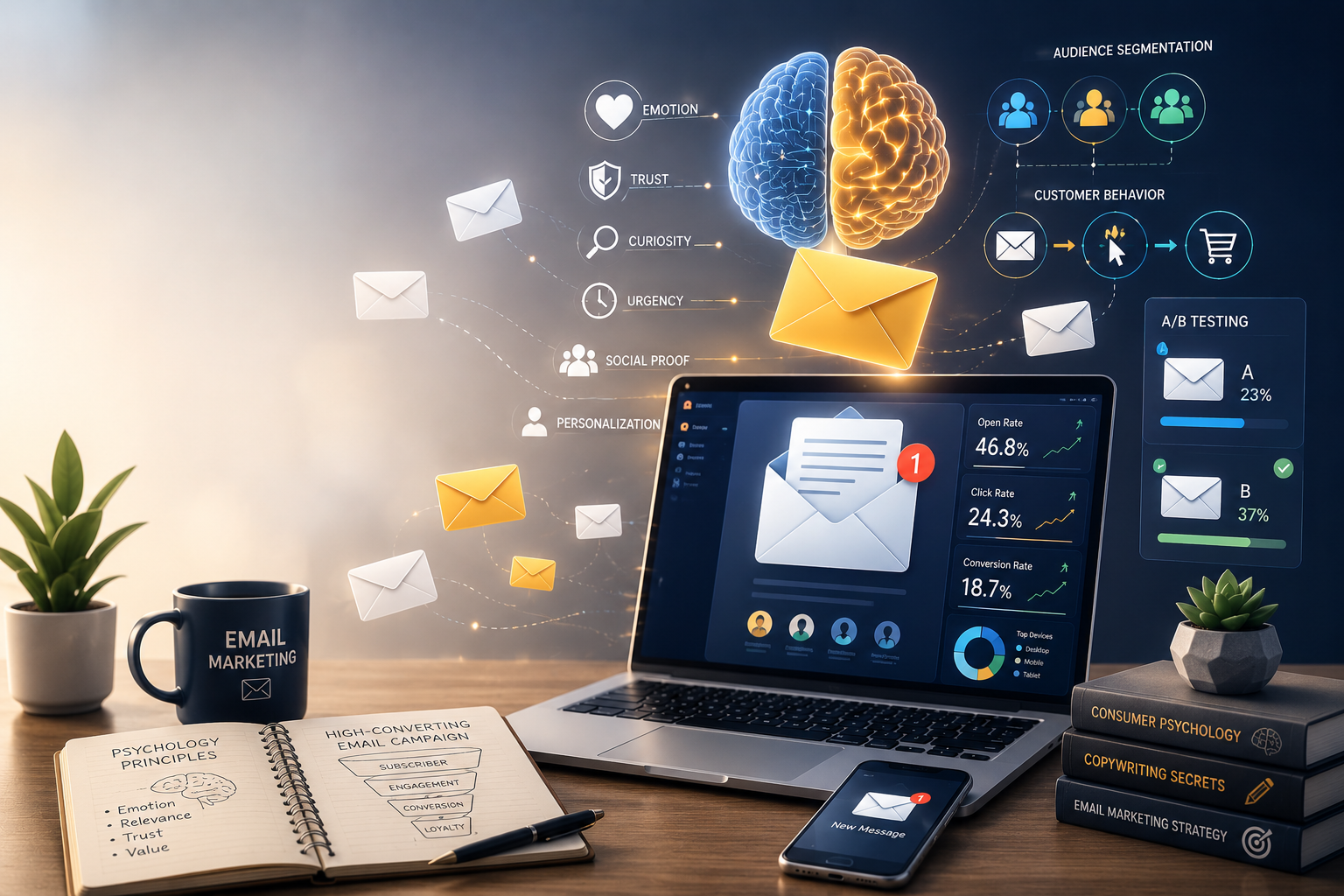
In an era dominated by algorithmic social media feeds and fleeting video trends, email marketing remains the uncontested king of ROI. It yields an average return of $36 for every $1 spent. But what separates the emails that get instantly deleted—or worse, marked as spam—from the ones that generate millions in revenue?
The answer isn’t a secret design layout or a hyper-optimized sending time. It is human psychology.
High-converting email campaigns don’t just pitch products; they trigger deeply ingrained psychological mechanisms that drive human decision-making. By understanding how the brain processes information, assesses value, and responds to persuasion, you can transform your email list into your most predictable growth engine.
Here is an in-depth breakdown of the psychological principles behind high-converting email campaigns and how you can implement them today.
1. The Art of the Open: Cognitive Hooks in Subject Lines
An email cannot convert if it isn’t opened. Your subject line acts as the gatekeeper to your campaign, and winning the battle for the inbox requires leveraging key psychological triggers before the subscriber even sees your body copy.
The Curiosity Gap
Coined by George Loewenstein in the early 1990s, the Information Gap Theory suggests that when human beings experience a gap between what they know and what they want to know, it creates a feeling of deprivation. We are driven to close this gap in the same way we are driven to satisfy hunger.
- Weak Subject Line: How to improve your email open rates.
- Psychologically Hooked Subject Line: The 3-word tweak that doubled our open rates…
The second subject line creates a missing piece of information. The brain feels a subtle tension that can only be resolved by clicking “open.”
Pattern Interruption
The human brain is a prediction machine. To conserve energy, it filters out predictable stimuli—including repetitive email subject lines that look like obvious marketing pitches. A pattern interrupt breaks this automatic filtering by presenting something unexpected.
- Lowercase formatting: Sending a subject line in all lowercase (e.g., quick question about your pitch) mimics an organic email from a friend or colleague, bypassing commercial visual filters.
- Unexpected counter-intuitive statements: Stop trying to grow your email list immediately disrupts standard industry logic, forcing the reader to pause and investigate.
2. Personalization and the Cocktail Party Effect
We are biologically wired to pay attention to information that directly relates to us. In psychology, the Cocktail Party Effect describes our ability to focus on a single voice in a noisy room full of chatter—such as hearing our own name spoken across a crowded party.
Basic email personalization (like dropping {{ First_Name }} into a subject line) is no longer enough. Modern audiences have adapted to it. To trigger a genuine psychological response, personalization must extend to behavioral relevance and segmentation.
Psychological Relevance over Static Personalization
When an email reflects a user’s exact actions, pain points, or recent browsing history, it creates a sense of dynamic resonance.
- Dynamic Product Recommendations: Showing items based on exact past purchases signals to the brain: “This brand understands my preferences.”
- Lifecycle-based Messaging: Sending an onboarding email that addresses a specific feature a user hasn’t tried yet feels tailor-made rather than broadcasted.
By shifting from surface-level personalization to deep behavioral context, your emails bypass the consumer’s defensive radar and feel like personal communication.
3. Levering Scarcity and Urgency (FOMO)
Loss aversion, a concept popularized by Nobel laureate Daniel Kahneman and Amos Tversky, demonstrates that the psychological pain of losing something is twice as powerful as the pleasure of gaining it. High-converting email campaigns tap into loss aversion through scarcity and urgency.
[ Pleasure of Gaining $100 ] < [ Psychological Pain of Losing $100 ]
When an opportunity is perceived as limited, its subjective value instantly increases.
Types of Scarcity in Email Campaigns
| Scarcity Type | Psychological Driver | Example Application |
|---|---|---|
| Quantity Scarcity | Fear of missing out on limited resources | “Only 12 seats left for this cohort.” |
| Time Scarcity | Action urgency due to an impending deadline | “This 20% discount expires at midnight.” |
| Exclusivity Scarcity | Need for social status and elite access | “Early VIP access available to top 100 subscribers.” |
Avoiding the “Cried Wolf” Trap
Urgency works only when it is authentic. If you run a “Final 2 Hours!” sale every Tuesday, your audience’s brain will adapt, recognize the artificial manipulation, and lose trust in your brand. Fake urgency creates cognitive dissonance and destroys long-term customer lifetime value.
4. Social Proof and the Bandwagon Effect
When people are uncertain about what action to take, they look to others to guide their behavior. This phenomenon, known as Social Proof (popularized by Dr. Robert Cialdini in his seminal book Influence), operates on the principle that if many people are doing something, it must be the correct choice.
In email campaigns, social proof reduces perceived risk and builds instant trust.
Incorporating Social Proof Elements
- User-Generated Content (UGC): Featuring customer photos or unboxing videos in your emails validates the product in a real-world context.
- Specific Numbers: Instead of saying “Thousands of people use our tool,” state “Join 47,812 marketers who read our newsletter daily.” Specificity breeds credibility.
- Micro-Case Studies: A 2-sentence testimonial highlighting a specific, measurable result (e.g., “This framework cut our customer acquisition cost by 34%”) is exponentially more persuasive than generic praise (“Great service!”).
5. Reducing Cognitive Load: Fitts’s Law and Choice Overload
The brain constantly attempts to minimize effort. If an email requires too much mental processing—known as high cognitive load—the subscriber will default to taking no action at all.
The Jam Experiment and Choice Overload
Psychologists Sheena Iyengar and Mark Lepper conducted a famous study involving jams in a supermarket. When presented with 24 options of jam, 60% of people stopped to sample, but only 3% made a purchase. When presented with just 6 options, 30% made a purchase.
More options lead to decision paralysis.
24 Choice Options  --> High Attention (60%)  --> Low Conversion (3%)
 6 Choice Options  --> Medium Attention (40%) --> High Conversion (30%)
Designing Low-Friction Emails
- The One Primary CTA Rule: Every email should have a single, clear objective. Whether it is reading a blog post, purchasing a product, or booking a call, don’t confuse the reader with competing offers.
- Fitts’s Law: The time required to rapidly move to a target area is a function of the ratio between the distance to the target and the width of the target. Make your Call-To-Action (CTA) buttons physically large, visually distinct, and easily clickable on mobile devices.
- Inverted Pyramid Structure: Guide the reader’s visual flow naturally from top to bottom:
[  1. Strong Visual / Headline  ]
 \                             /
  \   2. Supporting Body Copy /
   \                         /
    [   3. Focused CTA Button  ]
6. The Power of Storytelling and the Hero’s Journey
Humans are hardwired for stories. Long before written language existed, knowledge, culture, and survival advice were passed down through narrative. When we hear a story, our brains undergo neural coupling, allowing us to experience the events as if they were happening to us directly.
Emails structured around narrative arcs convert far better than plain product feature lists because they engage emotional centers in the brain before appealing to rational logic.
Structuring a Narrative Email
- The Hook (The Struggle): Introduce a relatable problem or pain point your audience faces every day.
- The Conflict (The Failed Attempts): Explain why standard solutions fail, building empathy and validating their past frustrations.
- The Epiphany (The Solution): Reveal the core insight or product that changed everything.
- The Transformation (The Outcome): Paint a vivid picture of the end result—how life or business looks after applying the solution.
- The Call to Action: Direct them on how to achieve that exact transformation themselves.
When you position the subscriber as the Hero and your product/brand as the Guide (think Luke Skywalker and Yoda), you build an emotional connection that transcends price-point competition.
7. Reciprocity: Give Value Before You Ask for Action
The Rule of Reciprocity dictates that when someone gives us something of value, we feel a powerful psychological obligation to give something back in return.
If every email you send is a pushy sales pitch, your audience feels extracted from, not cared for. High-converting brands play the long game by maintaining a strategic ratio of value-driven emails to promotional emails.
The “Jab, Jab, Jab, Right Hook” Strategy
- Educational Content: Free guides, actionable strategies, industry teardowns, or curated insights.
- Delight & Entertainment: Engaging stories, unique perspective pieces, or free resources (templates, spreadsheets, checklists).
- The Ask: Once you have built psychological capital through consistent value delivery, launching a promotional email triggers the recipient’s subconscious desire to support your business.
Practical Checklist for High-Converting Emails
Before hitting send on your next campaign, run it through this psychological filter:
- [ ] Subject Line: Does it create a curiosity gap or interrupt an inbox pattern?
- [ ] Personalization: Is the content relevant to the recipient’s specific stage in the customer journey?
- [ ] Cognitive Friction: Is the visual layout clean, uncluttered, and structured with an inverted pyramid?
- [ ] Choice Isolation: Is there one primary, unmistakable Call-To-Action button?
- [ ] Social Proof: Have you included real testimonials, numbers, or user feedback to minimize risk?
- [ ] Authentic Urgency: If you’re using a timer or deadline, is it grounded in real constraints?
- [ ] Value Exchange: Does the email offer genuine insight or entertainment, even if the user chooses not to buy?
Conclusion
High-converting email marketing isn’t about tricking your audience into clicking a link. It is about understanding the fundamental drivers of human behavior—curiosity, trust, fear of missing out, narrative resonance, and cognitive efficiency—and aligning your offer with those natural instincts.
When you stop writing emails for algorithms or generic lists, and start writing for the human brain on the other side of the screen, your open rates, click-through rates, and conversions will systematically soar.