
Have you ever scrolled through social media or checked your email and wondered if anyone actually wins those massive home makeovers, luxury vacations, or $10,000 cash giveaways?
It’s easy to dismiss sweepstakes as pure, unadulterated luck. Most casual entrants treat them like a digital lottery ticket: they enter once, forget about it, and never win a thing.
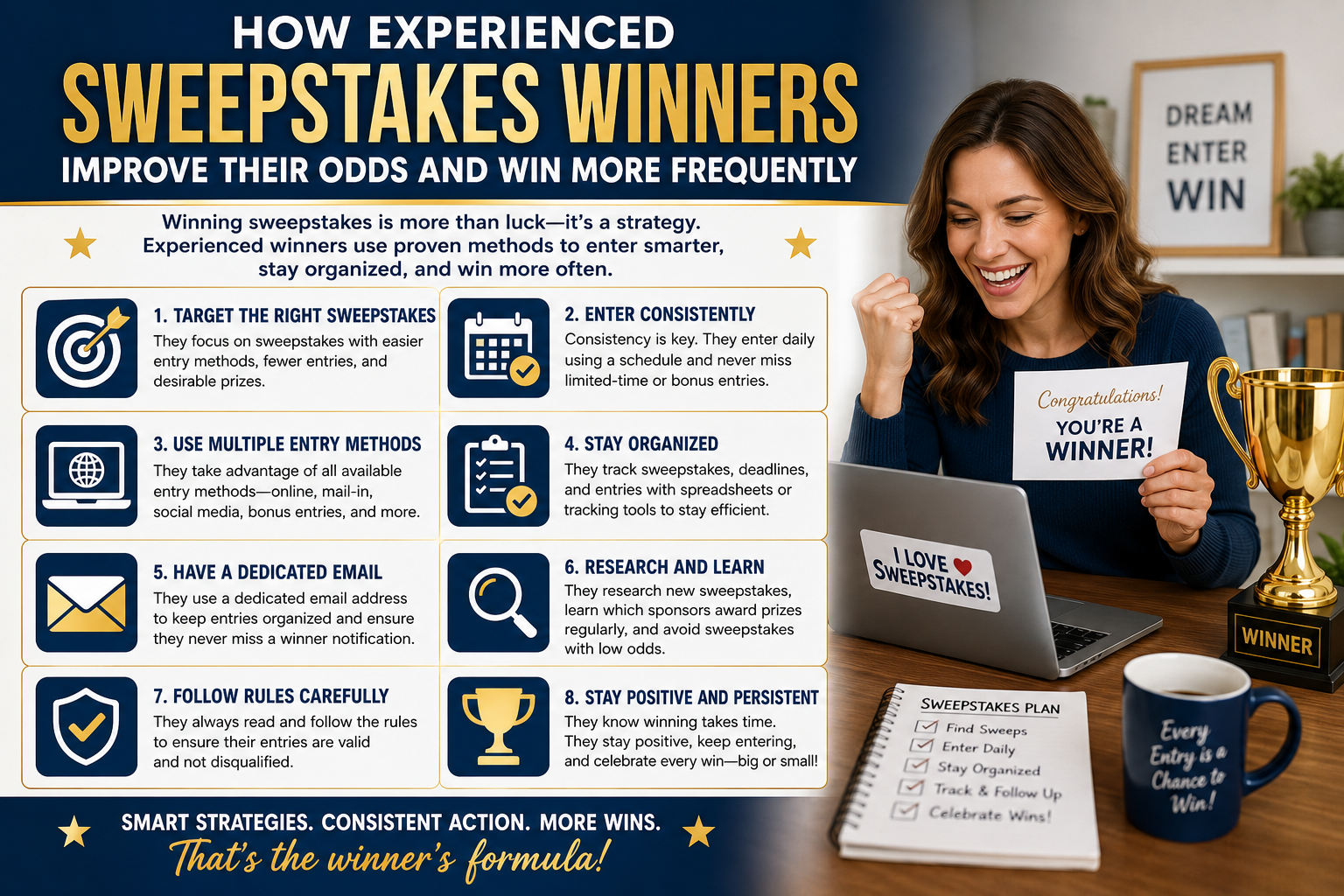
But behind the scenes of the giveaway world exists a dedicated group of hobbyists known as “sweepers.” For these experienced individuals, winning isn’t a rare stroke of cosmic luck — it’s a numbers game managed with discipline, efficiency, and strategy. They treat entering sweepstakes like a part-time job or a highly organized hobby, and their rewards include everything from free groceries and electronics to brand-new cars.
If you’re tired of filling out forms only to hear cricket sounds in return, it’s time to upgrade your approach. Let’s pull back the curtain on the exact strategies, habits, and tools that experienced sweepstakes winners use to stack the deck in their favor and win consistently.
1. The Math of Sweeping: Shifting from Luck to Probability
To understand how pros win frequently, you first have to understand the fundamental difference between a casual entrant and a strategic sweeper.
Casual entrants look at a grand prize and think, “I hope I get lucky.”
Pros look at a giveaway and ask, “What is my return on time invested (ROTI)?”
At its core, winning sweepstakes consistently relies on a basic mathematical principle: maximizing your entry volume while minimizing competition. While you can never guarantee a win in a random drawing, you can absolutely manipulate your mathematical probability of being selected.
The Power of Entry Frequency
Consider a sweepstakes that allows one entry per person per day over a 30-day period.
- The Casual Entrant: Enters once on day one. They have 1 entry in the hopper.
- The Pro Sweeper: Enters every single day. They have 30 entries in the hopper.
By simply showing up daily, the pro has multiplied their individual chances of winning by 300% compared to the casual user. When you scale this habit across hundreds of giveaways simultaneously, winning stops being an anomaly and becomes a statistical inevitability over time.
2. Choosing the Right Giveaways: Where the Pros Spend Their Time
Not all sweepstakes are created equal. One of the biggest mistakes beginners make is chasing only the massive, ultra-hyped giveaways—like the HGTV Dream Home or nationwide soda brand promotions. Because these contests receive tens of millions of entries, your individual odds are infinitesimally small, no matter how hard you try.
Experienced sweepstakes winners practice entry triage. They categorize giveaways by their barrier to entry and historical odds, focusing their energy where it yields the highest return.
[Low Effort / High Competition] ---> e.g., One-click Instagram giveaways (Millions of entries)
[High Effort / Low Competition] ---> e.g., Local radio/store contests, photo uploads (Few entries)
High-Odds Giveaway Types to Target
- Local or Regional Sweepstakes: Contests limited to specific zip codes, cities, or states have drastically smaller entry pools. A grocery store chain giveaway open only to residents of Ohio has thousands of times better odds than a giveaway open to the entire North American continent.
- Single-Entry Sweepstakes: Giveaways that strictly limit entries to one per person for the entire promotional period level the playing field. They neutralize the advantage of people with more free time, making them highly efficient for busy sweepers.
- Text-to-Win and Instant Win Games (IWGs): Instant win games give you immediate feedback. Pros love IWGs because many casual players forget to play daily, or give up after a few blank results, leaving prizes on the table—especially during odd hours of the night when traffic is low.
- High-Barrier Entry Contests: Giveaways that require you to upload a unique photo, write a short paragraph, submit a recipe, or answer a trivia question scare off 90% of casual clickers. If you are willing to put in five minutes of actual effort, your odds skyrocket because the total entry pool is incredibly small.
3. The Tech Stack: Tools and Automation for Maximum Efficiency
If you had to manually type your name, address, email, phone number, and birthdate into 50 different forms every day, you’d burn out within a week. Experienced winners rely on a streamlined digital toolkit to enter hundreds of giveaways in a fraction of the time.
Automated Form Fillers
The holy grail of efficient sweeping is form automation. Tools like RoboForm or the built-in autofill features of browsers like Google Chrome allow you to fill out complex entry fields with a single click.
A Note on Rules: Always read the official rules before using autofill tools. While standard browser autofill features are almost universally accepted, macro programs or bots that completely automate the submission process without human interaction are strictly forbidden and will get you disqualified instantly.
Dedicated Sweeping Communications
Pros never use their primary personal email address for sweepstakes. If you do, your personal inbox will quickly be buried under a mountain of marketing newsletters and promotional offers.
- Create a dedicated email account: Use a clean, professional email address (e.g., johndoewins@gmail.com) solely for your entries. This keeps your personal life organized and ensures you never miss a vital “Congratulations, you won!” notification.
- Set up a secondary phone number: Many sweepstakes require a phone number for verification or text-to-win campaigns. Consider using a free VoIP service like Google Voice to handle sweepstakes texts and calls without giving away your private mobile number.
Aggregators and Tracking Sheets
How do pros find all these contests? They don’t search Google blindly. They use curated directory sites and forums, such as:
- Sweepstakes Advantage (SA)
- SweepingAmerica
- Reddit communities like r/sweepstakes
To keep track of what they need to enter daily, weekly, or monthly, seasoned winners maintain a clean digital dashboard, often tracking their entries in a simple spreadsheet format:
| Giveaway Name | Frequency | End Date | Prize Value | Status Today |
| Local Grocery Gift Card | Daily | July 15 | $500 | Entered ✓ |
| Electronics Bundle Sweepstakes | Weekly | August 1 | $1,200 | Waiting |
| National Travel Getaway | Single | Dec 31 | $5,000 | Entered ✓ |
4. Mastery of the Fine Print: Reading Rules Like a Legal Pro
The difference between a beginner and an expert often comes down to reading the Official Rules document. Casual entrants skip it entirely; pros scan it like a contract lawyer looking for specific loopholes and parameters.
Crucial Details to Look For
- Eligibility Restrictions: Ensure your state or age group isn’t excluded. Many corporate sweepstakes exclude states with complex promotional laws like Rhode Island, New York, or Florida for high-value prizes.
- The “Mail-In” Alternative (AMOE): Under US federal law, sweepstakes cannot require a purchase to enter (this would constitute an illegal lottery). Look for the Alternative Method of Entry (AMOE) section. It will show you how to enter without buying the product—usually by mailing a handwritten index card. Pros frequently use mail-in entries because they often carry the exact same weight as a purchase-verified entry but have significantly lower participation.
- Drawing Structure: Is it one grand prize drawing at the very end, or are there rolling weekly drawings? If there are weekly drawings, entries often reset every week, meaning you need to time your inputs accordingly.
5. Security and Safety: Spotting the Scams
As you dive deeper into the world of giveaways, you will inevitably cross paths with bad actors. Scammers frequently mimic real brands to steal personal data or financial information. Experienced sweepers have a finely tuned radar for spotting fraudulent contests.
Red Flags That Signal a Sweepstakes Scam
- “You won! Now pay the processing fee/shipping costs.” Legitimate sweepstakes will never ask you to pay money, provide a credit card, or purchase a gift card to claim a prize. If there are taxes due on a major prize, they are reported directly to the IRS via a 1099-MISC form at the end of the year—not paid upfront to the sponsor.
- Vague Official Rules: Real giveaways always have a link to comprehensive official rules detailing the sponsor’s corporate identity, start/end dates, odds of winning, and prize retail values. If a giveaway consists only of an Instagram post saying “Tag 3 friends to win a MacBook,” without a link to real terms, tread carefully.
- Requests for Sensitive Personal Information: While it’s normal for a sweepstakes form to ask for your name, birthdate, and email, they do not need your Social Security Number, bank account details, or account passwords just to enter. (Note: Real corporate sweepstakes will ask for an SSN after you win a prize valued over $600 for tax compliance, but never on the initial entry form).
6. The Psychological Game: Consistency Over Instant Gratification
The hardest part of becoming a successful sweeper isn’t tracking data or filling out forms—it’s managing your own expectations.
Sweeping functions on a delay. The forms you fill out today might not draw a winner for three to six months. Beginners often enter aggressively for two weeks, don’t see an immediate influx of prizes, declare the whole thing a scam, and quit.
Cultivating the Winner’s Mindset
Pros approach sweeping with a mindset of detached consistency. They build a daily routine—perhaps 20 minutes over morning coffee or right before bed—where they systematically run through their tracker, hit their daily entries, and move on with their day.
They treat wins as a pleasant bonus rather than an immediate expectation. By taking emotional desperation out of the equation, they build a sustainable hobby that inevitably bears fruit over months and years.
Key Takeaways
- Treat Volume as Your Variable: Consistency beats luck. Entering a 30-day giveaway daily gives you thirty times the chance of a one-time entry.
- Diversify Your Targets: Don’t just chase million-dollar cash grand prizes. Balance your portfolio with high-odds local contests, instant win games, and high-barrier creative entry competitions.
- Build an Efficient System: Protect your daily schedule and your primary inbox by using browser autofill tools, dedicated sweepstakes email accounts, and structured tracking spreadsheets.
- Audit the Rules: Always check the fine print for geographic eligibility, entry limits, and alternative no-purchase methods of entry.
- Never Pay to Play: Real sweepstakes are completely free to enter and claim. If a promoter asks for a processing fee or banking info upfront, walk away immediately.
Frequently Asked Questions (FAQ)
Are online sweepstakes actually real?
Yes, they are completely real. Corporations use sweepstakes as a highly regulated marketing strategy to generate brand awareness, build email lists, and engage consumers. Because they are strictly regulated by federal and state consumer protection laws, companies face massive legal penalties if they do not award the advertised prizes.
Will I have to pay taxes if I win a big prize?
In the United States, sweepstakes prizes are treated as ordinary income by the IRS. If you win a prize valued at $600 or more, the sponsor will issue you a 1099-MISC tax form, and you will be responsible for paying income tax on the Fair Market Value (FMV) of that prize when you file your annual taxes.
How long does it take to start winning consistently?
Most experienced sweepers state that it takes roughly 3 to 6 months of daily, consistent entering before a steady stream of wins begins to arrive. This is due to the natural lag time between when a sweepstakes closes and when the random drawing is conducted and verified.
Can I use software bots to enter sweepstakes for me automatically?
No. Using automated bots, scripts, or mass-entry software is a violation of almost every giveaway’s official terms. Corporate verification systems can easily detect bot behavior, which will result in your entries being blacklisted and disqualified without your knowledge. Stick to standard browser autofill tools like RoboForm, which still require manual human oversight.
Why do some sweepstakes exclude residents of specific states?
States like New York, Florida, and Rhode Island have unique, stringent laws requiring companies to register and bond sweepstakes with high-value prize pools before they open. To avoid the expensive bureaucratic costs and paperwork, many smaller brands simply choose to exclude residents of those specific states from participating.
Ready to Turn Odds Into Prizes?
Winning sweepstakes isn’t an exclusive club reserved for a lucky few. It’s an accessible, rewarding hobby that honors patience, strategy, and organization. By shifting your focus toward local promotions, establishing a dedicated digital toolkit, and maintaining a steady daily entry rhythm, you can transform your relationship with online giveaways from a hopeful gamble into a proven winning system.
Set up your new dedicated sweeping email account tonight, find three local or single-entry contests, and take your first step toward your next big win!