
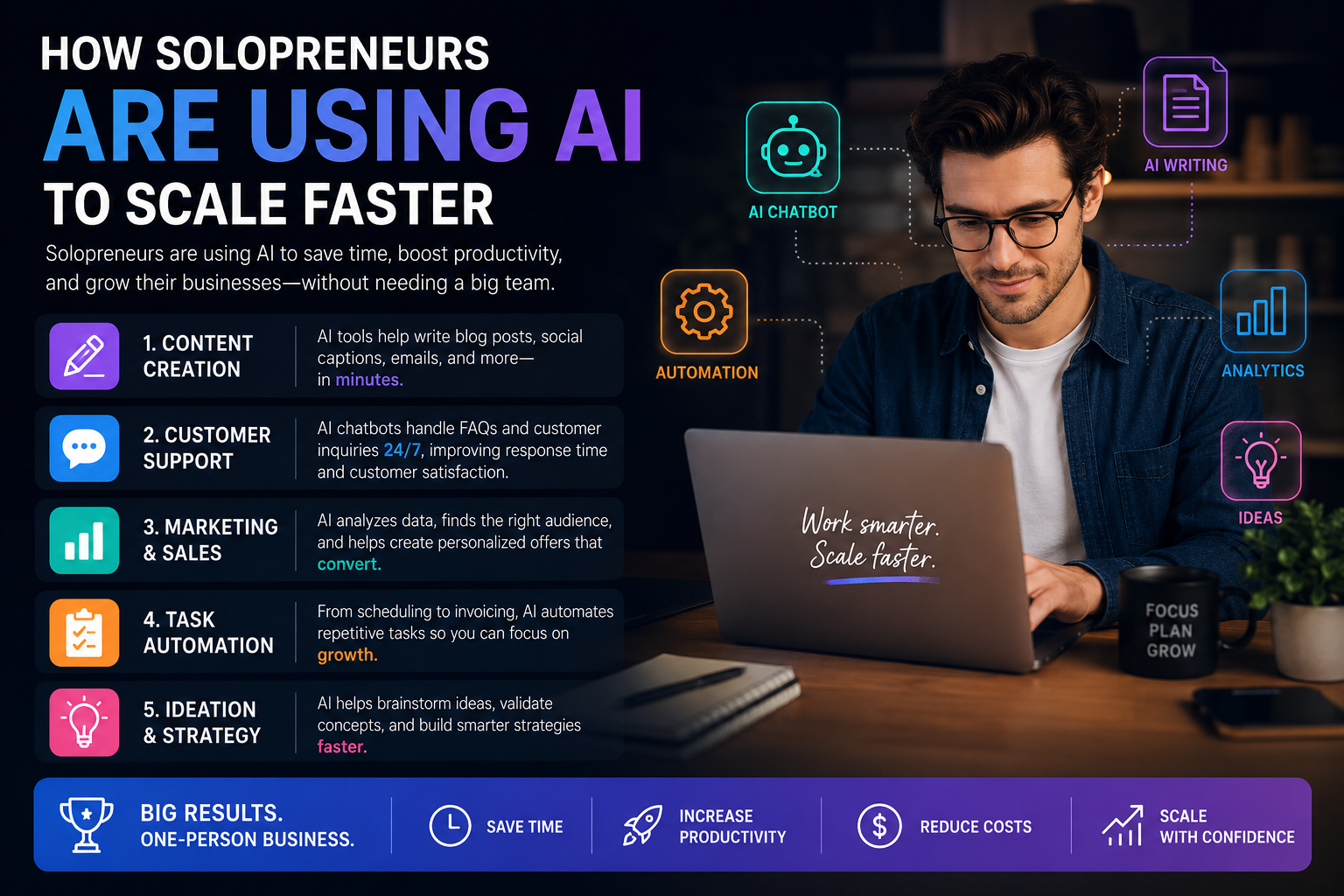
There was a time when scaling a business required a predictable playbook: validate a product, raise capital, and hire a team. If you wanted to double your revenue, you usually had to double your headcount.
Not anymore.
We are living in the era of the “One-Person Unicorn.” Thanks to the rapid maturation of artificial intelligence, solo founders, freelancers, and marketers are achieving operational scales that previously required entire departments. According to recent venture capital studies, the average revenue per employee at tech startups has skyrocketed, driven entirely by lean teams using automated systems.
For a solopreneur, AI is not just a glorified spellchecker or a basic chatbot. It is a fractional Chief Marketing Officer, an automated operations manager, a junior software developer, and a 24/7 customer support desk—all wrapped into an affordable software stack.
If you are running a business alone and feel hit by a growth ceiling, this guide will show you exactly how the world’s most successful solo founders are leveraging AI to work smarter, move faster, and build highly profitable, scalable empires.
Table of Contents
- The New Math of Solopreneurship
- Automating Content Engines and Organic Marketing
- Hyper-Personalized Sales and Lead Acquisition
- Streamlining Operations, Bookkeeping, and Admin
- Developing Products and MVPs Without Code
- The Human-in-the-Loop Framework: Avoiding the AI Trap
- Key Takeaways
- Frequently Asked Questions (FAQs)
- Conclusion: Your 30-Day AI Action Plan
1. The New Math of Solopreneurship
Historically, the biggest bottleneck for any solopreneur was time. There are only 24 hours in a day, and when you are responsible for product development, sales, invoicing, marketing, and customer service, you eventually hit a wall. You become trapped in your business rather than working on it.
AI shifts the paradigm from labor-leverage to code-leverage.
Instead of managing people, modern solopreneurs manage workflows. They build digital assembly lines where AI handles the heavy lifting, leaving the human founder to act as the ultimate editor, strategist, and creative director.
Consider the statistical shift: A recent survey of small business owners revealed that entrepreneurs utilizing advanced AI tools save an average of 12 to 15 hours per week. That is nearly two full workdays reclaimed—time that can be reinvested into high-level strategy, product innovation, or resting to prevent the dreaded solo-founder burnout.
2. Automating Content Engines and Organic Marketing
Organic content marketing is one of the most effective ways to build a brand, but it is notoriously exhausting. Writing blog posts, scripting videos, designing graphics, and scheduling social media can easily swallow a solopreneur’s entire week.
Smart solopreneurs are beating this bottleneck by using a “Hub and Spoke” AI content model.
H3: From One Pillar to Fifty Assets
Instead of creating dozens of unique social posts from scratch, a founder can record a single, high-quality 15-minute video or podcast episode (the Hub).
Using specialized AI video and audio platforms, that single piece of content can be automatically broken down into:
- Optimized blog posts with clean formatting.
- Dozens of short-form vertical videos (Reels, TikToks, Shorts) complete with engaging, kinetic subtitles and auto-framed visuals.
- A week’s worth of LinkedIn reflections, X threads, and newsletter summaries.
H3: Real-World Application: The Content Omnipresence
Imagine you run a solo consulting business. By spending one hour on a Monday recording a deep-dive video into a client case study, AI tools can instantly map out an entire month of promotional material.
The secret to ranking on search engines and standing out on social media is ensuring the original “Hub” content is filled with your unique, first-hand data and stories. The AI simply acts as a distribution amplifier, translating your raw expertise into platform-native formats.
3. Hyper-Personalized Sales and Lead Acquisition
Cold outreach has traditionally been a numbers game: send 500 generic emails and hope for a 1% response rate. However, modern buyers are completely blind to copy-and-paste templates. They demand personalization, which normally takes hours of research per lead.
AI bridges this gap by enabling personalized outreach at scale.
H3: Intelligent Prospecting
Solopreneurs are using advanced sales intelligence platforms that scan the web, LinkedIn, and corporate websites to understand a prospect’s current challenges, recent achievements, or company news.
The AI then drafts a highly specific, tailored introductory email. It might mention a recent article the prospect wrote or a specific feature flaw on their website, and explain exactly how the solopreneur can help.
[Traditional Approach]
Generic Email Sent to 1,000 People -> 5 Responses -> 0 Sales

[The AI-Driven Approach]
Deeply Tailored AI Outreach to 100 Highly Targets -> 25 Responses -> 5 Sales
By focusing on precision over raw volume, solo operators can successfully compete with enterprise sales teams without spending thousands of dollars on outbound SDRs (Sales Development Representatives).
4. Streamlining Operations, Bookkeeping, and Admin
The invisible killer of startup momentum is administrative friction. Sorting through receipts, categorizing expenses, updating CRM data, and managing calendars can drain a founder’s creative energy.
H3: The Zero-Admin Business
AI automation platforms (like Zapier or Make) allow disparate software systems to “talk” to one another and make intelligent decisions based on data.
For example, when a new client signs a contract, an automated AI workflow can instantly:
- Create a dedicated project folder in cloud storage.
- Generate and send an onboarding invoice via QuickBooks or Stripe.
- Draft a personalized welcome email containing their unique scheduling link.
- Set up their profile in a project management tool like Notion or Asana.
On the financial front, AI-powered bookkeeping tools automatically scan invoices, match receipts to transactions, predict tax liabilities, and flag anomalies. What used to require a part-time bookkeeper and hours of manual data entry is now reviewed and approved by the solopreneur in a 10-minute weekly dashboard check.
5. Developing Products and MVPs Without Code
Historically, if a non-technical entrepreneur had a great idea for a software app or digital product, they faced two expensive paths: find a technical co-founder or spend tens of thousands of dollars hiring a software agency.
AI code-generation assistants and advanced “no-code” platforms have democratized product development completely.
H3: Building Software in Natural Language
Today, non-technical solopreneurs are building fully functional MVPs (Minimum Viable Products) simply by describing what they want in plain English.
AI code tools can generate clean HTML, CSS, JavaScript, or Python backend architecture on command. If an error pops up, the founder simply pastes the error back into the AI window, and it debugs itself.
Case Study Example: Many solo founders have built profitable Micro-SaaS (Software as a Service) products in under a weekend. By utilizing AI to write the foundational code and structural layouts, they launched on platforms like Product Hunt within days, securing recurring subscription revenue before ever hiring an engineer.
6. The Human-in-the-Loop Framework: Avoiding the AI Trap
With all this incredible power at your disposal, it is vital to avoid a massive trap: becoming lazy.
As AI tools become more accessible, the internet is getting flooded with generic, low-effort, robotic content. Google’s search algorithms and modern audiences are highly sophisticated; they can spot copy-and-paste AI writing from a mile away, and they actively penalize it.
To successfully scale, you must implement a Human-in-the-Loop framework.
Step 1: Human Strategy (You define the unique angle, data, and voice)
       ↓
Step 2: AI Execution (The tool drafts, formats, or processes the data)
       ↓
Step 3: Human Curation (You edit, add personal anecdotes, and inject real empathy)
AI should handle the formatting, initial drafting, and structural organization. You must provide the soul, the contrarian opinions, the industry experience, and the emotional resonance.
AI can write a paragraph, but it cannot share the painful lesson you learned from losing your first major client. That human element is your ultimate moat against commoditization.
7. Key Takeaways
- Headcount Is No Longer a Metric of Success: True business leverage comes from building automated workflows, allowing solo founders to hit high revenue targets without high expenses.
- Content Multiplication Saves Time: Focus on creating one exceptional, original piece of content weekly, and let AI atomize it across platforms.
- Outreach Must Be Surgical: Use AI sales tools to research and hyper-personalize your business development, choosing high-conversion precision over low-conversion spam.
- Maintain Your Human Edge: Always use the Human-in-the-Loop model. Use AI to build the foundation, but always edit, refine, and infuse your unique human perspective into everything your business publishes.
8. Frequently Asked Questions (FAQs)
Q1: Will using AI tools harm my website’s Google ranking?
No, not if done correctly. Google’s official guidelines state that they reward high-quality, helpful content that demonstrates E-E-A-T (Experience, Expertise, Authoritativeness, and Trustworthiness), regardless of how it is produced. However, automated text pasted without human editing or real-world value is flagged as spam. Always edit your AI outputs to ensure real-world utility.
Q2: What is the minimum budget a solopreneur needs for an effective AI tech stack?
You can build a remarkably powerful AI system for under $100 to $150 a month. A premium conversational LLM subscription, an automation platform seat, and a specialized marketing tool are often all you need to handle marketing, operations, and basic admin tasks on autopilot.
Q3: How do I protect my proprietary business data when using AI?
This is a critical security step. When using major AI models, check the settings menu and turn off “Data Training” or history sharing. For highly sensitive operations, look for enterprise-level or API-driven accounts, which explicitly guarantee that your custom business inputs are never used to train public models.
Q4: I am completely non-technical. Can I really use AI to build software or automations?
Yes. Modern AI tools are built entirely around natural language interfaces. If you can clearly explain your business process or product concept to another human being over a cup of coffee, you have all the communication skills needed to prompt an AI system effectively.
Q5: What tasks should a solopreneur never delegate to AI?
Never outsource core strategic vision, sensitive high-stakes relationship building, or deep empathetic customer crisis resolution to an AI. While tools can support your customer service queues, the final, high-impact human touches are what build long-term brand loyalty.
9. Conclusion: Your 30-Day AI Action Plan
Scaling your solopreneur business through artificial intelligence doesn’t require an overnight overhaul of your entire operation. Trying to automate everything at once is a fast track to tech fatigue.
Instead, take a systematic, 30-day approach:
- Identify Your Largest Time Sink: Track your time for one week. Pinpoint the one repetitive, frustrating task that drains your calendar—whether it’s editing social clips, formatting invoices, or drafting cold proposals.
- Deploy One Tool to Solve It: Dedicate week two to integrating a single AI tool to handle that specific bottleneck. Master it until it runs smoothly.
- Audit and Polish: Review the output consistently to inject your personal brand voice and style guidelines.
- Repeat: Once that task is safely offloaded, move on to your next operational bottleneck.
By methodically turning manual tasks into automated, AI-driven workflows, you will steadily transition from an overworked freelancer into a highly leveraged, infinitely scalable solo founder. The tools are ready when you are.