
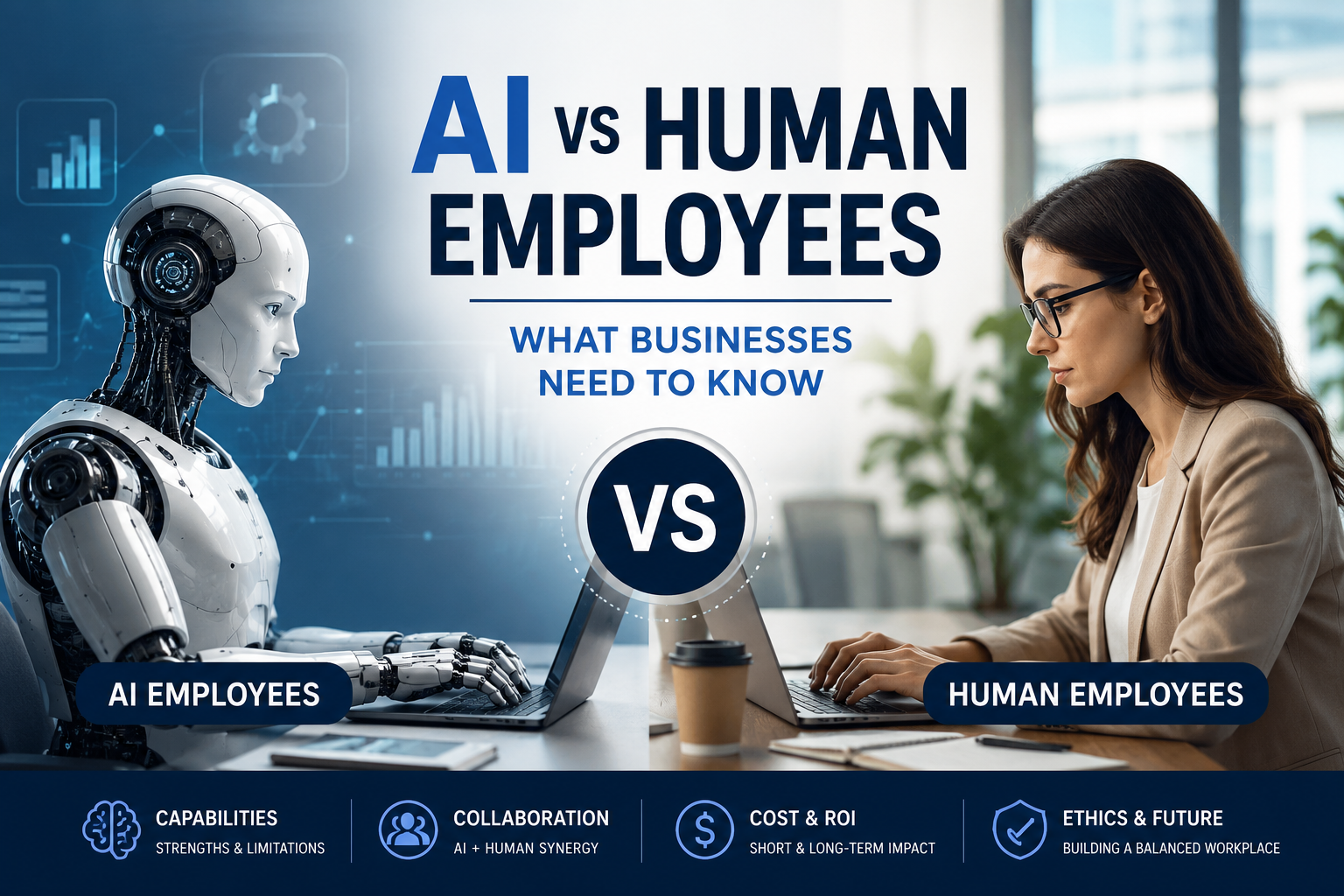
The narrative surrounding Artificial Intelligence (AI) in the business world usually defaults to extremes. On one side, tech futurists promise an automated utopia where lean startups achieve billion-dollar valuations with little more than an API key and a handful of prompts. On the other, critics warn of a dystopian displacement of human talent, leaving empty desks in its wake.
For entrepreneurs, startup founders, freelancers, and marketers, neither extreme is helpful.
The reality on the ground is far more nuanced. AI isn’t a magical replacement for human ingenuity, nor is it a passing fad you can afford to ignore. It is a fundamental shift in how work gets done. The businesses that thrive over the next decade won’t be those that blindly automate everything, nor will they be the ones that stubbornly resist technological change. Success belongs to the leaders who understand the distinct strengths of both AI and human employees—and design a workflow where they augment one another.
Table of Contents
- The State of the Modern Workforce
- Where AI Excels: The Core Strengths of Automation
- The Irreplaceable Human: Skills AI Cannot Replicate
- A Side-by-Side Comparison: Cost, Speed, and Reliability
- Real-World Applications: Finding the Sweet Spot
- The Hybrid Workflow Strategy: How to Integrate Both
- Key Takeaways
- Frequently Asked Questions (FAQs)
- Conclusion and Actionable Advice
The State of the Modern Workforce
We are no longer discussing the future of work; we are living it. Recent data indicates that over 80% of enterprise leaders have already integrated some form of generative AI into their daily operations. From drafting marketing copy to predicting supply chain bottlenecks, algorithms are handling tasks that previously required thousands of human hours.
However, this rapid adoption has exposed critical limitations. High-profile blunders—ranging from AI chatbots giving hallucinated legal advice to algorithms generating culturally tone-deaf marketing campaigns—have forced businesses to rethink their approach.
The initial rush to replace headcount with software is giving way to a more mature strategy: workforce optimization. Leaders are realizing that while software can handle the mechanics of a task, humans must still provide the meaning.
Where AI Excels: The Core Strengths of Automation
To deploy AI effectively, you have to understand what it is built to do. AI excels at pattern recognition, data processing, and execution at scale.
1. Speed and Scale of Data Processing
A human data analyst might spend a week cleaning a dataset, building pivot tables, and identifying trends. An AI engine can ingest millions of data points, cross-reference them with historical patterns, and output actionable insights in seconds. For startups trying to find product-market fit or marketers optimizing ad spend in real time, this velocity is a massive competitive advantage.
2. Routine and Repetitive Tasks
Every business is bogged down by administrative friction: invoicing, scheduling, basic customer service queries, and sorting data. These tasks drain human energy. AI thrives in these environments because it doesn’t get bored, drop its attention to detail, or suffer from fatigue.
3. Continuous Availability
An AI system doesn’t sleep, take parental leave, or require weekends off. It operates 24/7/365. For a small business with global aspirations, deploying an AI-driven customer support or lead triage system ensures that an inquiry from Tokyo at 3:00 AM local time is handled instantly.
The Irreplaceable Human: Skills AI Cannot Replicate
Despite the massive capabilities of large language models and neural networks, they lack the foundational traits that make human workers indispensable.
1. True Contextual Understanding and Empathy
AI can mimic empathy. It can read a customer service ticket, identify negative sentiment words, and generate a response that says, “I understand your frustration.” But it doesn’t actually understand.
Humans possess emotional intelligence (EQ). A human account manager can pick up on the subtle hesitation in a client’s voice during a Zoom call, read between the lines of a brief email, and pivot their strategy based on unexpressed anxieties. That contextual nuance is the bedrock of long-term business relationships.
2. Genuine Creativity and Innovation
AI is inherently derivative. It generates outputs based on the statistical probabilities of its training data. In other words, it predicts what should come next based on what has already happened.
True innovation requires breaking patterns, drawing unexpected parallels between unrelated industries, and taking calculated creative risks. A human marketer can draw inspiration from a childhood memory, an obscure indie movie, and a completely different niche to build a viral, mold-breaking campaign. AI cannot invent a new paradigm; it can only optimize an existing one.
3. Ethics, Nuance, and Accountability
When an AI model makes a catastrophic error—such as leaking proprietary client data or generating biased outputs—the software cannot take responsibility. It cannot stand in front of a board of directors, a regulatory body, or a furious client to explain its intent. Businesses require human oversight to navigate complex ethical landscapes, ensure regulatory compliance, and accept accountability for outcomes.
A Side-by-Side Comparison: Cost, Speed, and Reliability
When building out your organizational chart, it helps to compare these two forces across core operational metrics.
| Metric | AI Systems | Human Employees |
| Operational Speed | Near-instantaneous execution. | Variables based on complexity and cognitive load. |
| Scalability Cost | Flat or incremental API costs; highly predictable. | Step-function costs (salaries, benefits, onboarding). |
| Adaptability | Requires explicit training data or structural tuning. | High; can pivot instantly based on abstract instructions. |
| Error Dynamics | Rare systemic errors, but prone to bizarre hallucinations. | Human error occurs, but easily mitigated by common sense. |
| Creative Input | Synthesis of existing information; pattern-matching. | Authentic innovation, original perspectives, emotional depth. |
Real-World Applications: Finding the Sweet Spot
Let’s look at how specific roles are evolving to see how this balance plays out in practice.
Marketing and Copywriting
- The AI Role: Generating high-volume ad variations, brainstorming initial content outlines, translating copy into multiple languages, and optimizing meta descriptions for SEO.
- The Human Role: Setting the overarching brand voice, conducting original interviews, inserting proprietary insights, and editing the content to ensure it resonates on a deeply human level.
- The Result: A single human editor utilizing AI can produce three times the volume of high-quality, research-driven content compared to a traditional writer working from scratch.
Customer Support and Success
- The AI Role: Answering common, Tier-1 FAQs (e.g., “Where is my order?”, “How do I update my password?”).
- The Human Role: Stepping in when a customer is angry, dealing with complex edge cases that don’t fit standard documentation, and proactively building relationships with high-value accounts.
- The Result: Support queues drop dramatically, allowing human agents to spend high-quality time resolving complex issues rather than repeating basic instructions.
The Hybrid Workflow Strategy: How to Integrate Both
If you want to maximize efficiency without losing your company’s soul, you need a framework for integration. Stop asking, “Can AI do this job?” Start asking, “Which components of this job should be handed to an algorithm, and which require a human touch?”
Step 1: Map Your Workflows
Break down your core business processes into discrete steps. Identify the bottlenecks. If your sales team spends 40% of their time researching leads and drafting cold emails, that is an obvious candidate for automation.
Step 2: Implement the “Human-in-the-Loop” Model
Never let AI publish content, ship code, or interact with sensitive client data without human verification. Design a pipeline where AI generates the first draft or initial data model, and an expert human reviews, refines, and approves the final output.
Step 3: Upskill Your Existing Talent
The biggest risk to your business isn’t AI replacing your workers; it’s your workers being outpaced by competitors who use AI. Provide your team with the training, tools, and psychological safety to experiment with these tools. Encourage them to automate the mundane parts of their roles so they can focus on high-leverage strategic initiatives.
Key Takeaways
- Complement, Don’t Replace: The goal of modern business automation is not a zero-headcount organization; it’s an empowered, highly leveraged team.
- Context Over Content: AI can produce an infinite amount of text, code, and imagery, but humans must provide the intent, guardrails, and strategic context.
- Efficiency Drives Growth: By offloading repetitive operational tasks to software, small teams and freelancers can compete with enterprise-level operations.
- E-E-A-T Still Rules: Search engines and consumers are getting better at spotting generic AI content. Original human experience, expertise, authoritativeness, and trustworthiness remain your primary competitive advantages.
Frequently Asked Questions
1. Will AI completely replace human employees in the next few years?
No. While AI will radically redefine specific tasks within jobs, it will not eliminate the need for human workers. Roles that depend heavily on data entry, basic transcription, or repetitive sorting will shrink, but demand will increase for professionals who can manage AI systems, think strategically, and manage relationships.
2. How can a small business afford to implement advanced AI?
You don’t need a massive engineering budget to leverage AI. Most modern software-as-a-service (SaaS) platforms—from CRMs like Salesforce and HubSpot to creative suites like Adobe and Canva—have robust, native AI features built right into their standard tiers. Additionally, tools like ChatGPT Plus, Claude, and Zapier allow small teams to build custom automations for a nominal monthly fee.
3. What are the legal risks of using AI for business operations?
The primary risks center around copyright, data privacy, and intellectual property. Generative AI models can occasionally output plagiarized snippets or infringe on existing patents. Furthermore, inputting sensitive client information or proprietary source code into public AI models can violate data protection laws (like GDPR or CCPA). Always use enterprise-grade AI tools that guarantee data privacy.
4. How do clients feel about businesses using AI?
It depends entirely on transparency and results. Clients care about quality, speed, and accuracy. If you use AI to draft an initial project framework but deliver an exceptional, customized final product, clients will appreciate the efficiency. However, if you pass off unedited, generic AI outputs as custom, high-ticket work, you will quickly destroy client trust.
5. What skills should employees focus on to stay relevant?
Professionals should focus on developing “durable skills” that software cannot easily copy. These include critical thinking, complex problem-solving, prompt engineering (learning how to direct AI tools effectively), leadership, and advanced emotional intelligence.
Conclusion and Actionable Advice
The debate of AI vs. human employees is framed as a battle, but it is actually a partnership. AI provides the leverage; humans provide the direction.
If you want to future-proof your business starting today, don’t wait for a perfect corporate policy or an all-in-one software solution. Start with one small, repeatable bottleneck in your workflow. Automate it. Monitor the results. Use the time your team saves to invest back into deep strategic thinking, product development, or building deeper connections with your customers.
The future belongs to the augmented business. Make sure yours is one of them.