
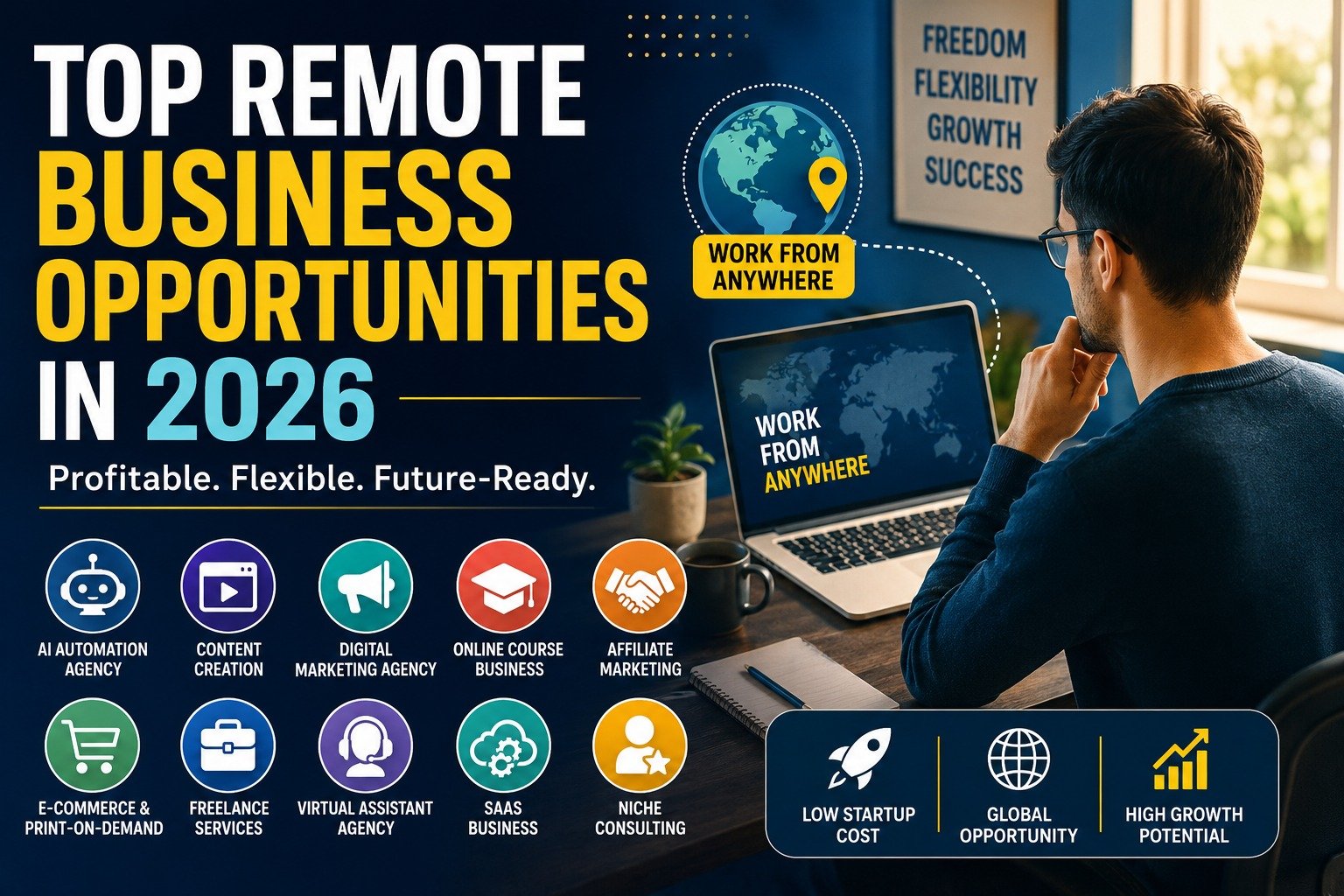
The landscape of remote work has officially moved past the trial phase. In 2026, building a digital business is no longer just about avoiding a daily commute or working from a coffee shop. It is about tapping into a highly stabilized, globally distributed economy. Recent data from Gallup indicates that 53% of remote-capable workers have settled into hybrid structures, while 27% operate entirely remotely.
For entrepreneurs, startup founders, and freelancers, this structural shift creates massive market gaps. Businesses are actively hunting for specialized, decentralized partners who can streamline workflows, secure distributed networks, and scale digital content.
If you want to build a highly profitable, location-independent company this year, you need to target industries where demand heavily outpaces supply. This guide breaks down the top remote business opportunities in 2026, complete with real-world applications, data, and execution strategies.
Table of Contents
- AI Automation Agencies (AAA)
- Fractional Operations and Fractional Leadership
- Niche Cybersecurity Consulting for Distributed Teams
- B2B High-Ticket Content Repurposing Hubs
- Micro-SaaS and Specialized Digital Template Marketplaces
- Key Takeaways for Launching in 2026
- Frequently Asked Questions (FAQs)
- Conclusion: Your Actionable Launch Plan
1. AI Automation Agencies (AAA)
The initial hype surrounding basic generative tools has evolved into a practical corporate mandate. In 2026, businesses are moving toward “agentic AI”—systems capable of managing complex, multi-step operations with minimal human oversight. According to a recent tech landscape study by the U.S. Chamber of Commerce, there is a massive surge in demand for specialists who can build, train, and deploy customized internal tools.
An AI Automation Agency does not just write copy or generate generic images. It designs structural systems that connect software stacks, automate data pipelines, and eliminate manual admin tasks.
Real-World Application
Imagine a mid-sized real estate firm handling hundreds of inbound property inquiries daily. A standard CRM setup requires manual data entry, human sorting, and delayed follow-ups.
An AAA steps in to build a custom agentic workflow: An inbound email triggers an AI agent that extracts client preferences, cross-references internal databases via API, drafts a hyper-personalized response, schedules a viewing in the agent’s calendar, and updates the CRM—all in under 60 seconds without human intervention.
How to Monetize
Instead of chasing one-off project fees, successful AAAs operate on a monthly retainer model ($2,500 to $7,500+ per month) to continuously monitor, optimize, and update automated workflows as enterprise software ecosystems evolve.
2. Fractional Operations and Fractional Leadership
Startups and mid-market companies frequently find themselves in a structural trap: they outgrow their early-stage processes but lack the capital to hire a full-time, six-figure Chief Operating Officer (COO) or Chief Marketing Officer (CMO). This friction has fueled the explosive rise of fractional leadership businesses.
As a fractional executive, you provide elite, strategic oversight to multiple non-competing businesses simultaneously, working entirely from your home office.
The Shift to Outcome-Based Metrics
Corporate culture has fundamentally broken up with “butts-in-seats” time tracking. Research from organizations like Splashtop highlights that 2026 workplace performance is judged entirely on outcome-based frameworks. Founders care about efficiency, pipeline health, and system scaling—not how many hours you spend logged into Slack.
[Early-Stage Startup] ──> Needs Executive Strategy ──> Cannot Afford $200k+ Full-Time Salary
                                                               │
                                                               ▼
                                                  [Your Fractional Service]
                                            (10 Hours/Week at $5,000/Month Retainer)
Real-World Application
A bootstrap e-commerce brand scaling from $1 million to $5 million in annual revenue needs an automated inventory system and data-driven logistics management. A fractional COO steps in for 5 to 10 hours a week, audits their supply chain, implements clean infrastructure, and leads weekly syncs, charging a steady monthly advisory fee.
3. Niche Cybersecurity Consulting for Distributed Teams
Cybersecurity is no longer just an IT department concern; it is a critical remote business vulnerability. Enterprise data networks now extend to thousands of home Wi-Fi routers and public coffee shop hotspots. IBM enterprise data shows that approximately 70% of successful data breaches originate at endpoint devices like personal laptops and smartphones.
With 75% of employees utilizing personal devices for work tasks (BYOD), small and mid-sized businesses are desperately seeking consultants to lock down their distributed data.
Services in High Demand
- Zero-Trust Network Audits: Setting up strict verification processes for every remote login.
- BYOD Hardening and MDM Deployment: Installing Mobile Device Management software to isolate corporate data on personal hardware.
- Employee Threat Simulation: Conducting targeted phishing simulations to train distributed workforces.
Target Client Profile
Focus your consulting firm on highly regulated, remote-friendly verticals like legal tech, digital health startups, and accounting firms. These industries face devastating compliance fines if a remote employee accidentally leaks client files over an unsecured network.
4. B2B High-Ticket Content Repurposing Hubs
The creator economy is projected to surge toward a value of $480 billion by 2027. However, the most lucrative segment of this ecosystem isn’t lifestyle vlogging—it is B2B corporate content. Founders, venture capitalists, and enterprise SaaS companies need to maintain constant visibility across LinkedIn, YouTube, and specialized business communities to drive inbound sales.
The issue? High-value executives have plenty of insights but zero time to edit video, format text strings, or draft multi-platform campaigns.
Moving Beyond Simple Video Editing
A premium content repurposing business takes a single source asset—such as a 45-minute executive podcast or an internal webinar—and extracts an entire month’s worth of marketing assets.
| Source Asset | Repurposed Output Deliverables |
| 45-Minute Raw Executive Video | * 4 Highly polished vertical clips (TikTok/Shorts/Reels) * 3 Deep-dive LinkedIn text carousels * 2 Long-form SEO blog posts * 1 Bi-weekly customer newsletter |
By pairing creative editors with AI-driven translation and transcription platforms (like Adobe Podcast or Descript), a small remote team can manage content engines for dozens of corporate clients simultaneously.
5. Micro-SaaS and Specialized Digital Template Marketplaces
Building a highly profitable remote business does not require a massive development team or millions in venture backing. The global productivity management software market is climbing at a compounding 14% annual growth rate. Knowledge workers are highly eager to pay out-of-pocket for specialized digital tools that eliminate friction from their workday.
The Opportunity in Micro-SaaS
Micro-SaaS businesses focus on solving a highly specific problem within an existing software ecosystem. Instead of trying to build “the next Salesforce,” you build a premium plug-in, chrome extension, or add-on for a platform that already has millions of active users.
The Rise of No-Code Marketplaces
If you are not a software engineer, the template marketplace model offers incredible passive scaling. Experts are generating significant revenue by building and selling complex, pre-configured workspaces on platforms like:
- Notion (Advanced project management frameworks for specific niches)
- Airtable (Custom databases designed for content production lines or supply chains)
- Excel / Google Sheets (Financial modeling tools for real estate investors or fractional CFOs)
Because these are purely digital products, your profit margins remain close to 95%, with zero physical inventory or shipping infrastructure required.
Key Takeaways for Launching in 2026
- Prioritize Specialized Retainers: Move away from low-cost, transactional freelancing. Position your remote business as a recurring partner with monthly retainer packages.
- Capitalize on System Integrations: The money is in the architecture. Businesses don’t just want more apps; they want their current apps to talk to each other seamlessly via AI and automation.
- Focus Heavily on High Security: As a distributed business owner, highlighting your own data security standards serves as a massive competitive advantage when pitching corporate clients.
- Productize Your Knowledge: Turn your daily services into downloadable assets, templates, or micro-SaaS applications to insulate your revenue from market fluctuations.
Frequently Asked Questions (FAQs)
1. Do I need an advanced computer science degree to start an AI Automation Agency?
No. Most modern automation architectures rely on low-code API integrators like Make.com, Zapier, and native developer environments. Success in this field relies heavily on understanding operational workflows, logical conditional mapping, and system architecture rather than writing raw syntax from scratch.
2. Why are companies hiring fractional leaders instead of traditional full-time executives?
Flexibility and cost efficiency. Hiring an elite, full-time executive requires expensive recruitment fees, equity packages, health benefits, and high base salaries. A fractional framework allows mid-sized companies to access top-tier industry minds for a fraction of the cost, paying exclusively for strategic execution.
3. How do remote service businesses find their first high-paying corporate clients?
The most reliable organic funnel in 2026 is strategic, value-first content positioning on platforms like LinkedIn. By publishing detailed case studies, breakdown breakdowns of systems you’ve built, and data-driven industry analysis, you attract decision-makers who are actively looking to solve those precise operational bottlenecks.
4. What is the average startup cost required to launch a remote business?
Many digital service models (like fractional consulting, content repurposing, or agency structures) can be launched for less than $500. Your primary initial investments will focus on baseline operational infrastructure: custom domain registration, professional email hosting, a reliable CRM tool, and specialized software access.
5. Is the remote e-commerce landscape still viable for new entrepreneurs?
Traditional, low-effort dropshipping has seen a steep decline due to extended shipping timelines and poor quality control. However, e-commerce models focusing on hyper-specialized digital products, eco-friendly private labeling, or print-on-demand setups targeted at highly passionate communities continue to see strong margins.
Conclusion: Your Actionable Launch Plan
Building a successful remote business this year requires a clean shift from generalization to specialized automation. The companies thriving right now are those that actively reduce digital friction, secure distributed operations, and help brands handle a lightning-fast digital landscape.
To get started, do not try to build every solution at once. Identify a single, acute operational bottleneck within an industry you understand intimately. Package your solution into a clear, scalable service model, build a clean structural system to back it up, and open your digital doors to a massive global marketplace.
Featured Image Generation Prompt
A modern, hyper-minimalist home workspace scene. A clean wooden desk features a high-end laptop showing abstract colorful data visualization graphs and interconnected nodes on screen. In the background, a large soft-focus window shows a subtle, bright cityscape. The lighting is warm, premium, professional, and corporate, emphasizing focus, digital connection, and sophisticated remote entrepreneurship.
Social Media Captions
🚀 The remote work debate is officially settled—and the opportunities for entrepreneurs have never been larger. In 2026, building a highly profitable online business is all about solving specific modern bottlenecks: agentic AI workflows, secure distributed systems, and fractional scaling.
We’ve put together a comprehensive, data-driven guide mapping out the absolute best remote business opportunities you can launch right now with low startup capital.
Read the full breakdown on the IdeasPros blog and discover how to transition your skills into high-ticket recurring retainers this year:
Remote work didn’t disappear; it matured. According to Gallup, 80% of remote-capable workers now operate in hybrid or fully distributed frameworks.
For founders, freelancers, and growth marketers, this creates a massive strategic opportunity. Companies are actively outsourcing specialized operations to independent partners who can optimize workflows and protect cloud data.
Our latest deep-dive on IdeasPros analyzes the top remote business models dominating 2026, including:
- AI Automation Agencies (AAA) managing agentic workflows
- Fractional Operations & Leadership frameworks
- Niche Distributed Cybersecurity Consulting
- High-Ticket B2B Content Repurposing Hubs
If you are looking to scale a location-independent company built on high-ticket retainers rather than transactional hours, this playbook is for you.