
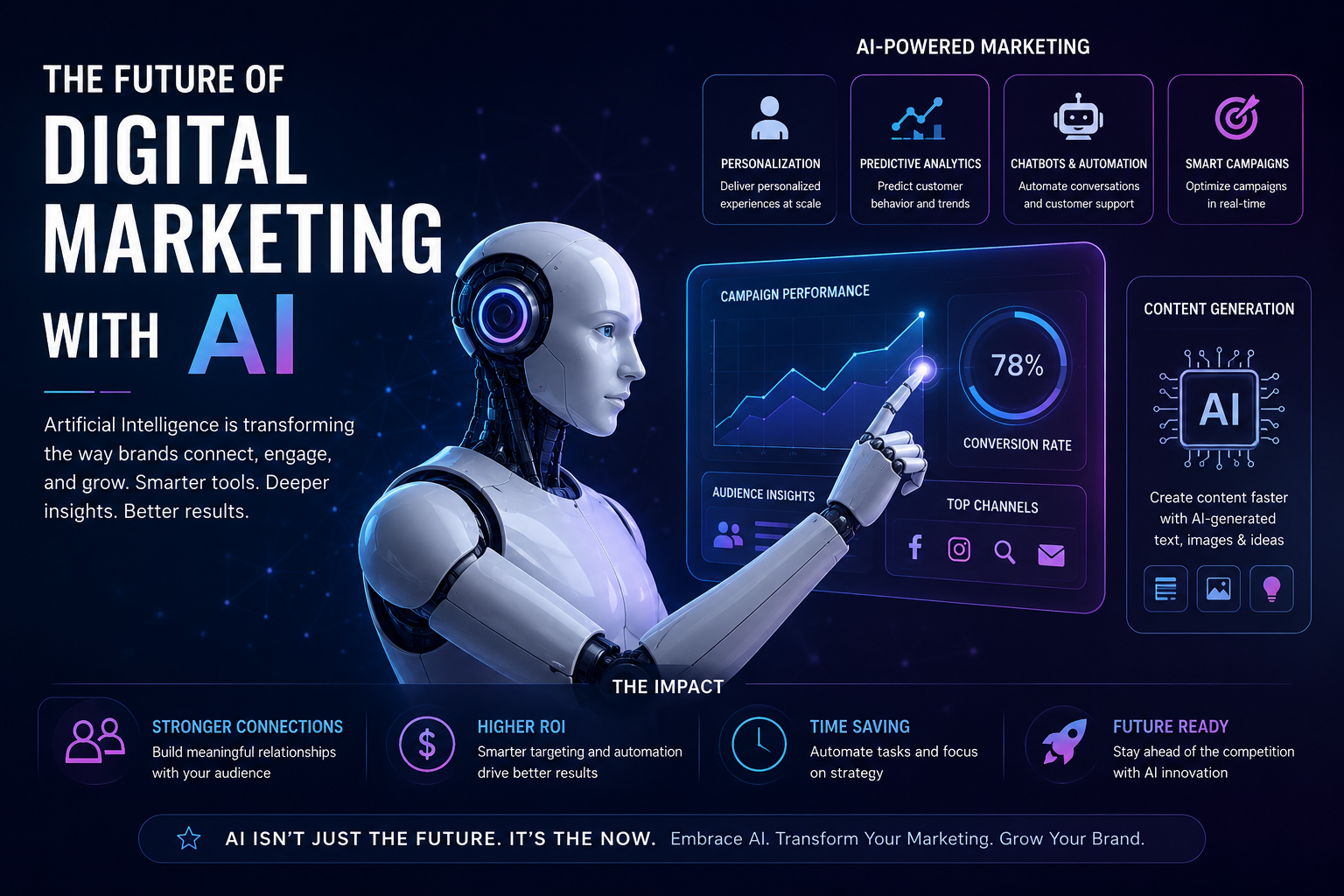
Artificial intelligence has officially evolved from an experimental tech trend into the foundational architecture of digital marketing. The days of treating AI tools as simple copy generation shortcuts or basic autocomplete features are gone. Today, machine learning algorithms and agentic workflows orchestrate entire multi-channel campaigns, predict buying intent, and shape consumer experiences.
For entrepreneurs, startup founders, freelancers, and growth marketers, this shift means the playground rules have fundamentally changed. Surviving and scaling in this landscape requires shifting your focus from simple keyword matching to building digital trust, brand authority, and dynamic personalization.
This comprehensive guide breaks down the critical trends, data points, and real-world strategies you need to master to stay ahead.
Table of Contents
- The Paradigm Shift: From Search Engines to Answer Engines
- Hyper-Personalization at Scale
- The Rise of Autonomous Marketing Agents
- Creative Disruption: Video and Interactive Content
- Navigating the Trust Economy: E-E-A-T and First-Party Data
- Key Takeaways
- Frequently Asked Questions
- Conclusion & Actionable Steps
1. The Paradigm Shift: From Search Engines to Answer Engines
The foundational layer of the internet—search—is undergoing its most disruptive transformation since the inception of Google. We are moving rapidly out of the blue-link era and into the age of the Answer Engine.
The Rise of GEO (Generative Engine Optimization)
Traditional SEO focused heavily on matching exact keywords, building backlink profiles, and optimizing meta tags to win page-one real estate. While those technical basics still matter, they are no longer enough. Platforms like Google AI Overviews, ChatGPT Search, Perplexity, and Microsoft Copilot are altering user habits. Instead of browsing through a list of fragmented websites, users are receiving direct, synthesized text responses to long, conversational queries.
According to search data, Google’s AI Overviews have contributed to an average 18% drop in organic click-through rates (CTRs) across standard searches, spiking up to 47% for purely informational queries. The user’s intent is being fully met directly on the results page.
To maintain visibility, your focus must pivot to Generative Engine Optimization (GEO). This means optimizing your content so that AI models recognize your brand as a primary source, quoting and citing you directly in their answers.
Real-World Application: AI systems prioritize real entity recognition and brand authority. To rank inside an AI summary, your content must incorporate original research, case studies, and structured data schema. Recent data from Reboot Online confirms that unambiguous brand mentions and data citations correlate far more strongly with appearing in AI search overviews than old-school domain ratings or sheer backlink numbers.
2. Hyper-Personalization at Scale
Mass email blasts and broad demographic ad targeting are rapidly losing their efficacy. Modern consumers expect brands to understand their specific problems in real time.
[Broad Demographic Groups] ➔ [AI Intent & Real-Time Tracking] ➔ [Dynamic hyper-personalized assets]
From Demographics to Predictive Intent
AI enables teams to process massive, multi-channel datasets instantly to predict future buying behavior rather than analyzing what happened last quarter.
- Dynamic Landing Pages: AI web frameworks can adjust headings, hero images, and CTA buttons on the fly based on the specific industry or past search patterns of an incoming visitor.
- Predictive Lead Scoring: Machine learning patterns analyze user interactions across your site and predict which leads have a higher likelihood of conversion, allowing sales teams to prioritize high-value prospects. According to data from Salesforce, companies utilizing AI-driven lead scoring models produce up to 50% more sales-qualified leads with less manual tracking.
- Tailored Email Experiences: Instead of sorting lists into broad buckets, AI engines write unique, dynamically shifting subject lines and body copy based on an individual reader’s past open times and clicked links. This approach yields an average 28% increase in open rates over standardized campaigns.
Real-World Example: Shopify and Amazon
Amazon’s machine learning recommendation models have long driven a massive percentage of its platform revenue by instantly computing browsing patterns and search intent. Today, that enterprise-grade capacity has been democratized. Platforms like Shopify utilize AI-powered product recommendation engines that increase average order value (AOV) by up to 26% for small-to-medium e-commerce brands, bringing advanced personalization tools to startups and indie founders.
3. The Rise of Autonomous Marketing Agents
We are transitioning away from disconnected AI tools that require manual prompt engineering for every single sentence. The current standard is built around Agentic AI—autonomous systems capable of planning, executing, and self-correcting multi-step marketing tasks.
Moving Beyond Simple Scripting
An AI assistant can write a caption if you ask it to. An AI agent, however, can look at your monthly performance data, identify a drop in engagement on a specific platform, draft five alternative ad creatives, A/B test them automatically, and reallocate ad spend based on real-time returns.
| Task Category | Traditional Workflow | Agentic AI Workflow |
| Ad Campaign Optimization | Weekly manual budget shifts and manual ad copy asset testing. | Continuous real-time adjustments to bids, creative matching, and distribution. |
| Customer Journey Tracking | Fixed drip sequences triggered by broad, static actions. | Multi-path journeys adapting dynamically to real-time interaction signals. |
| Reporting & Performance | End-of-month data export, spreadsheet parsing, and static decks. | Real-time dashboards with automatic anomaly detection and text summaries. |
Research from Forrester projects that autonomous marketing agents will reliably manage up to 40% of routine marketing execution and operations tasks, allowing small growth teams to run enterprise-scale distribution plays with minimal friction.
4. Creative Disruption: Video and Interactive Content
The economics of creative production have shifted dramatically. High-impact video content, which once required significant production budgets and complex gear, can now be executed cleanly at scale.
The Explosion of AI-Assisted Multimedia
With advanced video models like Sora, Runway, and HeyGen, the friction of scaling video channels has diminished. Data from Wistia shows a massive 340% increase in marketing teams leveraging AI-driven video creation and localization software.
[Raw Content/Data] ➔ [AI Localization & Video Engines] ➔ [Multi-Language Shorts & Reels]
This structural shift opens huge doors for lean businesses:
- Dynamic Ad Creative Variation: You can automatically output dozens of highly specific video variations of a single base asset, matching the exact visual style and pacing preferred by different target segments.
- Instant Global Localization: You can translate a single video asset into multiple languages with perfect voice-cloning and natural lip-syncing within minutes, instantly lowering the barrier to entry for international markets.
- The UGC-AI Hybrid: Brands are scaling authentic user-generated content (UGC) by using AI to intelligently edit, caption, and test thousands of short-form iterations for TikTok, YouTube Shorts, and Instagram Reels—formats that drive up to 2.5 times higher retention than standard static images.
5. Navigating the Trust Economy: E-E-A-T and First-Party Data
As AI-driven content engines saturate channels with generic articles and cheap text, the premium on human credibility and distinct data has reached an all-time high.
Double Down on Google’s E-E-A-T
To win in both Google’s traditional search results and modern answer engines, content must explicitly display Experience, Expertise, Authoritativeness, and Trustworthiness (E-E-A-T).
- Real Experience: Share your actual operational wins, unique perspectives, failures, and firsthand lessons. AI models can easily summarize data, but they cannot replicate genuine human case studies or proprietary project findings.
- Transparent Authorship: Clearly connect your content to verifiable professionals with established digital footprints, clear background info, and linked social channels.
- The Power of First-Party Data: With strict privacy laws and the deprecation of traditional tracking networks, owned data is gold. High-growth teams are prioritizing direct customer relationships through newsletters, private communities, and zero-party data strategies (like interactive surveys). In fact, 89% of top-tier growth marketers note that first-party data strategies are their highest priority for training accurate, predictive marketing AI models.
6. Key Takeaways
- Optimize for Discoverability (GEO): Pivot from simple keyword injection to answering long-tail, natural conversational queries that AI engines love to cite.
- Build an Unfair Data Advantage: Prioritize collecting clean first-party data. Proprietary data loops are the only way to train marketing AI tools to outperform your competitors.
- Embrace Agentic Automation: Delegate routine tracking, scheduling, and A/B split-testing to autonomous agents so your team can focus entirely on core strategy and relationship building.
- Prioritize Human Proof: Combat text saturation by infusing your content strategy with real human case studies, video-first delivery, and transparent thought leadership.
7. Frequently Asked Questions (FAQs)
Q1: Will AI tools make traditional SEO completely obsolete?
No, traditional SEO is not dead, but it has fundamentally changed. While standard search queries still drive plenty of web traffic, search engines are increasingly answering queries directly. Optimization strategies must now focus on Generative Engine Optimization (GEO)—making sure your site is authoritative and well-structured enough for AI answer engines to reference and link to your business as a primary source.
Q2: How can small businesses and solo founders compete with huge enterprise AI budgets?
AI actually democratizes competitive advantages. While enterprise companies spend heavily on custom infrastructure, lean teams can leverage affordable, highly capable SaaS platforms (like HubSpot AI, Canva AI, Claude, and ChatGPT) to handle hyper-personalization, ad targeting, and video creation at a fraction of historic agency costs.
Q3: What is the proven ROI of implementing AI in marketing workflows?
According to data from McKinsey Digital and Gartner, companies fully integrating AI into their core workflows experience an average revenue growth increase of 35%, with an average 5.2x return on investment on their marketing tech stack. The clearest initial efficiency gains show up as a 63% reduction in content production time and a 41% drop in ad cost-per-acquisition (CPA).
Q4: How do I keep my content from sounding robotic or penalized by search engines?
Search engines do not penalize content simply because AI helped create it; they penalize unhelpful, low-effort content. To ensure your brand scales properly, always use AI as a collaborative drafting partner. Infuse your final assets with distinct human perspectives, original data sets, internal case studies, and practical operational experience that an algorithm cannot replicate.
Q5: What specific skills should digital marketers prioritize learning right now?
The highest-demand marketing skills have shifted. To stay ahead, prioritize data analysis (knowing how to interpret AI-synthesized datasets), prompt engineering and agent configuration (learning to steer autonomous systems effectively), and strategic brand building (creating high-trust ecosystems that AI algorithms will naturally recommend).
8. Conclusion & Actionable Steps
Artificial intelligence isn’t taking your marketing job; however, a marketer using AI effectively just might. The ultimate goal isn’t to push out more low-effort content, but to build deeper, smarter, and faster loops of value for your target audience.
To turn these trends into immediate business growth, implement this step-by-step framework over the next quarter:
- Run an AI Tech Stack Audit: Identify the repetitive tasks eating up your team’s time (e.g., manual formatting, basic copywriting, or data extraction) and test specialized tools to recapture those hours.
- Transition to an Entity-Focused Content Playbook: Restructure your blog posts and case studies to answer direct, complex consumer questions cleanly. Use clear schema markup to make it easier for AI search engines to find and parse your data.
- Build a Dedicated First-Party Data Funnel: Launch an interactive quiz, calculators, or an expert email newsletter to gather clean customer preference data directly, reducing your long-term reliance on changing ad networks.
The future of digital marketing belongs to those who blend the efficiency of machine intelligence with the unique trust of authentic human insight. Start small, iterate fast, and build your growth engine for tomorrow.
Supplementary Marketing Resources
1. SEO Meta Assets
- SEO Title: The Future of Digital Marketing with AI: 2026 Strategy Guide
- Meta Description: Discover how AI, Answer Engines, and autonomous agents are reshaping digital marketing. Learn actionable strategies to scale your business.
- URL Slug: future-digital-marketing-ai-guide
2. Primary SEO Target Keywords
- AI digital marketing
- Generative Engine Optimization
- Future of SEO
- AI marketing automation
- Growth marketing strategy
- Hyper-personalization
- Agentic AI tools
- Predictive analytics marketing
- Digital marketing trends
- E-E-A-T content optimization
3. Featured Image Generation Prompt
Prompt: A professional, ultra-modern digital marketing workspace. A sleek, clean desk features an open high-end laptop displaying vibrant, clean data visualization dashboards, 3D growth charts, and glowing nodes symbolizing artificial intelligence integration. The background is a beautifully lit, soft-focus contemporary creative tech office space with warm lighting and a minimalist aesthetic. Cinematic composition, shallow depth of field, 8k resolution, authentic and photorealistic style.
4. Ready-to-Use Social Media Copy
For LinkedIn
The landscape of digital marketing has shifted permanently. We’ve officially moved past basic text generation and entered the era of Answer Engine Optimization (GEO) and fully autonomous marketing agents.
If your growth strategy still relies entirely on classic keyword matching and generic content loops, you’re competing for shrinking click-through rates. High-growth brands are winning right now by focusing heavily on deep hyper-personalization, first-party data loops, and unquestionable human authority (E-E-A-T).
Check out our comprehensive blueprint on IdeasPros to master the new rules of AI-driven market growth: [Insert Link]
#DigitalMarketing #ArtificialIntelligence #GrowthHacking #StartupStrategy #SEO
For Facebook
Is your marketing strategy ready for the age of AI search engines? 🤖📈
From Google’s AI Overviews drastically altering search behavior to autonomous agents taking over complex campaign management, the growth playbook for entrepreneurs and founders has been rewritten.
In our latest guide on IdeasPros, we break down exactly how you can use AI to build hyper-personalized campaigns, lower your customer acquisition costs by up to 41%, and out-pace your competitors.