
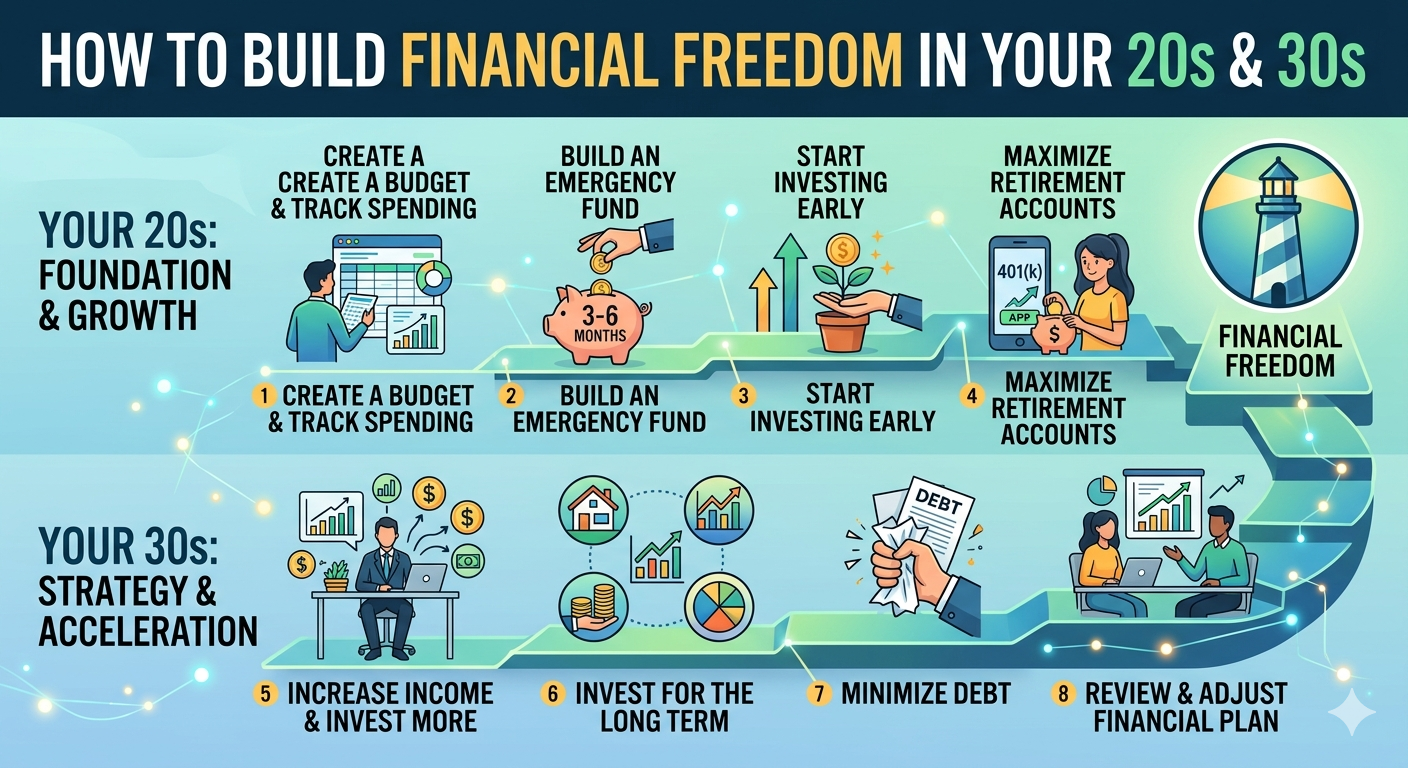
Financial freedom is a goal that many people dream about, but only a small percentage actively work toward it. In today’s fast-moving world, managing money wisely has become more important than ever. Rising living costs, economic uncertainty, and social pressure make financial planning essential for long-term stability.
The good news is that you do not need to be born rich to achieve financial freedom. Most financially successful people build wealth through smart habits, discipline, and consistent decision-making over time.
Your 20s and 30s are especially important because the financial choices you make during these years can shape your future for decades.
In this article, we’ll explore practical strategies that can help you build financial freedom, reduce stress, and create long-term wealth.
What Is Financial Freedom?
Financial freedom means having enough money and financial stability to live life without constant money stress.
It does not always mean becoming a millionaire.
For some people, financial freedom means:
- Living debt-free
- Having savings for emergencies
- Being able to travel
- Leaving a stressful job
- Supporting family comfortably
- Retiring early
True financial freedom gives you more control over your time and choices.
Why Starting Early Matters
One of the greatest advantages in personal finance is time.
The earlier you start building good money habits, the easier wealth creation becomes in the future.
Small actions repeated consistently can produce huge results over time because of compound growth.
A=P(1+nr)nt
PV
r(%)
n24681012141618205001000150020002500$2,653.30
Even investing small amounts regularly during your 20s can lead to significant financial growth later in life.
Unfortunately, many people delay saving and investing until much later.
The sooner you start, the stronger your financial future may become.
1. Create Clear Financial Goals
People often struggle financially because they lack clear goals.
Without direction, money gets spent randomly.
Start by asking yourself:
- What do I want financially?
- How much do I want to save?
- Do I want to buy a house?
- Do I want passive income?
- Do I want early retirement?
Your financial goals should be:
- Realistic
- Measurable
- Long-term focused
Clear goals make financial decisions easier.
2. Learn to Budget Properly
Budgeting is one of the most important financial skills.
A budget helps you:
- Control spending
- Increase savings
- Avoid unnecessary debt
- Improve financial discipline
A simple budgeting strategy is the 50/30/20 rule:
- 50% for needs
- 30% for wants
- 20% for savings and investments
50%+30%+20%=100%
Budgeting does not restrict freedom. It helps you use money more intentionally.
3. Build an Emergency Fund
Life is unpredictable.
Unexpected situations like:
- Medical bills
- Job loss
- Car repairs
- Family emergencies
can create serious financial stress.
An emergency fund protects you during difficult times.
Experts often recommend saving:
- 3 to 6 months of living expenses
Even small emergency savings can reduce anxiety significantly.
4. Avoid Lifestyle Inflation
Many people increase spending every time their income grows.
This is called lifestyle inflation.
Examples include:
- Buying expensive phones frequently
- Overspending on fashion
- Luxury lifestyle pressure
- Constant upgrades
Higher income does not automatically create wealth.
What matters more is:
- Saving rate
- Investment habits
- Financial discipline
Learning to live below your means is one of the strongest wealth-building habits.
5. Eliminate High-Interest Debt
Debt can slow financial progress dramatically.
High-interest debt is especially dangerous because interest payments grow over time.
Examples include:
- Credit cards
- Personal loans
- Buy-now-pay-later debt
Focus on paying off expensive debt as quickly as possible.
Avoid borrowing for unnecessary purchases whenever possible.
Financial freedom becomes difficult when large amounts of income go toward debt payments.
6. Start Investing Early
Saving money alone is often not enough because inflation reduces purchasing power over time.
Investing helps grow wealth faster.
Popular investment options include:
- Stocks
- Index funds
- Real estate
- Mutual funds
- Retirement accounts
The biggest advantage young investors have is time.
Even modest investments made consistently can grow substantially over decades.
Many wealthy people build fortunes slowly through long-term investing.
7. Develop Multiple Income Streams
Relying on only one income source can be risky.
Modern technology has created countless ways to earn additional income.
Examples include:
- Freelancing
- Blogging
- Affiliate marketing
- Selling digital products
- Online teaching
- YouTube content creation
Multiple income streams provide:
- Greater financial security
- Faster savings growth
- Better investment opportunities
The internet economy has made side hustles more accessible than ever.
8. Improve Financial Education
Financial literacy is one of the most valuable skills in modern life.
Unfortunately, many schools do not teach:
- Investing
- Taxes
- Budgeting
- Wealth building
- Retirement planning
People who educate themselves financially often make better long-term decisions.
Ways to improve financial knowledge:
- Read finance books
- Follow reliable blogs
- Listen to podcasts
- Learn investment basics
- Study successful financial habits
Financial education can produce lifelong benefits.
9. Avoid Emotional Spending
Many financial problems are emotional rather than mathematical.
People often spend money because of:
- Stress
- Boredom
- Social pressure
- Advertising influence
- Fear of missing out
Impulse purchases may feel good temporarily but can damage long-term financial goals.
Before buying expensive items, ask:
- Do I truly need this?
- Will this improve my future?
- Can I comfortably afford it?
Mindful spending is essential for financial freedom.
10. Build Long-Term Wealth, Not Short-Term Appearances
Social media often creates pressure to appear wealthy.
People sometimes spend beyond their means trying to impress others.
True financial success is usually quiet.
Many financially successful individuals focus on:
- Investing
- Saving
- Skill development
- Long-term planning
Building real wealth often matters more than appearing rich.
The Power of Compound Growth
Compound growth is one of the strongest forces in finance.
It allows your money to generate returns, which then generate additional returns over time.
FV=PV(1+r)t
PV
r(%)
n24681012141618205001000150020002500$2,653.30
This is why starting early matters so much.
Patience and consistency are extremely important in wealth building.
Common Financial Mistakes Young Adults Make
Ignoring Savings
Many people postpone saving because they think they will earn more later.
Starting small is better than waiting.
Depending Only on Salary
Relying entirely on a single paycheck limits financial growth potential.
Chasing Quick Money
Get-rich-quick schemes often lead to financial losses.
Real wealth usually requires time and discipline.
Not Investing Early
Waiting too long to invest reduces the benefits of compound growth.
How Technology Is Changing Finance
Technology has transformed personal finance completely.
Today people can:
- Invest from smartphones
- Track spending instantly
- Learn finance online
- Start online businesses
- Automate savings
AI tools are also helping people:
- Analyze budgets
- Improve investing decisions
- Plan financial goals
- Manage expenses
The future of finance will likely become even more digital and accessible.
Why Financial Freedom Improves Life
Financial stability can improve many areas of life.
Benefits include:
- Less stress
- Better mental health
- More opportunities
- Greater independence
- Increased flexibility
Money may not solve every problem, but financial insecurity can create major difficulties.
Good financial habits create stronger long-term stability.
The Importance of Patience
Building wealth usually takes years, not weeks.
Social media sometimes creates unrealistic expectations about success.
True financial growth often comes from:
- Consistency
- Smart habits
- Long-term thinking
- Continuous learning
Patience is one of the most valuable financial skills.
Final Thoughts
Financial freedom is not reserved only for wealthy people. It is often the result of small smart decisions repeated consistently over time.
Budgeting, saving, investing, and improving financial education can completely transform your future.
Your 20s and 30s are powerful years for building long-term wealth. The habits you develop now may shape your financial future for decades.
You do not need to become perfect overnight.
Start small, stay consistent, and focus on long-term growth.
The financial choices you make today could create a future with greater freedom, stability, and peace of mind.
FAQs
1. What is the first step toward financial freedom?
The first step is understanding your income, expenses, and creating a realistic budget.
2. How much should I save every month?
Many experts recommend saving at least 20% of your income if possible.
3. Why is investing important for young adults?
Investing early allows compound growth to work over a longer period of time.
4. Can financial freedom be achieved with an average income?
Yes. Smart spending, saving, and investing habits matter more than income alone.
5. What is the biggest obstacle to financial success?
Poor money habits, emotional spending, and lack of financial education are common obstacles.