
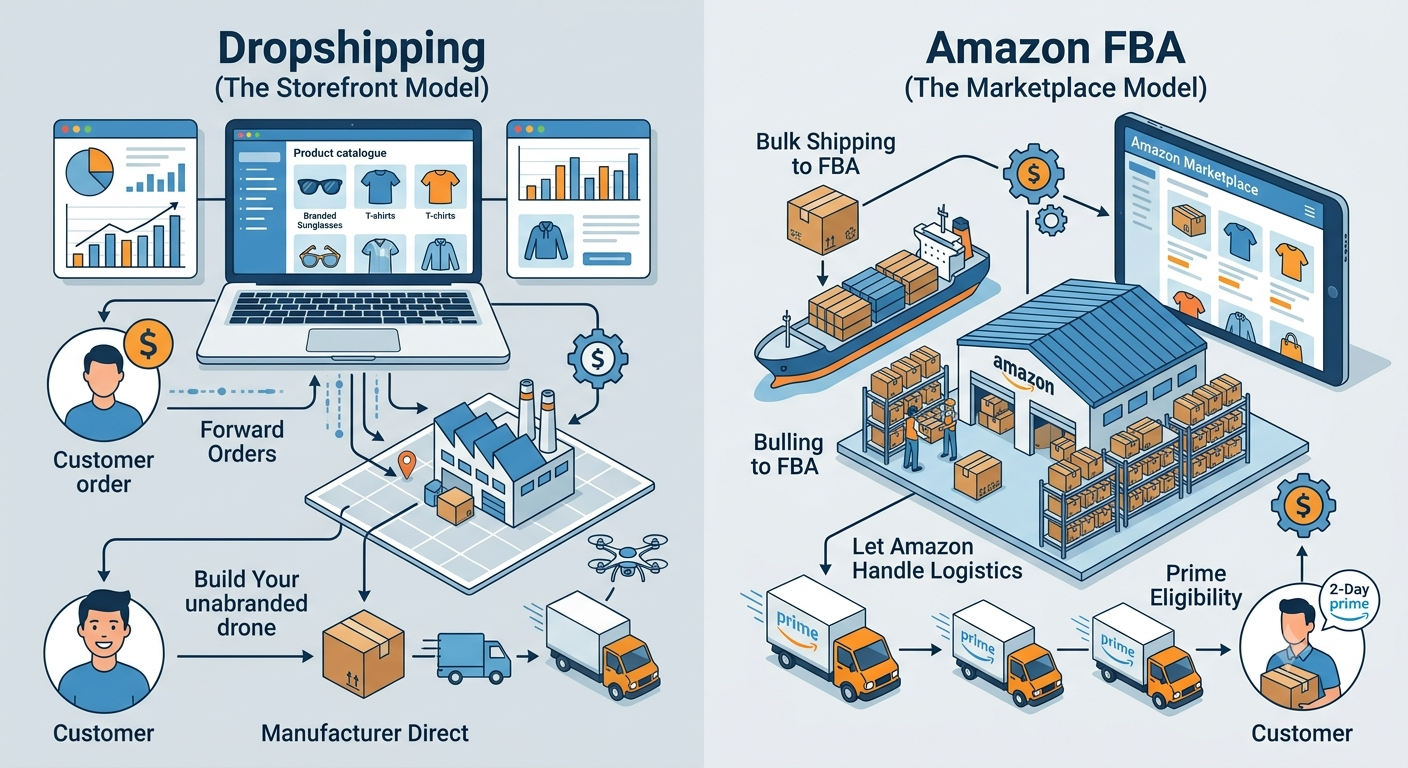
Starting an online business has never been more accessible, yet the eCommerce landscape is evolving faster than ever. As thousands of aspiring entrepreneurs enter the digital marketplace each year, two fulfillment models continue to lead the industry: Dropshipping and Amazon FBA (Fulfillment by Amazon).
While both models allow you to generate income online without managing a physical retail storefront, their underlying operations, financial requirements, and scalability vectors are fundamentally different. Choosing the wrong model for your financial situation, risk tolerance, and skill set can lead to wasted capital and burnt-out efforts.
This detailed, step-by-step guide breaks down the core mechanics of Dropshipping and Amazon FBA in 2026. We will analyze startup capital requirements, profit margins, supply chain logistics, customer trust metrics, and risk factors so you can confidently launch your eCommerce business.
Table of Contents
- What is Dropshipping? (Core Mechanics & 2026 Landscape)
- What is Amazon FBA? (Core Mechanics & 2026 Landscape)
- Step-by-Step: How Dropshipping Works
- Step-by-Step: How Amazon FBA Works
- Comprehensive Side-by-Side Comparison
- Detailed Financial Breakdown: Startup Costs
- Profit Margins & Revenue Potential
- Inventory Management & Supply Chain Control
- Shipping Speeds, Logistics, & Customer Service
- Operational & Financial Risk Analysis
- Which Business Model Should You Choose in 2026?
- Critical Mistakes to Avoid
- Actionable Tips for E-Commerce Success
- Frequently Asked Questions
- Final Verdict & Strategic Advice
What is Dropshipping?
Dropshipping is a retail fulfillment model where an online store does not keep the products it sells in stock. Instead, when a customer purchases an item from your website, you purchase that item from a third-party manufacturer, wholesaler, or supplier. The supplier then packages and ships the product directly to the end consumer.
Because you never physically handle or store inventory, the entry barrier to dropshipping remains relatively low.
[ Customer Orders from Store ] ---> [ You Forward Order to Supplier ] ---> [ Supplier Ships to Customer ]
Advantages
- Minimal Upfront Capital: You do not purchase inventory until a customer pays you.
- Low Overhead: No warehouse space, storage fees, or fulfillment labor cost.
- Location Independence: Run your store from anywhere with a stable internet connection.
- Wide Product Selection: Test thousands of trending items without stock commitments.
- High Flexibility: Easily pivot your store focus if a product line fails to sell.
Disadvantages
- Thin Profit Margins: High supplier charges and competitive advertising costs eat into profits.
- Logistics & Quality Control Risk: You cannot inspect products before shipment.
- Supplier Reliance: Out-of-stock suppliers or delayed shipping times directly harm your brand image.
- Rising Paid Acquisition Costs: Paid traffic (Meta, TikTok, Google Ads) requires skilled ad optimization.
What is Amazon FBA?
Amazon FBA stands for Fulfillment by Amazon. Under this business model, you source products in bulk (typically under your own private label brand), package them according to Amazon’s compliance rules, and ship them to Amazon’s global network of fulfillment centers.
Once your stock arrives, Amazon handles warehouse storage, order fulfillment, Prime shipping logistics, customer service, and product returns on your behalf.
[ Source Bulk Inventory ] ---> [ Send Stock to Amazon Warehouse ] ---> [ Amazon Fulfills Orders & Handles Support ]
Advantages
- Instant Customer Trust: Tap directly into Amazon’s vast, loyal Prime subscriber base.
- Prime Shipping Advantage: Access to 1-to-2 day shipping boosts conversion rates significantly.
- Hands-Off Operations: Amazon handles physical picking, packing, shipping, and returns.
- Built-in Traffic: Leverage Amazon as a search engine rather than relying purely on external ads.
- Asset Creation: Building a successful Amazon FBA store creates a sellable corporate asset.
Disadvantages
- Capital Intensive: Requires upfront investments in inventory, shipping, and branding.
- Platform Dependency: You must strictly follow Amazon’s terms of service or risk account suspension.
- Ongoing Storage & Platform Fees: Monthly subscription fees, FBA fulfillment fees, and long-term storage penalties apply.
- Inventory Risk: Unsold items generate warehouse holding fees and tied-up cash flow.
How Dropshipping Works
Operating a successful dropshipping store requires maintaining a seamless connection between your digital storefront, paid ad channels, and supplier infrastructure.
+------------------------+
|  1. Customer Orders    |
|  Product from Store    |
+-----------+------------+
            |
            v
+------------------------+
|  2. Order Forwarded    |
|  to Third-Party Vendor |
+-----------+------------+
            |
            v
+------------------------+
|  3. Vendor Packages &  |
|  Ships to Customer     |
+-----------+------------+
            |
            v
+------------------------+
|  4. You Keep Profit    |
|  Margin After Costs    |
+------------------------+
- Store Setup: Build a branded e-commerce store using platforms like Shopify or WooCommerce.
- Supplier Integration: Connect your store with suppliers via platforms like AutoDS, CJ Dropshipping, or direct factory contracts.
- Marketing & Acquisition: Drive target buyers to your site via social ads, influencer collaborations, or search engine optimization (SEO).
- Order Automation: When an order comes in, software automatically forwards the shipping details to your supplier.
- Direct Delivery: The supplier packages the item (often with custom invoices/branding) and ships it to the customer.
How Amazon FBA Works
Amazon FBA requires a traditional manufacturing and supply chain approach upfront, followed by marketplace optimization on Amazon’s platform.
+------------------------+
|  1. Product Research   |
|  & Sourcing in Bulk    |
+-----------+------------+
            |
            v
+------------------------+
|  2. Freight Shipping   |
|  to Amazon Fulfillment |
+-----------+------------+
            |
            v
+------------------------+
|  3. Customer Purchases |
|  Item on Amazon        |
+-----------+------------+
            |
            v
+------------------------+
|  4. Amazon Picks, Packs|
|  & Ships Order         |
+------------------------+
- Product Research: Use tools like Helium 10 or Jungle Scout to identify high-demand, low-competition products.
- Manufacturer Sourcing: Contract with manufacturers (via Alibaba or domestic factories) to produce custom inventory under your brand name.
- Freight Shipment: Transport products directly to designated Amazon Fulfillment Centers.
- Listing Optimization: Publish high-converting Amazon product listings featuring SEO-rich titles, bullet points, and 3D render/lifestyle images.
- Amazon Fulfillment: When a sale occurs, Amazon automatically processes, packs, ships, and handles follow-up support.
Dropshipping vs Amazon FBA Comparison
| Feature | Dropshipping | Amazon FBA |
|---|---|---|
| Startup Capital Required | Low ($100 – $500+) | Medium to High ($1,500 – $5,000+) |
| Inventory Requirement | Zero physical inventory held | Bulk physical inventory required |
| Fulfillment Lead Time | 5 to 14 Business Days (typically) | 1 to 2 Days (Amazon Prime) |
| Profit Margins | 10% – 20% | 20% – 45% |
| Financial Risk | Low (Pay per order) | Moderate to High (Tied in inventory) |
| Customer Acquisition | External Ads (Meta, Google, TikTok) | Internal Amazon Search + PPC Ads |
| Customer Trust Level | Moderate (Requires store branding) | Extremely High (Amazon Prime trust) |
| Scalability | Good (Dependent on ad budgets) | Excellent (Fulfillment handled by Amazon) |
Startup Costs
Understanding capital commitments prevents cash flow bottlenecks during launch.
Dropshipping Startup Costs (~$500 Total):
[ Shopify/Domain: $40 ] [ Samples: $60 ] [ Marketing/Ads: $400 ]

Amazon FBA Startup Costs (~$3,500 Total):
[ Bulk Inventory: $2,000 ] [ Shipping/Customs: $600 ] [ Inspection/Branding: $400 ] [ Software/Ads: $500 ]
Dropshipping
- E-Commerce Platform: $29–$39/month for Shopify or $10/month hosting for WooCommerce.
- Domain Name: $12–$15 per year.
- Marketing Budget: $200–$400 for initial ad testing on Meta, TikTok, or Pinterest.
- Product Samples: $50–$100 to test item build quality before pushing ads.
- Estimated Minimum Entry Cost: $100 – $500
Amazon FBA
- Professional Seller Account: $39.99/month subscription fee.
- Initial Inventory Run: $1,000–$2,500 for a minimum order quantity (MOQ) of 200–1,000 units.
- Freight & Import Duties: $400–$800 depending on cargo weight and air/sea freight rates.
- Branding & Packaging: $200–$400 for custom logo designs, packaging inserts, and UPC barcodes.
- Amazon PPC & Keyword Software: $150–$300 for software and initial launch PPC campaigns.
- Estimated Minimum Entry Cost: $1,500 – $5,000+
Profit Margins
Profitability structures vary based on supplier pricing, ad expenditures, and platform fees.
Dropshipping Profit Structure:
Sale Price: $50
- Supplier Item Cost: $20
- Customer Acquisition Cost (Ads): $22
= Net Profit: $8 (16% Margin)

Amazon FBA Profit Structure:
Sale Price: $50
- Bulk Product Unit Cost: $9
- Freight & Inspection Cost: $3
- Amazon FBA Fees: $16
= Net Profit: $22 (44% Margin)
Dropshipping
Dropshippers often operate on 10% to 20% net margins.
Because you buy products individually from suppliers, your cost per unit is much higher than buying wholesale. Your major expense will be Customer Acquisition Cost (CAC) via paid digital ads. If your target marketing campaign isn’t carefully optimized, advertising costs can quickly eat into your profits.
Amazon FBA
Private label Amazon FBA sellers often aim for 20% to 45% net margins.
By purchasing inventory in bulk, your unit production cost drops significantly. While Amazon takes a substantial cut (roughly 30–35% for FBA fulfillment fees and referral commissions), the high conversion rate of Prime customers and lower wholesale product costs often yield better net profits per sale.
Inventory Management
Dropshipping:  [Supplier Warehouse]  ==Direct Shipping==>  [Customer]
                                     (No stock risks, rely on supplier inventory)

Amazon FBA:    [Bulk Factory]  ==Freight==>  [Amazon FBA Warehouse]  ==Prime==>  [Customer]
                                     (Full product control, holding costs apply)
Dropshipping
- You never hold or manage physical inventory.
- Zero storage, holding, or liquidation fees.
- Testing new trending products takes minutes: simply add the item listing to your store and run an ad campaign.
- Downside: You rely completely on supplier inventory levels. If your supplier runs out of stock without notice during a successful ad launch, your scale halts immediately.
Amazon FBA
- You maintain total oversight over packaging, custom design, user manuals, and bundling strategies.
- Higher quality assurance; you can hire third-party inspection agencies to audit products at the factory floor before shipment.
- Downside: If a product does not sell, your capital remains trapped in Amazon warehouses, accumulating monthly long-term storage fees.
Shipping Speeds, Logistics, & Customer Service
Modern consumers demand fast, reliable delivery. How each model handles order fulfillment drastically impacts your customer retention.
Order Lead Times Comparison:

Dropshipping (Standard Vendor):
[ Order Placed ] -------------------- (5 to 12 Days) --------------------> [ Delivered ]

Amazon FBA (Prime System):
[ Order Placed ] -- (1 to 2 Days) --> [ Delivered ]
Dropshipping Logistics
Standard dropshipping via suppliers based overseas (e.g., China) can lead to delivery windows ranging from 7 to 14 business days. While domestic supplier networks (US/EU warehouses) have shortened this gap to 3–5 days, shipping costs for domestic fulfillment are higher.
Furthermore, you are solely responsible for handling customer service emails, order tracking complaints, refund requests, and chargebacks.
Amazon FBA Logistics
Amazon FBA excels at fulfillment logistics. Products stored in FBA facilities automatically qualify for Amazon Prime 1-Day or 2-Day Delivery.
Amazon manages customer service inquiries, tracking updates, and return processing. This operational convenience allows business owners to focus purely on marketing, brand strategy, and product development.
Risk Analysis
Every business model involves trade-offs between financial investments and operational stability.
Risk Balance:

Dropshipping Risk Profile:
[ Financial Loss Risk: LOW ] <---------------> [ Operational & Ad Volatility: HIGH ]

Amazon FBA Risk Profile:
[ Financial Loss Risk: HIGH ] <--------------> [ Store Operational Stability: HIGH ]
Dropshipping Risks
- Ad Account Bans: Over-reliance on paid social platforms (Meta, TikTok) leaves stores vulnerable to ad account suspensions.
- Supplier Errors: Low-quality supplier shipments, incorrect items, or delayed shipping can generate customer disputes and payment gateway holds (PayPal/Stripe holds).
- Low Entry Barriers: Low startup costs invite high competition selling identical items.
Amazon FBA Risks
- Capital Loss: Investing thousands of dollars into product inventory that fails to convert results in tied-up cash flow.
- Amazon Account Suspensions: Operating on Amazon’s platform means abiding strictly by their terms of service. Policy violations or listing hijacking attempts by competitors can pause seller accounts.
- Fee Structure Changes: Annual adjustments to Amazon’s fulfillment and storage fees can impact net profit margins over time.
Which Business Model Should You Choose in 2026?
Choose Dropshipping If:
- You have limited startup capital ($100 to $500).
- You excel at digital marketing, copywriting, short-form video creation, and audience targeting.
- You want to quickly test multiple product niches without long-term commitments.
- You prefer location independence without managing inventory shipments.
Choose Amazon FBA If:
- You have at least $1,500 to $3,000+ in starting capital.
- You want to build a private-label brand that creates long-term business equity.
- You want to leverage Amazon’s logistics infrastructure to handle customer service and fast shipping.
- You prefer optimizing marketplace listings and search traffic rather than managing daily social media ads.
Common Mistakes to Avoid
- Skipping Product Research: Launching products without analyzing search volume, customer demand, and margin profiles usually leads to low sales.
- Relying on Single-Source Suppliers: Depending on a single factory or vendor exposes your business to unexpected out-of-stock issues or sudden price increases.
- Ignoring Net Profits: Tracking gross sales revenue instead of net profits after ad spends, platform fees, and refunds can distort financial reporting.
- Neglecting Brand Presence: Selling unbranded, generic items makes it difficult to stand out against price-cutting competitors.
- Underestimating Ad Costs: Running digital ad campaigns without testing content hooks or audience targeting can deplete marketing budgets quickly.
Actionable Tips for E-Commerce Success
- Run a Hybrid Strategy: Use dropshipping to test product demand with zero risk. Once an item shows steady demand, source it in bulk, brand it, and transition it to Amazon FBA.
- Work with Local Suppliers: If dropshipping, partner with domestic suppliers in your target region to reduce shipping times to 3–5 days.
- Prioritize High-Quality Visuals: Invest in high-resolution product photography, 3D renderings, and short-form video assets to improve store conversion rates.
- Master Organic Channels: Drive traffic using short-form organic video (TikTok, Instagram Reels, YouTube Shorts) to reduce customer acquisition costs.
- Audit Your Unit Economics: Calculate all fees, operational costs, ad spends, and supplier expenses to ensure your final price leaves healthy margins.
Frequently Asked Questions
1. Which business model is more profitable in 2026?
Amazon FBA generally offers higher net profit margins (20%–45%) due to bulk wholesale purchasing discounts. Dropshipping requires less upfront capital, but higher ad spend and single-unit costs lead to tighter margins (10%–20%).
2. Is dropshipping still viable for beginners in 2026?
Yes. However, success requires moving away from generic stores. Modern dropshipping relies on fast domestic shipping, strong brand identity, and engaging visual content on platforms like TikTok and Instagram.
3. Can I launch an Amazon FBA store with under $500?
While technically possible with micro-budget strategies, launching an Amazon FBA private label store generally requires at least $1,500 to $3,000. This covers minimum manufacturing order quantities, freight shipping, packaging design, and initial PPC advertising.
4. Can I run both Dropshipping and Amazon FBA simultaneously?
Yes. Many successful e-commerce brands use dropshipping as an R&D tool to test trending products. When a item proves successful, they order bulk stock, brand the packaging, and launch it on Amazon FBA for better margins and Prime fulfillment.
5. Which model carries less financial risk?
Dropshipping carries significantly less upfront financial risk because you do not purchase inventory before securing a customer sale. If a product fails to sell, your loss is limited to your ad spend and web software subscriptions.
Final Verdict
Both Dropshipping and Amazon FBA remain viable pathways to building an e-commerce business in 2026. The right choice depends on your capital, risk tolerance, and long-term business goals.
If you have a limited budget, want to test multiple products quickly, and excel at direct-to-consumer digital marketing, Dropshipping offers an accessible, low-risk starting point.
If you have capital to invest, want to build a distinct private-label brand, and prefer leveraging world-class logistics for fast customer shipping, Amazon FBA offers long-term scalability and higher profit potential.
Review your resources, choose the model that fits your operational strengths, and focus on building a customer-centric brand.
Call to Action
Found this comparison helpful? Explore more expert guides on IdeasPros.xyz to discover business strategies, AI tools, SEO techniques, and modern digital income paths.