
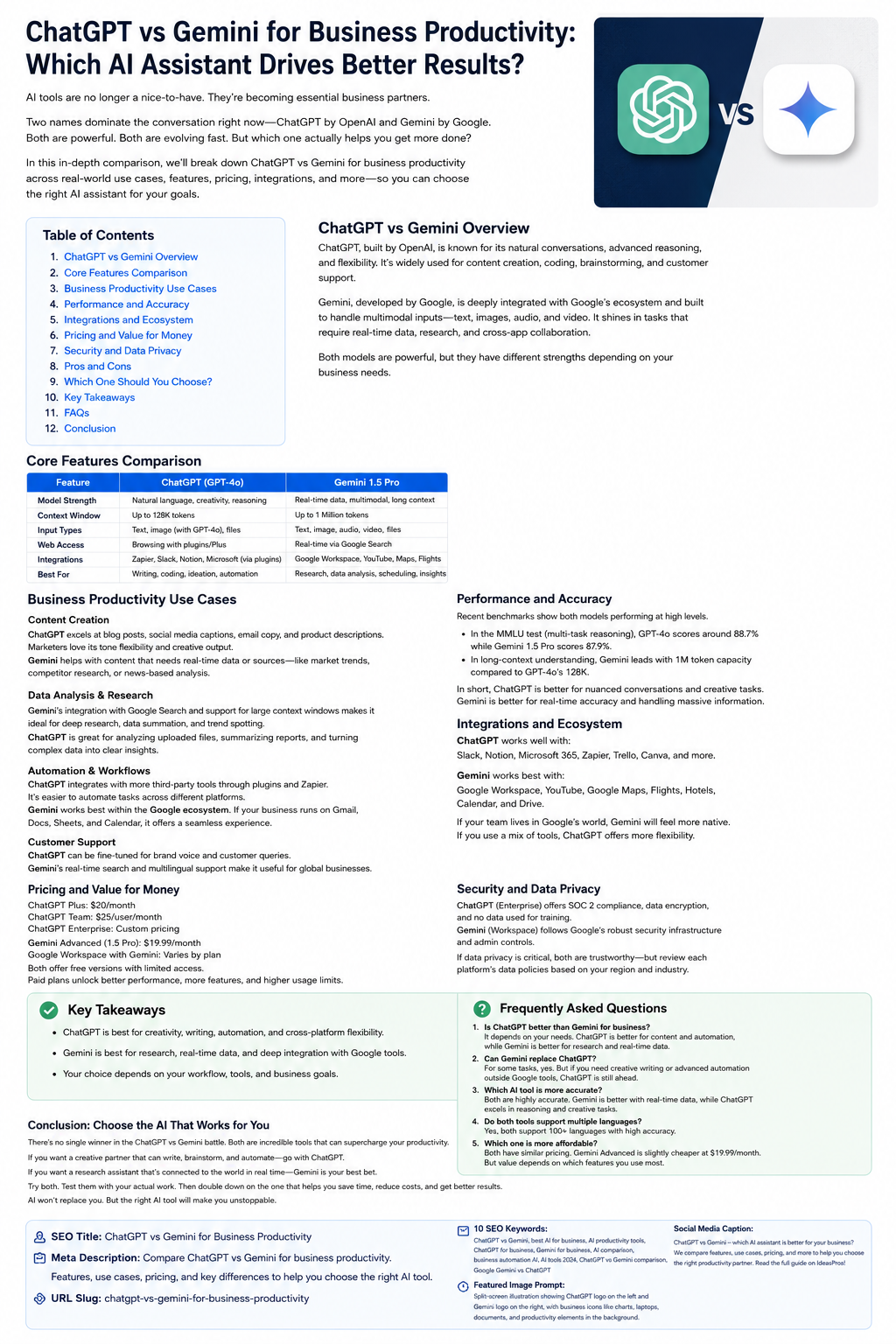
The AI landscape isn’t what it used to be a couple of years ago. We have moved past the initial awe of “look at this poem an AI wrote” and entered the era of hard-nosed business execution. Today, founders, freelancers, and growth marketers don’t just use generative AI as a novelty—they rely on it to automate operations, scale content creation, analyze code, and parse heavy datasets.
Two giants continue to fight for the center square of your operational tech stack: OpenAI’s ChatGPT (running the GPT-5.4 engine) and Google’s Gemini (powered by the Gemini 3 family).
Both tools are highly capable, but they have evolved to serve radically different business workflows. Choosing the wrong one doesn’t just cost you twenty bucks a month; it costs your team hours of fragmented productivity and messy context-switching.
This comprehensive guide breaks down the architecture, specific business use cases, and distinct strengths of ChatGPT and Gemini so you can make an informed, data-backed choice for your business operations.
Table of Contents
- Key Takeaways
- The Core Architectural Shift: Context vs. Control
- Content Creation and Growth Marketing
- Data Analysis and Real-Time Market Research
- Ecosystem Integration and Workflow Automation
- Coding, Development, and Tech Operations
- The Financial Breakdown: Pricing and Licensing
- Frequently Asked Questions (FAQs)
- The Verdict: Actionable Framework for Your Team
Key Takeaways
If you only have two minutes to spare, here is how the data splits the field for business owners:
- Go with ChatGPT if: Your primary business bottlenecks are creative copywriting, building highly specific custom internal tools (Custom GPTs), complex step-by-step reasoning, or autonomous desktop task execution.
- Go with Gemini if: Your team lives entirely inside Google Workspace (Docs, Sheets, Drive, Gmail), you need to process massive data payloads (like entire 200-page operational manuals or hour-long video transcripts), or you require native audio/video analysis.
- The Intelligence Baseline: Both platforms hit highly competitive marks on industry benchmarks (scoring near identically on major reasoning frameworks), meaning the decision isn’t about raw intelligence—it’s about workflow alignment.
The Core Architectural Shift: Context vs. Control
Before analyzing specific tasks, it helps to understand the engineering advantages that separate these two platforms.
Gemini’s Context Window Advantage
Gemini’s defining feature is its 1 million token context window available in its premium tiers. In plain terms, tokens represent pieces of words. A 1-million token limit means Gemini can hold roughly 700,000 words in its active memory during a single chat session.
You can upload an entire video of an all-hands meeting, three distinct quarterly financial reports, and a legal contract simultaneously. Gemini will read it all, map the relationships between the files, and answer highly specific cross-referenced questions instantly.
ChatGPT’s Reasoning and Control Edge
ChatGPT counters this massive memory dump with deep structural control. While its standard context window sits lower at 272K tokens, its Interactive Thinking (GPT-5.4 Thinking) feature gives users visibility into its internal reasoning loops.
When you task ChatGPT with a complex business logic problem—such as drafting an intricate operational standard operating procedure (SOP) with multiple conditional outcomes—it builds a visible plan. Better yet, it allows you to pause the model mid-thought and correct its logic before it outputs a broken document. Furthermore, ChatGPT retains highly robust persistent memory across distinct chat histories, ensuring it remembers your core brand voice and business preferences across weeks of interaction.
Content Creation and Growth Marketing
For solo marketers, agency founders, and growth teams, content execution is the most common use case for generative AI.
Where ChatGPT Wins: Copywriting and Brand Consistency
When it comes to the fluid nuance of language, ChatGPT remains the choice for performance marketers. It adapts seamlessly to brand voice guidelines and handles colloquial phrasing without veering into generic corporate jargon.
If you use its dedicated writing environment, Canvas, you can collaborate with the AI inline—meaning you can highlight a single paragraph of a sales page and ask ChatGPT to make just that section “more urgent” or “less technical” without rewriting the entire document.
- Real-World Application: Developing high-converting landing page copy, writing long-form SEO blog posts from complex outlines, and producing highly targeted ad variants for multi-channel paid social campaigns.
Where Gemini Wins: Content Sourcing and Multimedia Repurposing
Gemini tends to write with a more factual, structured tone. While this can feel slightly sterile for creative copy, it is incredibly powerful for content research and multimodal sourcing. Because Gemini handles video natively, marketing teams can use it to completely invert their content production pipelines.
- Real-World Application: You can drop an hour-long raw YouTube video or podcast file directly into Gemini. You can then instantly command it to extract five core thematic pillars, draft 10 LinkedIn text posts based on timestamps, and flag visual cues within the video to use as social clips.
Data Analysis and Real-Time Market Research
Data-driven decision-making separates scaling startups from struggling ones. Here is how both platforms handle heavy business intelligence.
+------------------------+---------------------------------------+---------------------------------------+
| Feature                | ChatGPT (GPT-5.4)                     | Google Gemini 3                       |
+------------------------+---------------------------------------+---------------------------------------+
| Best Workflows         | Complex data logic, custom code,      | Live web-dependent analysis, massive  |
|                        | creative content assets               | document audits, video breakdown      |
+------------------------+---------------------------------------+---------------------------------------+
| Data Freshness         | Trained data + web-browsing fallback  | Native integration with live Google   |
|                        |                                       | Search indexing layers                |
+------------------------+---------------------------------------+---------------------------------------+
| Context Processing     | 272K tokens standard; optimized for   | 1 Million+ tokens; optimized for deep |
|                        | targeted, granular document queries   | cross-file analytical synthesis       |
+------------------------+---------------------------------------+---------------------------------------+
Gemini for Fresh Insights and Live Tracking
Because Gemini is built directly on top of Google’s search infrastructure, its access to real-time public data is immediate and deep. If you ask Gemini to look into trending market entry barriers or competitor pricing shifts that occurred over the last 48 hours, it pulls live data points with linked citations. It excels at parsing large, disorganized data tables uploaded directly via CSV or linked from your Drive.
ChatGPT for Sandboxed Quantitative Calculations
ChatGPT approaches data analysis like a software engineer. Through its Advanced Data Analysis workspace, it sets up a sandboxed Python execution environment. When you upload a dataset, it writes and runs code to generate statistically accurate mathematical breakdowns, trend charts, and regressions.
If your data analysis requires rigorous math and advanced logical validation rather than simply reading web trends, ChatGPT provides fewer calculation errors.
Ecosystem Integration and Workflow Automation
An AI tool is only as valuable as the software stack it communicates with. How seamlessly do these platforms slide into your regular workday?
Gemini: The Google Workspace Omnipresence
If your business operations are built inside Google Workspace, Gemini offers unmatched convenience. It is embedded directly into your sidebar across Gmail, Docs, Sheets, and Google Meet.
The Frictionless Workflow: Instead of copying data back and forth, you can open a blank Google Doc and type a prompt directly into the interface to pull a data summary from a PDF sitting deep inside your shared Google Drive folder. During a late client call on Google Meet, Gemini can auto-generate a comprehensive summary of action items and draft immediate follow-up email responses directly within your Gmail tab.
ChatGPT: Custom GPT Infrastructure and Custom Automation
ChatGPT functions as an independent, highly adaptable control center. If you use a broad, mixed software stack (Notion, Slack, Salesforce, HubSpot), ChatGPT offers an expansive ecosystem of integrations.
Its standout business feature is the ability to create Custom GPTs. Founders can build private, internal bots tailored to specific employee roles without writing a single line of code.
- Example: You can build a custom “Onboarding Assistant” GPT pre-loaded with your company’s internal wiki, HR policies, and Slack guidelines. New hires can chat with it to answer operational questions without pulling senior staff away from high-priority work.
Coding, Development, and Tech Operations
For technical founders, freelancers, and development teams, AI acts as a 24/7 junior developer.
On technical benchmarks like SWE-bench (which measures an AI’s ability to resolve real software bugs), both platforms trade blows, scoring closely.
- ChatGPT tends to generate cleaner, more modular code fragments when building custom scripts from scratch. Its ability to work inside its specialized coding spaces makes it easier to build small, functional web apps or prototypes (“vibe coding”) through iterative prompting.
- Gemini leverages its massive context window to excel at codebase refactoring. If you have an existing application with thousands of lines of legacy code, you can drop the entire file framework into Gemini. It can map out architectural bugs, trace memory leaks, and generate comprehensive documentation for your team across the entire repository at once.
The Financial Breakdown: Pricing and Licensing
For teams scaling their seats, understanding the cost structure is crucial.
- Consumer Premium Tiers ($20/month): ChatGPT Plus and Gemini Advanced cost essentially the same amount. Gemini Advanced bundles its access with 2TB of Google One cloud storage, which provides excellent added value if you already pay for storage.
- Business/Enterprise Tiers: ChatGPT Business provides a secure workspace with advanced admin controls, ensuring that your company’s proprietary operational data is never used to train OpenAI’s public models. Gemini for Google Workspace charges per user as an add-on to your existing corporate Google account, making user access provisioning exceptionally simple for IT administrators.
- API Scaling Costs: If you are building custom software products, Gemini’s developer API infrastructure is significantly more affordable, offering entry tiers like Flash-Lite that allow high-volume processing at a fraction of the cost of OpenAI’s developer endpoints.
Frequently Asked Questions
1. Does ChatGPT or Gemini protect sensitive company data better?
Both platforms offer strict enterprise security, but only if you use their paid business tiers (ChatGPT Team/Enterprise or Gemini for Google Workspace). On free consumer tiers, both companies may use your prompt history to train their models. Never paste proprietary financial models, client identities, or medical data into the free versions of either platform.
2. Can I use both tools together effectively?
Absolutely. Many lean startup teams run a hybrid model to get the best of both worlds. They use ChatGPT to draft customer customer replies, write cold sales sequences, and build creative marketing briefs. Concurrently, they use Gemini to summarize lengthy video meetings, analyze complex research documents, and keep real-time tabs on market shifts.
3. Which tool is better at creating charts and visual presentations?
ChatGPT is generally better at creating clean, accurate data visualizations because it runs actual Python code to generate its graphics. Gemini can quickly generate basic visual charts, but its true strength lies in processing complex imagery and diagrams that you upload into it rather than creating them from scratch.
4. Is the free version of ChatGPT better than the free version of Gemini?
The free tier of ChatGPT grants access to its core engine with occasional usage limits, giving you high-quality reasoning and creative writing out of the gate. Gemini’s free tier runs on its streamlined Flash model, which is optimized for sheer speed and real-time web searches. If you need creative writing, choose ChatGPT Free; if you need rapid research, choose Gemini Free.
5. Can Gemini read my entire company database?
If your database files are stored securely inside Google Drive (PDFs, Sheets, Docs), Gemini can search, cross-reference, and analyze them across folders instantly, provided you grant it workspace permissions. ChatGPT requires you to manually upload files or connect third-party API connectors like Zapier to achieve similar internal access.
The Verdict: Actionable Framework for Your Team
To stop over-analyzing and start executing, look closely at your company’s daily administrative friction:
                  Which core challenge does your team face?
                                      |
         +----------------------------+----------------------------+
         |                                                         |
[Information Overload]                                    [Execution Bottlenecks]
         |                                                         |
- Sifting through huge file sets                          - Writing endless sales copy
- Stuck in hours of daily video meetings                  - Building internal role-based tools
- Operating entirely in Google Workspace                 - Custom coding or script creation
         |                                                         |
         v                                                         v
  CHOOSE GEMINI 3                                         CHOOSE CHATGPT PLUS
By matching the tool to your actual operational workflows rather than chasing abstract feature lists, you turn generative AI from an open tab into an active driver of business growth.
SEO and Social Media Strategy Suite
1. SEO Title
ChatGPT vs Gemini for Business: Which AI Wins in 2026?
2. Meta Description
Discover whether ChatGPT or Gemini is better for your business productivity. Compare features, pricing, context windows, and real 2026 workflows.
3. URL Slug
chatgpt-vs-gemini-business-productivity
4. 10 SEO Keywords
- ChatGPT vs Gemini for business
- AI productivity tools 2026
- OpenAI GPT 5.4 features
- Google Gemini for Google Workspace
- AI tools for entrepreneurs
- Business workflow automation AI
- Gemini context window length
- AI data analysis tools
- Custom GPTs for startups
- Best AI for marketing copy
5. Image Generation Prompt
A modern, clean workspace split down the middle with subtle ambient lighting. On the left side, a sleek minimalist UI featuring abstract green data nodes and clean code syntax blocks (representing ChatGPT). On the right side, a native cloud-workspace dashboard showing integrated email threads, clean document streams, and interconnected blue and purple network arcs (representing Gemini). No text or words on screen, professional tech blog aesthetic, photorealistic depth of field, 8k resolution.
6. Social Media Captions
Facebook Caption
Are you using the right AI tool for your business, or are you just losing hours to copy-and-paste friction? 🛑
In 2026, the battle between ChatGPT and Gemini isn’t about which tool is “smarter”—it’s about which one fits your daily operational workflow. Whether you’re an entrepreneur trying to scale content, a freelancer managing clients, or a startup founder auditing massive data sets, choosing the wrong ecosystem is costing you money.
We broke down the hard data, actual business benchmarks, and clear use cases to help you decide which tool deserves a spot in your tech stack.
Read the full breakdown on the blog: [Link]
#BusinessProductivity #Startups #Entrepreneurs #GenerativeAI #ChatGPT #GoogleGemini
LinkedIn Caption
Generative AI has evolved past the novelty phase. For founders, freelancers, and growth marketers, it is now an infrastructure choice.
But when looking at ChatGPT (GPT-5.4) vs. Google Gemini 3, most teams make the mistake of comparing raw intelligence scores rather than workflow alignment.
The structural differences are massive:
📊 Gemini offers a 1-million token context window and native integration into Google Workspace—making it a powerhouse for processing massive multi-file audits, hours of video, and live market data.
💡 ChatGPT dominates when it comes to creative brand copywriting, intricate reasoning control via Canvas, and building custom internal role-based bots (Custom GPTs).
Which platform actually moves the needle for your specific business bottlenecks? We’ve published a comprehensive, real-world comparison guide on IdeasPros to help you optimize your team’s operational velocity.