
Launching a startup feels like building a plane while jumping off a cliff. It is thrilling, chaotic, and incredibly risky. According to historical data from the U.S. Bureau of Labor Statistics, roughly 20% of new businesses fail during their first year, and about 50% crumble by year five.
But here is the silver lining: failure is rarely random. Most startups do not die from bad luck; they die from predictable, avoidable missteps. Whether you are an aspiring entrepreneur, a freelancer scaling into an agency, or a tech enthusiast launching your first SaaS, knowing where the hidden landmines are can mean the difference between becoming a cautionary tale or a success story.
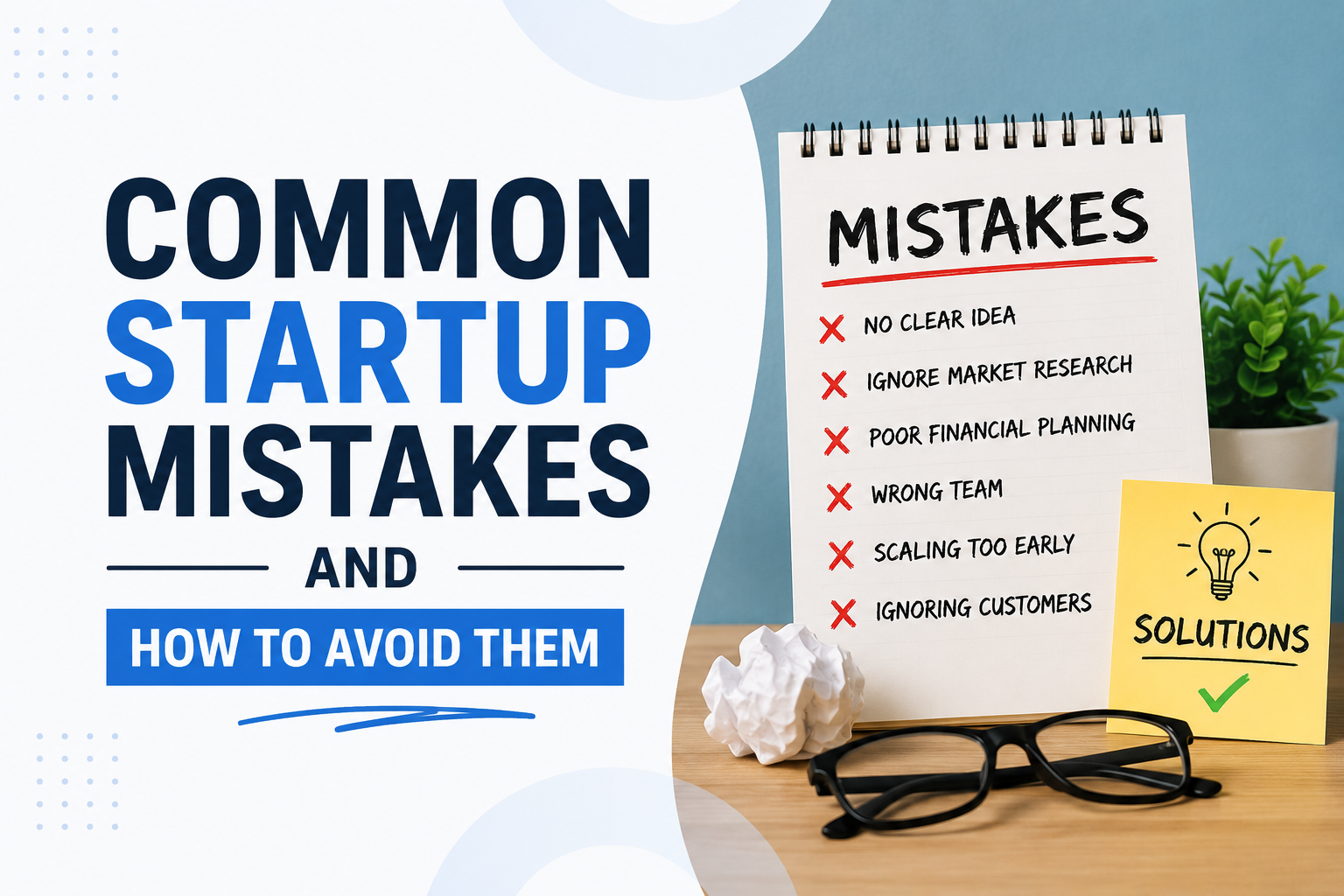
Let’s break down the seven most common startup mistakes, real-world examples of how they manifest, and the practical frameworks you can use to protect your business.
Table of Contents
- Mistake 1: Building a Product Nobody Wants
- Mistake 2: Scaling Too Quickly (Premature Scaling)
- Mistake 3: The Wrong Co-founder or Team Dynamic
- Mistake 4: Mismanaging Cash Flow and Running Out of Money
- Mistake 5: Poor Marketing and Distribution Strategy
- Mistake 6: Ignoring Customer Feedback and Failing to Pivot
- Mistake 7: Legal and Regulatory Oversight
- Key Takeaways
- Frequently Asked Questions (FAQs)
- Conclusion & Actionable Next Steps
1. Building a Product Nobody Wants
The Trap of the “Genius Idea”
Many founders fall deeply in love with their own ideas. They spend months, sometimes years, locked in a room writing code or designing a physical product, fully convinced that the world will beat a path to their door once it launches.
This is a classic trap: solving a problem that does not exist or one that people do not care enough about to pay to solve. Research by CB Insights consistently ranks “no market need” as one of the top reasons startups go under.
The Real-World Example: Juicero
Remember Juicero? The startup raised $120 million to build a high-tech, internet-connected juicer that cost $700. The problem? Consumers quickly realized they could squeeze the company’s proprietary juice packs with their bare hands just as quickly, without a costly machine. The company built a marvel of engineering for a problem nobody actually had.
How to Avoid It
- Talk to 30 prospects before writing code: Interview potential users. Do not ask, “Would you buy this?” Ask, “How do you currently solve this problem, and what does it cost you?”
- Build a Minimum Viable Product (MVP): Launch the simplest version of your idea that delivers value. Test user engagement before investing your life savings.
- Measure willingness to pay: A “Yes, I like it” is not validation. A pre-order or a credit card deposit is validation.
2. Scaling Too Quickly (Premature Scaling)
The Illusion of Growth
Premature scaling happens when you spend significant amounts of money on growth before you have achieved true Product-Market Fit (PMF). Founders often assume that because they have a few passionate early adopters, they are ready to blitzscale. They pour cash into massive marketing campaigns, expensive office spaces, and a massive hiring spree.
According to the Startup Genome Project, premature scaling accounts for 74% of startup failures. When you scale a broken business model, you simply accelerate your path to bankruptcy.
The Real-World Example: Fast
The online checkout startup Fast raised over $120 million and scaled its team to hundreds of employees globally. However, their underlying revenue stream did not justify the massive headcount and high cash burn rate. When the funding climate shifted, their high expenses made it impossible to survive, and they shut down abruptly.
How to Avoid It
- Nailed it before you scaled it: Keep your team lean and your expenses low until your customer retention metrics prove that people stick around long-term.
- The “Unit Economics” Rule: Ensure you make more profit from a single customer than it costs to acquire them before pouring money into ads.
3. The Wrong Co-founder or Team Dynamic
The “Mirror Image” Hiring Mistake
In the early days, culture is not a document; it is the behavior of your first five employees. A common mistake is partnering with a co-founder who shares your exact skillset. If two non-technical founders launch a software company, they will struggle to build it. If two engineers launch a startup, they might build a flawless product that nobody knows how to sell.
Equally dangerous are misaligned long-term visions. If one founder wants a lifestyle business and the other wants an aggressive venture-backed IPO, the company will eventually tear itself apart.
How to Avoid It
- Seek complementary skills: If you are a visionary storyteller, partner with an analytical execution expert. If you are a builder, find a seller.
- Draft a Founder Agreement early: Do not rely on handshakes. Use a vesting schedule for equity (e.g., a standard 4-year vest with a 1-year cliff) so no one can walk away with half the company after three months of work.
4. Mismanaging Cash Flow and Running Out of Money
The Danger of the Wrong Runway Calculation
Cash is the oxygen of a startup. When you run out of it, nothing else matters. Many founders look at their bank account and confuse “funding” with “revenue.” They fail to accurately calculate their Burn Rate (how much money they lose each month) and their Runway (how many months the company can survive before running out of cash).
Runway (in Months) = Total Cash Balance / Monthly Burn Rate
How to Avoid It
- Be conservative with revenue projections: Assume sales will take twice as long to close as you think.
- Maintain a 6-month buffer: Always assume your next funding round or revenue milestone will take six months longer to hit than planned.
- Track everything: Use simple cloud accounting tools from day one. Know exactly where every dollar goes.
5. Poor Marketing and Distribution Strategy
The “Build It and They Will Come” Myth
The internet is incredibly crowded. Having a superior product does not matter if your target audience has no idea you exist. Many technical founders assume that great products sell themselves. They treat marketing as an afterthought, allocating 95% of their budget to development and 5% to distribution.
In reality, distribution is just as important as the product itself. If you do not have a clear, repeatable channel to reach your audience—whether through SEO, content marketing, paid acquisition, or B2B sales—your startup will remain a well-kept secret.
How to Avoid It
- The 50/50 Rule: Spend half your time building the product and the other half building your audience and distribution channels.
- Identify your One Core Channel: Do not try to be on TikTok, LinkedIn, SEO, and Meta ads all at once. Master one channel where your audience actively spends time before diversifying.
6. Ignoring Customer Feedback and Failing to Pivot
The Danger of Confirmation Bias
It hurts when a customer tells you your software is confusing or your product is missing key features. The natural human reaction is to assume the user “just doesn’t get it.”
Stubbornly sticking to your original plan when the data tells you otherwise is a fast track to irrelevance. Successful startups are highly adaptable; they listen to the market and pivot when necessary.
The Real-World Example: Slack
Slack did not start as a communication tool. It began as an internal chat system built by a gaming company called Tiny Speck while they were working on an online game called Glitch. When the game failed to gain traction, the founders realized the true value was the internal communication tool they had built for themselves. They pivoted, and Slack became a multi-billion dollar platform.
How to Avoid It
- Build tight feedback loops: Make it incredibly easy for users to submit feedback directly inside your app or website.
- Look at behavior over words: Watch analytics data. If users say they love a feature but never click on it, trust their behavior, not their words.
7. Legal and Regulatory Oversight
The Cost of Cutting Corners
When resources are scarce, spending money on lawyers and corporate structures feels painful. Founders often download generic templates for terms of service, ignore data privacy regulations (like GDPR or CCPA), or fail to properly protect their intellectual property (IP).
This can completely ruin a business later during due diligence when an investor or buyer discovers that your core code belongs to an uncontracted freelancer, or that you face massive fines for non-compliance.
How to Avoid It
- Incorporate properly from day one: If you plan to raise venture capital, use a standard structure like a Delaware C-Corp (or your region’s equivalent standard).
- IP Assignment Agreements: Ensure every employee, advisor, and freelancer signs an agreement stating that everything they build for the company belongs entirely to the company.
Key Takeaways
- Validate Before Investing: Never build a full-scale product based purely on an assumption. Validate market demand with interviews, MVPs, and early financial commitments.
- Watch Your Runway: Treat your cash like oxygen. Calculate your monthly burn rate accurately and plan your next moves around a realistic survival timeline.
- Prioritize Distribution: A mediocre product with excellent marketing will often outperform an excellent product with zero marketing.
- Protect the Core: Solidify team equity vesting, IP ownership, and legal compliance early on to avoid devastating disputes later.
Frequently Asked Questions (FAQs)
1. How do I know if my startup idea is actually validated?
True validation means a customer is willing to exchange something of high value—usually money or sensitive data—for your solution. Landing pages with email signups offer basic validation, but pre-orders, signed letters of intent (LOIs) in B2B contexts, or active daily usage of an MVP are much stronger indicators.
2. When is the right time to hire my first employee?
Hire only when your current team faces a clear bottleneck that directly limits your revenue growth or product delivery. Avoid hiring for prestige or assumed future needs. Look for multi-talented people who can handle ambiguity and wear multiple hats in the early stages.
3. What is a healthy runway length for an early-stage startup?
Ideally, an early-stage startup should maintain a runway of 12 to 18 months. This runway gives you enough time to iterate on your product, find product-market fit, and navigate the fundraising process, which frequently takes six months or longer from start to finish.
4. Should I seek venture capital or bootstrap my business?
Bootstrapping allows you to keep 100% control and ownership, forcing you to focus on profitability from day one. Venture capital is built for rapid, aggressive scaling in large markets where being first matters. Choose bootstrapping if you want steady growth, and venture capital if you are targeting massive scale and can handle high pressure.
5. How can a startup compete against massive, established competitors?
Startups win by focusing on niches that are too small or specific for corporate giants to care about. Big companies move slowly and build generic products for the average user. A startup can win by being exceptionally fast, offering superior customer service, and building a highly tailored solution for a specific group of users.
Conclusion & Actionable Next Steps
Building a successful startup is a marathon, not a sprint. While the risks are undeniably high, the errors that cause failure are completely within your control to fix. By shifting your focus from chasing an ideal vision to gathering real-world data, managing your cash carefully, and building a balanced team, you significantly improve your odds of success.
Your Action Item for This Week: Take an objective look at your venture. Calculate your exact financial runway down to the dollar. Reach out to three of your churned or inactive customers and ask them for an honest, unfiltered phone call about why your solution didn’t work for them. The insights you uncover might just save your business.
SEO Optimization Details
- SEO Title: 7 Fatal Startup Mistakes and How to Avoid Them
- Meta Description: Discover the top reasons why early-stage startups fail. Learn actionable, real-world strategies to protect your cash flow, validate your product, and scale.
- URL Slug: common-startup-mistakes-how-to-avoid-them
- 10 SEO Keywords: startup mistakes, business failure reasons, product-market fit, startup runway calculation, premature scaling, validation frameworks, entrepreneur guide, founder equity vesting, business cash flow management, startup marketing strategy.
Visual Content Concept
- Featured Image Prompt: A clean, high-contrast flat-lay conceptual photograph from a top-down angle. A clean wooden desk features a notebook with an architectural sketch of a rocket ship blueprint. Next to the notebook sits a sleek modern laptop showing a line graph with a steady upward trend, a modern smartphone showing analytics, a ceramic coffee mug, and a crisp, well-organized financial spreadsheet. The lighting is bright, minimalist, and professional, capturing an organized workspace focused on strategy and growth.
Social Media Captions
Facebook Caption
Why do 50% of startups fail within their first five years? 📉 It’s rarely due to bad luck. Most of the time, it comes down to predictable, avoidable mistakes—like building something the market doesn’t actually want or scaling up way too fast.
We broke down the 7 most common traps founders fall into, along with real-world examples (remember Juicero?) and actionable frameworks to protect your business. Whether you’re an entrepreneur, freelancer, or marketer, this guide is built for you.
Read the full breakdown on IdeasPros: [Insert Link] 🚀
LinkedIn Caption
The Startup Genome Project found that premature scaling accounts for 74% of early-stage business failures. Scaling a business model before securing genuine Product-Market Fit (PMF) simply accelerates your path to high cash burn.
In our latest comprehensive guide on IdeasPros, we analyze the 7 structural mistakes that derail founders, tech enthusiasts, and builders—and outline the practical ways to avoid them:
🔹 Overcoming confirmation bias during product validation 🔹 Managing burn rates and protecting runway buffers 🔹 Structuring clean founder equity vesting schedules 🔹 Balancing development budgets with distribution execution