
The old playbook for launching a tech startup used to look like this: write a 50-page business plan, spend $50,000 building a clunky Minimum Viable Product (MVP), and spend months begging venture capitalists for cash.
But the landscape has fundamentally shifted. Thanks to the explosion of advanced AI tools, robust no-code platforms, and frictionless global payment infrastructure, capital is no longer the gatekeeper to entrepreneurship. Ingenuity and speed to market are.
According to data from the Small Business Administration, the vast majority of micro-businesses cost around $3,000 to start. However, if you focus on asset-light, service-first, or digital-product models, you can easily slice that number down to under $500.
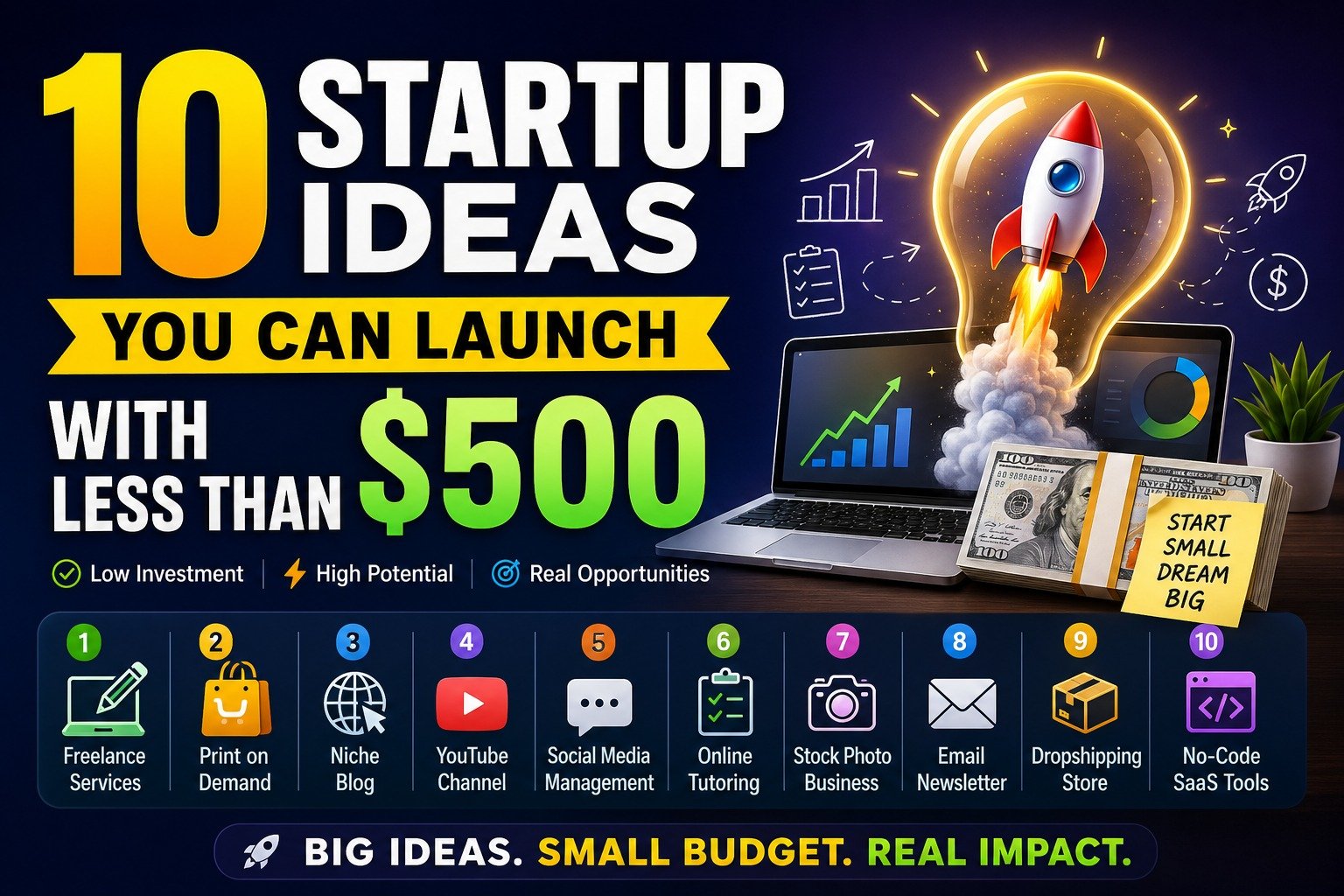
Whether you are a seasoned freelancer looking to scale into a micro-agency, a marketer aiming to monetize your expertise, or a tech enthusiast searching for a highly scalable side hustle, this guide will walk you through 10 viable business models you can launch this week without draining your savings.
Table of Contents
- The Anatomy of a $500 Lean Startup
- 10 Low-Cost Startup Ideas for 2026
- 1. Productized AI Automation Agency
- 2. Niche Micro-SaaS (Using No-Code)
- 3. Ghostwriting & Content Strategy for B2B Executives
- 4. Conversion Rate Optimization (CRO) Auditing
- 5. Hyper-Local SEO & Google Maps Management
- 6. Fractional Operations Management for Creators
- 7. Curated Premium Job Boards & Talent Networks
- 8. High-Ticket Digital Infoproducts & Cohorts
- 9. Podcast Production and Repurposing Studio
- 10. Setup & Integration Consultant for Remote Teams
- Key Takeaways for Bootstrappers
- Frequently Asked Questions (FAQs)
- Conclusion: The 72-Hour Execution Challenge
The Anatomy of a $500 Lean Startup
Before looking at specific ideas, we need to understand how to allocate a sub-$500 budget. When your capital is limited, you cannot afford to waste money on speculative expenses like fancy branding packages, expensive trademarks, or premature legal setups.
Instead, a true lean startup budget filters every dollar through a single question: Does this directly help me acquire a customer or deliver the service?
Here is a blueprint for a baseline tech stack that keeps overhead incredibly low:
| Expense Category | Recommended Tools | Estimated Cost |
| Domain & Professional Email | Namecheap, Google Workspace | $15 – $20 |
| Landing Page & Hosting | Carrd, Framer, or Webflow | $20 – $50 |
| Inbound/Outbound Marketing | LinkedIn Premium, Instantly.ai | $100 – $150 |
| Operational Infrastructure | Notion, Stripe, Zapier / Make.com | $30 – $60 |
| Working Capital (Buffer) | Saved for targeted software/ads | Remaining balance |
By keeping your fixed monthly software costs low, you drastically lower your business’s break-even point. If your operating costs are only $50 a month, landing just one client paying $500 a month makes you instantly profitable.
10 Low-Cost Startup Ideas for 2026
1. Productized AI Automation Agency
Many small-to-medium businesses (SMBs) know they should be using artificial intelligence to cut costs, but they don’t have the internal tech talent to set it up. They don’t want a massive corporate tech integration; they want simple, practical solutions that save time.
Instead of charging a vague hourly consulting fee, sell productized automations. This means offering a fixed-price package for a specific deliverable, such as “An automated customer service ticket routing system” or “An automated lead enrichment workflow.”
- Real-World Application: You build a workflow using Make.com that scans a client’s incoming contact forms, uses OpenAI to categorize the intent of the message, enriches the lead profile via Clay, and populates their CRM while drafting a personalized email response for their sales team.
- Startup Cost Breakdown:
- Domain & Professional Email: $20
- Framer Landing Page: $30
- Make.com Pro Account: $10/month
- Clay Starter Plan: $149/month
- Total Launch Cost: ~$209
2. Niche Micro-SaaS (Using No-Code)
Software-as-a-Service (SaaS) remains one of the most lucrative business models on earth due to its recurring revenue and high margins. The secret is that you no longer need to know how to write complex code to build software.
By utilizing no-code application builders like Bubble or FlutterFlow, you can construct functional, beautiful web and mobile applications designed to solve a single, hyper-specific problem for a very tight niche.
[Target Audience: Commercial Realtors]
       └───> [Pain Point: Generating compliant property brochures]
                   └───> [Micro-SaaS Solution: A 3-click PDF brochure generator]
- Real-World Application: Build a simple tool that allows commercial real estate agents to upload property images and details, which then instantly formats them into beautifully designed, regulation-compliant PDF marketing brochures.
- Startup Cost Breakdown:
- Bubble.io Starter Plan: $32/month
- Premium UI Template: $60
- Domain & Google Workspace: $20
- Community outreach / Direct cold email: $0
- Total Launch Cost: ~$112
3. Ghostwriting & Content Strategy for B2B Executives
In the modern business landscape, an executive’s personal brand is a massive organic growth engine for their company. Founders, venture capitalists, and enterprise sales leaders need to publish consistently on platforms like LinkedIn and X (formerly Twitter) to drive pipeline, but they rarely have the hours required to write daily content.
If you have sharp writing skills and a deep understanding of corporate dynamics, you can pitch yourself as an executive ghostwriter.
- Real-World Application: Partner with B2B SaaS founders. Interview them for 45 minutes every two weeks, record the conversation, extract their unique insights, and translate those raw thoughts into two weeks worth of highly engaging, optimized social posts and newsletters.
- Startup Cost Breakdown:
- Portfolio site (Carrd): $19/year
- Descript (for transcribing interviews): $15/month
- Calendly & Typeform (for scheduling and onboarding): $25/month
- Total Launch Cost: ~$59
4. Conversion Rate Optimization (CRO) Auditing
Companies spend thousands of dollars driving paid traffic via Google and Meta ads to their e-commerce stores or landing pages, only to see their traffic bounce without buying. Often, simple design flaws, confusing copy, or slow loading times are killing their sales.
A CRO Specialist analyzes websites to identify these conversion bottlenecks. Instead of offering broad web design services, you sell an exhaustive, actionable teardown report with exact changes they need to implement to boost revenue.
- Real-World Application: You target Shopify brands doing between $20k and $100k in monthly revenue. You deliver a Loom video walkthrough alongside a detailed Figma file outlining 15 specific changes across their checkout flow, hero section, and mobile menus to optimize conversions.
- Startup Cost Breakdown:
- Loom Pro (for high-quality screen recording): $10/month
- Figma Professional Account: $15/month
- Hotjar Basic Plan (for tracking user heatmaps): $0
- Outbound cold email via Instantly.ai: $97/month
- Total Launch Cost: ~$122
5. Hyper-Local SEO & Google Maps Management
Main street business owners—such as plumbers, dentists, roofers, and boutique gym owners—excel at their crafts, but they rarely understand local search algorithms. Ranking in the top three results of Google’s “Local Pack” (the map section displayed during a local search) can completely transform a local business’s monthly revenue.
This model is incredibly stable because you can charge a recurring monthly retainer to maintain and optimize their local digital footprint.
- Real-World Application: You approach local service businesses with poor or unoptimized listings. For a monthly fee, you optimize their Google Business Profile, systematically collect and respond to customer reviews, clean up their online directory citations, and post weekly updates to boost their local map rankings.
- Startup Cost Breakdown:
- BrightLocal or Whitespark (Local SEO software): $40/month
- Canva Pro (for social/local posts): $15/month
- Simple website & domain: $30
- Total Launch Cost: ~$85
6. Fractional Operations Management for Creators
The creator economy is growing rapidly, with independent content creators scaling into multi-million dollar media companies. However, high-earning creators often face a major obstacle: they are creative geniuses but struggle with operational logistics. They get bogged down handling sponsorship contracts, managing video editors, tracking affiliate links, and organizing production calendars.
As a Fractional Operations Manager, you step in as the behind-the-scenes operator, keeping the business organized while the creator focuses entirely on content production.
- Real-World Application: You build out a comprehensive, centralized workspace in Notion or ClickUp for a YouTuber with 200,000 subscribers. You manage their brand deal pipeline, review sponsorship contracts, track production deadlines, and manage their editing team.
- Startup Cost Breakdown:
- Notion Plus Account: $10/month
- Slack Pro (for team communication): $9/month
- Professional contract templates (for protection): $100
- Total Launch Cost: ~$119
7. Curated Premium Job Boards & Talent Networks
Even in a shifting economic climate, companies struggle to hire top-tier, highly specialized talent, and candidates struggle to filter out spam on massive job boards like Indeed. A curated, niche job board solves both sides of this equation.
By narrowing your focus to a specific vertical—such as “Remote Web3 DevOps Roles,” “AI Product Managers,” or “Fractional CFOs”—you create a high-signal environment that companies are willing to pay premium prices to post on.
[Massive Job Board: Spammy, general tech jobs]
       ❌ High noise, low match rate
[Niche Job Board: Curated AI Product Managers Only]
       ✅ Low noise, high-intent talent pool
- Real-World Application: You set up a job board using software like Niceboard or Pallet. You scrape and curate the best roles for free to build initial candidate traffic. Once you reach a few thousand newsletter subscribers, you charge companies $150–$300 per featured job listing.
- Startup Cost Breakdown:
- Niceboard or Pallet platform fee: $149/month
- Beehiiv (for the accompanying newsletter): $0 (under 2,500 subscribers)
- Domain name: $10
- Total Launch Cost: ~$159
8. High-Ticket Digital Infoproducts & Cohorts
If you possess an advanced technical skill or have spent a decade navigating a specific corporate function, your institutional knowledge is highly valuable. The era of the low-cost, generic video course is fading; today’s market values deep, actionable, specialized frameworks and community-driven learning models.
By packaging your expertise into a comprehensive digital playbook or a short, intense cohort-based program, you can charge premium prices with zero manufacturing or shipping overhead.
- Real-World Application: An experienced software engineering manager creates a premium digital toolkit titled The Engineering Manager’s Blueprint: 90 Days to Building Elite Tech Teams. It includes Notion frameworks, onboarding templates, and automated hiring rubrics, priced at $250.
- Startup Cost Breakdown:
- Gumroad, Lemon Squeezy, or Whop (for payments/delivery): $0 upfront (percentage of sales)
- ConvertKit/Kit (for email marketing): $29/month
- Loom (for recording educational walkthroughs): $10/month
- Total Launch Cost: ~$39
9. Podcast Production and Repurposing Studio
Thousands of businesses and executives start podcasts every month, but most quit after less than 10 episodes. Why? The “creative friction” of audio clean-up, ID3 tagging, writing show notes, and formatting clips for social media becomes overwhelming.
If you have a knack for audio/video editing, you can launch a productized podcast studio that handles the heavy lifting post-recording.
- Real-World Application: A B2B company records a raw 45-minute interview on Riverside.fm and uploads it to your shared folder. You edit the audio, generate SEO-friendly show notes, write a promotional newsletter, and cut the episode into five highly engaging, vertical short-form video clips (Shorts/Reels) formatted for social media.
- Startup Cost Breakdown:
- Descript or Adobe Premiere Pro: $30/month
- Opus Clip (AI tool to instantly generate viral shorts): $19/month
- Frame.io (for client review and video collaboration): $15/month
- Total Launch Cost: ~$64
10. Setup & Integration Consultant for Remote Teams
When companies switch to remote or hybrid work setups, they often piecemeal their technology together. They use Slack, Asana, Google Drive, and Monday.com, but none of these systems talk to one another. Information gets lost, teams become fragmented, and productivity drops.
A Remote Systems Consultant audits a company’s internal communications and workflow stack, designs a clean architecture, and configures the integrations so the business runs like a well-oiled machine.
- Real-World Application: You consult for a 20-person digital agency. You clean up their disorganized project management workspace, connect their sales CRM directly to their internal project channels via Zapier, and build a unified onboarding portal for new hires.
- Startup Cost Breakdown:
- Professional website portfolio: $30
- Zapier Starter Plan (for building complex internal tests): $20/month
- LinkedIn Sales Navigator (for finding prospects): $100/month
- Total Launch Cost: ~$150
Key Takeaways for Bootstrappers
- Validate Before You Build: Never spend money building a complex product until you have verbal or financial validation from a real human being who has the budget to pay you.
- Sell Your Strengths: Choose a business model that scales your existing unfair advantages. If you are an exceptional writer, choose ghostwriting over micro-SaaS. If you are highly analytical, choose CRO auditing.
- Focus on High-ROI Activities: In the early days, do not spend time designing perfect business cards or debating logo color gradients. Spend your hours sending personalized cold emails, cold calling, networking, and creating valuable public content.
- Reinvest Your Revenue: Once you land your first two or three clients, take that capital and immediately plow it back into your business to purchase better software, automate your tasks, or hire freelancers to increase your capacity.
Frequently Asked Questions (FAQs)
1. Do I need an LLC or formal business registration before launching?
No, you do not need to spend $300+ on legal registration just to test an idea. In the early stages, you can operate as a sole proprietorship. Focus your initial $500 budget entirely on validation and customer acquisition. Once you have consistent recurring revenue and proof of concept, you can use those earnings to formally set up an LLC.
2. How do I get my very first paying client with no portfolio?
The most reliable strategy is offering a value-first, zero-risk pilot project. Find five ideal clients and offer a stripped-down version of your service for free or at cost in exchange for a video testimonial if you hit a specific metric. Use those initial case studies to sign full-paying clients.
3. What if I lack deep technical skills? Can I still launch a tech-focused startup?
Yes. The current software ecosystem is intentionally designed for non-technical users. Tools like Make.com, Zapier, Bubble, and Framer feature visual, drag-and-drop interfaces. If you can navigate an advanced Excel spreadsheet or put together a complex PowerPoint presentation, you have all the technical aptitude required to learn these tools via free YouTube tutorials.
4. How long does it typically take to become profitable using these lean models?
Because your overhead is minimal (frequently under $100 per month in ongoing software costs), you can reach profitability the exact day you sign your first client. If you commit to daily, targeted outbound sales efforts, most service-based lean startups can realistically land their first client within 30 to 45 days.
5. Can these low-cost startups scale, or will they stay small side hustles?
They are highly scalable. Many massive agencies and software companies started as simple, single-person service operations. As your client roster fills up, you can raise your prices, transition your manual services into software workflows, and hire contractors to handle delivery—shifting your role from a freelancer to a true CEO.
Conclusion: The 72-Hour Execution Challenge
The difference between a dreamer and an entrepreneur comes down to execution. Having an idea means very little; putting that idea into the market where real people can reject or pay for it is what counts.
With less than $500, a laptop, and an internet connection, you have more leverage and access to raw technological power than a multinational corporation did thirty years ago. The barrier to entry has dropped to zero.
Your next steps: Pick one idea from this list that aligns with your professional skill set. Spend the next 24 hours setting up a basic landing page and professional email. Spend the following 48 hours finding and reaching out to 50 potential customers. Don’t wait for the perfect moment, more funding, or a flawless economic environment. Launch fast, learn from real feedback, and build your business on your own terms.