
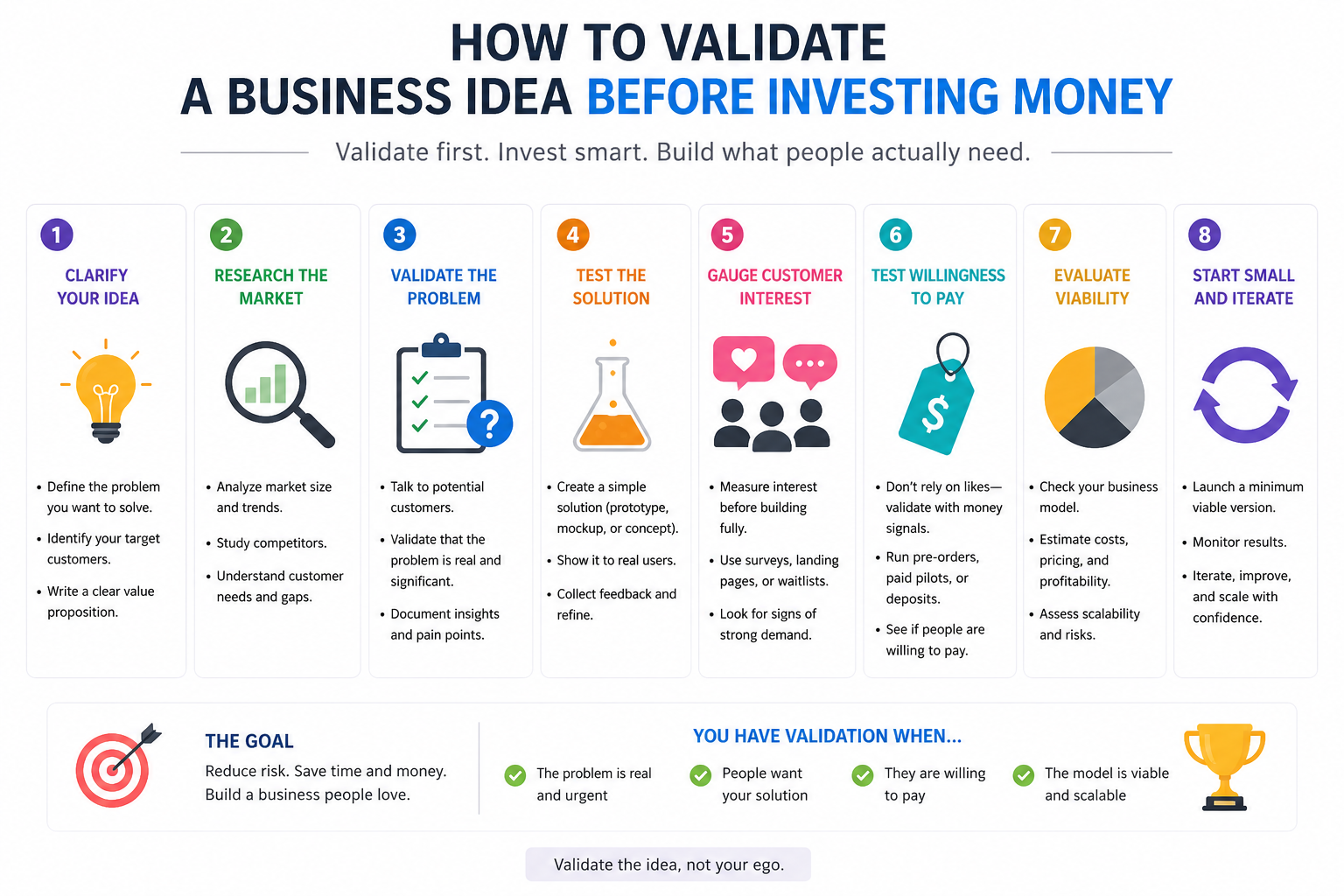
Every year, thousands of brilliant business ideas are born. Entrepreneurs stay up until 3:00 AM drafting logos, buying domain names, and sketching out product features. It feels exhilarating. You are convinced you have found the next big thing.
Then comes the launch. You open the doors, launch the website, or hit “publish” on the app store… and nothing happens. Just the sound of crickets.
According to data from the U.S. Bureau of Labor Statistics, roughly 20% of new businesses fail during their first two years. When CB Insights analyzed the post-mortems of hundreds of failed startups, they found the number one reason for failure: there was no market need. In 35% of cases, founders built something beautiful that nobody actually wanted or was willing to pay for.
The good news? You do not have to be part of that statistic. Validation is the process of testing your business concept in the real world before risking your hard-earned savings. Think of it as a stress test for your idea.
This guide will walk you through a step-by-step, capital-efficient framework to validate your business idea, prove demand, and hit the market with confidence.
Table of Contents
- Deconstruct Your Business Assumptions
- Analyze the Competitive Landscape and Market Size
- Conduct Deep-Dive Customer Interviews
- Build a Smoke Test (The Smoke and Mirrors Validation)
- The Ultimate Validation: Securing Pre-Sales
- Key Takeaways
- Frequently Asked Questions (FAQs)
- Conclusion: The Cost of Waiting vs. The Cost of Testing
Deconstruct Your Business Assumptions
Before you talk to a single customer, you need to pull the idea out of your head and lay it flat on a table. Every new business is built on a stack of unproven assumptions. Your job is to identify which of those assumptions are fatal if proven wrong.
The Lean Canvas Approach
Forget writing a 40-page traditional business plan. At this stage, it is a waste of time. Instead, map out your concept using a single-page Lean Canvas. Focus heavily on three core areas:
- The Problem: What are the top three pain points your target audience faces?
- The Customer Segment: Who exactly feels this pain most acutely? (Be specific: “Busy suburban working mothers” is better than “Women”).
- The Value Proposition: Why will they care about your solution over what already exists?
Differentiating Facts from Hypotheses
Look at your canvas and ruthlessly label your statements.
- “Freelancers struggle to track their billable hours” is a hypothesis.
- “There are 64 million freelancers in the US” is a fact.
Isolate the riskiest hypothesis—usually the assumption that a specific problem exists and is painful enough that people want a solution. Test that first.
Analyze the Competitive Landscape and Market Size
A common trap for new founders is saying, “No one else is doing this!”
If no one else is doing it, it usually means one of two things: either you have stumbled upon a truly untouched goldmine, or (much more likely) others have tried and discovered that the market cannot sustain a business. Competition is a sign of validation. It proves people are already spending money on this problem.
Evaluating Indirect vs. Direct Competitors
If you are launching a premium meal-prep delivery service for fitness enthusiasts, your competitors aren’t just other meal-prep companies (direct competition). Your competitors include local grocery stores, fast-casual restaurants, and even the habit of skipping meals (indirect competition).
Analyze how your target audience currently solves their problem. Your goal isn’t necessarily to be completely different; it is to be appreciably better for a specific subset of that market.
Levering Search Intent and Digital Footprints
Before spending a dime, use free or low-cost digital tools to see if people are actively looking for a solution:
- SEO Tools (Ahrefs, SEMrush, or Google Keyword Planner): Are people searching for terms related to your solution? If a specific problem keyword has thousands of monthly searches, demand exists.
- Google Trends: Is interest in this topic growing, stagnant, or dying?
- Online Communities (Reddit, Quora, Facebook Groups): Search for keywords related to your business. Read the complaints. What frustrates people about the current tools or services on the market?
Conduct Deep-Dive Customer Interviews
Data points and search volumes give you a macro view, but qualitative interviews give you a human view. You need to talk to real people in your target demographic.
However, there is a right way and a wrong way to talk to potential customers. If you ask your mom, your best friend, or a casual acquaintance, “Hey, I have an idea for an app that does X. Would you buy it?” they will almost always say yes. They want to protect your feelings. This is a false positive.
The “Mom Test” Framework
Rob Fitzpatrick, author of The Mom Test, outlines a simple rule: Never ask anyone if your business idea is a good idea. Instead, ask them about their past behavior and current frustrations.
❌ WRONG: "Would you pay $20 a month for an app that manages your social media scheduling?"
✓ RIGHT: "How do you currently plan and post your social media content? What takes up the most time in that workflow? How much did you pay for the tools you used last month?"
People are terrible at predicting their future behavior, but they are highly accurate when describing their past actions. If they have never spent money or time trying to solve the problem in the past, they won’t buy your product in the future.
How to Find Interviewees Without a Budget
Do not buy expensive market research panels. Instead, go where your audience hangs out:
- LinkedIn: Search for professionals matching your buyer persona and send a polite, non-salesy message: “Hey [Name], I’m researching a project to help solve [Problem]. I’re not selling anything. Would you be open to a 10-minute chat about your experience with it?”
- Niche Online Forums: Become an active participant on a subreddit or Discord channel. Ask open-ended questions about pain points.
- Local Meetups: Attend industry events and chat up attendees.
Aim for 15 to 20 deep-dive interviews. By the 15th interview, you should start hearing the exact same complaints over and over. That repetition means you have hit a core truth.
Build a Smoke Test (The Smoke and Mirrors Validation)
Once you have verified that the problem is real and painful, you need to test if your specific solution resonates. You do not need to write code or manufacture a product to do this. You just need a “smoke test”—a front-end asset that looks like a finished business but has no complex backend infrastructure.
The Minimal Viable Landing Page (MVLP)
Create a clean, single-page website dedicated to your product concept. Tools like Carrd, Wix, or Framer allow you to build stunning pages in an afternoon for little to no cost.
Your landing page must include:
- A Compelling Headline: Clearly state the benefit of your product.
- Supporting Copy: Explain how it works and what pain it eliminates.
- A Clear Call to Action (CTA): This is your validation mechanism. Use buttons like “Join the VIP Waitlist,” “Get Early Access,” or “View Pricing.”
[ Hero Image of Product Concept / Wireframe ]
Headline: The Easiest Way for Freelancers to Automate Invoicing.
CTA Button: "Join 1,200+ Freelancers on the Early Access List"
Driving Targeted Traffic on a Shoestring Budget
A landing page is useless without traffic. Allocate a tiny budget—think $50 to $100—to run hyper-targeted ads on Facebook, Instagram, LinkedIn, or Google Ads.
Target your precise customer segment. Run the ads for 3 to 5 days. Your goal isn’t to make money; it is to measure the conversion rate (the percentage of visitors who click your CTA or give you their email address). If 10% to 15% of highly targeted visitors drop their email to get access to your unfinished product, you have strong emotional validation.
The Ultimate Validation: Securing Pre-Sales
The highest form of validation is not an email signup, a compliment, or an encouraging survey response. The ultimate validation is a financial transaction.
When someone gives you their credit card information, they are saying, “This problem hurts so badly that I am willing to part with my hard-earned money to fix it.”
The Wizard of Oz and Concierge Techniques
Before investing heavily in building an automated system, deliver the service manually behind the scenes.
- The Concierge Method: Deliver the service out in the open. If you want to build an automated software tool that generates optimized real estate descriptions, start by writing those descriptions yourself by hand for local realtors. Learn the nuances before scaling.
- The Wizard of Oz Method: The front end looks completely automated, but a human does all the work in the background. When Zappos started, the founder took photos of shoes in local stores, posted them online, and when someone bought a pair, he went to the store, purchased them at retail price, and mailed them out. He proved demand before buying inventory.
Running a Successful Pre-Order Campaign
If you are launching a physical product or a software platform, offer a steep discount or exclusive perks for early adopters who pay upfront. Platforms like Kickstarter or Indiegogo are built for this, but you can easily handle it yourself using a simple Stripe or Shopify integration on your landing page.
Clearly state that the product is in development and provide an honest timeline for delivery. If people are willing to pay you today for a product that won’t arrive for three months, your business idea has passed the ultimate test. You now have capital to fund production, and you haven’t given away a single percentage of equity.
Key Takeaways
- Fall in love with the problem, not your solution. Solutions can change, but the core customer pain point must remain valid.
- Market size and competition are healthy indicators. A complete lack of competitors usually signals a lack of profitable customers.
- Never ask if your idea is good. Use behavioral interviewing techniques to find out how customers currently deal with the issue.
- Fake it before you make it. Use smoke tests, landing pages, and manual operations (Wizard of Oz) to test demand before writing code or manufacturing inventory.
- Cash is king. Pre-sales and paid deposits are the only 100% reliable forms of business validation.
Frequently Asked Questions (FAQs)
1. How much time should I spend validating my business idea?
For most small businesses and startups, the validation phase should take between two to six weeks. Spending less time risks missing critical flaws while spending more time can lead to analysis paralysis. Set clear, time-bound goals for your validation experiments.
2. What if someone steals my business idea during the validation phase?
This is the number one fear of new founders, and it is almost always unfounded. Ideas are cheap; execution is everything. Most people are too busy with their own lives and businesses to drop everything and copy an unproven idea. Furthermore, hiding your idea prevents you from getting the honest feedback required to build it successfully.
3. What is a “good” conversion rate on a validation landing page?
While it varies by industry, a standard benchmark for a cold-traffic landing page asking for an email address is between 5% and 15%. If your conversion rate is above 20%, you have tapped into a highly enthusiastic market. If it is below 2%, your messaging may be confusing, or the problem might not be painful enough.
4. Should I make users sign a Non-Disclosure Agreement (NDA) before interviewing them?
Absolutely not. Asking a potential customer to sign an NDA before a casual discovery interview creates an immediate barrier and makes you look amateurish. Keep the conversation focused on their past experiences and habits rather than the secret mechanics of your upcoming product.
5. What should I do if my idea fails validation?
Celebrate! You just saved months of your life and thousands of dollars. Failing validation is not a true failure; it is a successful pivot point. Look at the data you collected during your interviews and landing page tests. Where did the interest spike? Use those insights to tweak, adjust, or completely pivot your idea into something the market actively wants.
Conclusion: The Cost of Waiting vs. The Cost of Testing
Validating your business idea requires discipline. It forces you to confront the uncomfortable reality that your initial concept might not be perfect. But skipping this step is the financial equivalent of jumping out of an airplane and hoping your parachute will weave itself on the way down.
Do not wait until you have spent $10,000 on software development or manufacturing minimums to find out if anyone cares.
Your immediate next step: Pick three people in your target audience today. Do not pitch them your idea. Send them a message asking for 10 minutes to learn about the last time they struggled with the specific problem you are trying to solve. Start there. Listen closely, adapt quickly, and build your business on a foundation of real-world demand.
Social Media Captions
🚨 The #1 reason startups fail? Building something nobody actually wants.
Before you spend your savings on logos, inventory, or custom development, you need to stress-test your concept. Check out our latest guide on how to validate your business idea using low-cost, real-world strategies. Learn how to run a “smoke test,” conduct customer interviews that actually yield honest data, and secure pre-sales before launch day.
Many entrepreneurs fall in love with their solution when they should be falling in love with the problem. Data from CB Insights reveals that 35% of startups fail simply because there is no market need.
Market validation isn’t an optional step; it’s your financial safety net. Our latest comprehensive guide breaks down a capital-efficient framework for validating new business concepts before investing significant capital.
Key highlights include:
- Deconstructing assumptions using the Lean Canvas framework
- Conducting unbiased user interviews using “The Mom Test” rules
- Running high-converting landing page smoke tests on a budget
- Executing the “Wizard of Oz” technique to prove transaction intent